Courses
Speak, write, and understand English clearly with English Tutoring Online tailored to your needs. Learn efficiently from anywhere!
Online English tutoring works by pairing you with a real teacher in real time, through a digital classroom that fits your schedule and goals. Instead of fixed lessons in a physical room, you get one-on-one guidance, targeted corrections, and practice that focuses on your weak spots.
Sessions can be short or long, early morning or late at night, and the curriculum adjusts as you improve. You still get structure, just without the limits of place and time. Keep reading to see how this can match your level, pace, and purpose,whether you’re starting out or refining advanced skills.
Key Takeaways
- Personalized learning plans that adapt to your pace and goals.
- Immediate feedback on speaking, writing, and pronunciation.
- Flexible scheduling that fits learning into your existing routine.
Online English Tutoring Benefits
The biggest strength of online English tutoring is how flexible it is. You don’t have to follow a school timetable or travel to a classroom anymore.
You can learn from home, at your office, or on the road, as long as you can get online. In fact, more than 60% of online tutoring platforms offer live video sessions, giving learners real-time interaction, instant feedback, and flexible scheduling [1].
This makes it much easier to show up for lessons regularly, which is where real progress happens.
You also get access to a much larger range of tutors. You’re not limited to whoever lives in your city. Instead, you can choose teachers who focus on exactly what you need, like business English, academic writing, test prep, or everyday speaking. That kind of match helps each lesson stay focused and useful.
Because lessons happen online, tutors can bring a lot of tools straight into the session. They can share their screen for grammar practice, use a virtual whiteboard for new words or sentence structures, and play audio or video clips for listening work on the spot. This mix of text, sound, and visuals helps different types of learners stay engaged and understand faster.
In fact, in a study of undergraduate EFL learners at a Saudi university, over 40 students reported that virtual‑classroom (online) English lessons significantly improved their oral communication skills, helping increase confidence, motivation, and speaking performance [2].
- Schedule lessons around your work or family commitments.
- Access specialized tutors from anywhere in the world.
- Use interactive digital tools during live sessions.
- Review recorded sessions to reinforce learning.
We find that students thrive when they have control over their learning environment. The ability to learn in a comfortable, familiar space often reduces anxiety and increases willingness to take part. This comfort level is crucial for practicing speaking skills, which is the foundation of fluency.
English for Beginners (Starter Strategies)
Starting a new language can feel like a lot at once, but online tutoring turns it into small, clear steps. In the beginning, the focus stays on useful language you can actually use.
You start with simple greetings, easy questions, and basic words about everyday life, like family, food, work, and hobbies. Because you can use these right away, the lessons feel practical, and progress feels real from the first day.
| Core Component | Example Practice Activity | Purpose |
| Verb “to be” | “I am a student” / “He is happy” | Learn basic sentence structure |
| Basic prepositions | “The book is on the table” | Understand position, place, and time |
| Common nouns | Family members, objects, daily items | Build essential vocabulary |
| Simple present tense | “I eat breakfast at 7am” | Talk about daily routines |
| Greetings & basic questions | “Hello, how are you?” / “Where is the bus?” | Begin interacting confidently in English |
From the very first session, pronunciation gets close attention. Your tutor listens as you speak and gently corrects how you form sounds, so you don’t build strong habits that are hard to change later.
By hearing clear models, repeating them, and practicing out loud, you build muscle memory for English sounds. This early work makes it much easier to be understood when you speak in real situations.
For beginners, the lesson structure is very supportive and often quite repetitive on purpose. You might practice short dialogues, act out simple situations like ordering coffee, meeting someone new, or asking for directions, and do plenty of question-and-answer practice.
The aim isn’t perfect grammar, it’s to help you feel more relaxed when speaking. Mistakes are treated as a normal and useful part of learning, not as something to be ashamed of.
A typical beginner session might include practicing these core building blocks:
- The verb “to be” (I am, you are, he/she/it is).
- Basic prepositions (in, on, at, under).
- Common nouns for everyday objects.
- Simple present tense for daily routines.
We encourage beginners to supplement their tutoring with short, daily practices. This could be labeling items around the house with their English names or listening to a simple English song.
Consistency, even in small doses, is far more effective than occasional, long study sessions for building foundational skills.
Intermediate English Breakthroughs
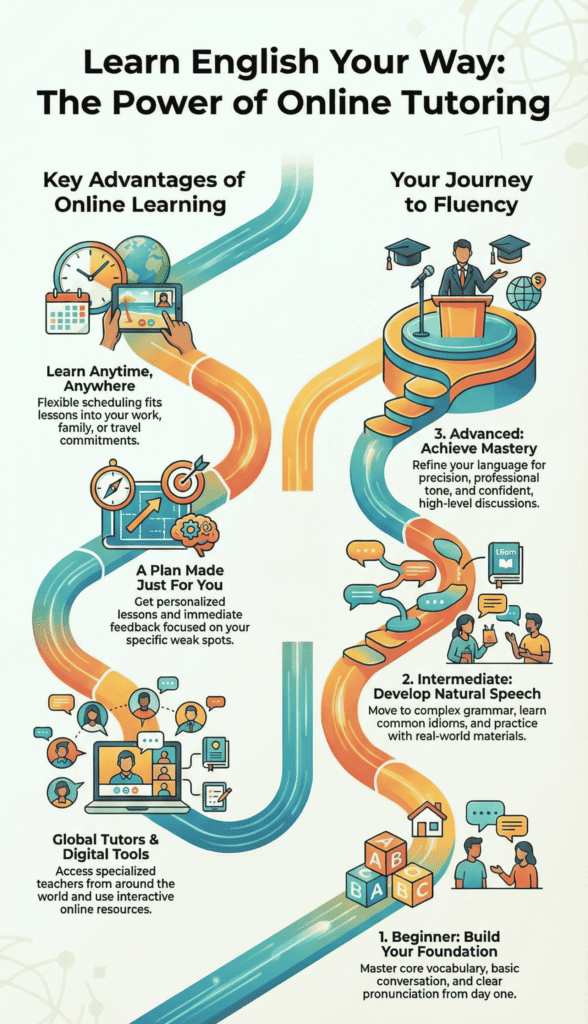
At the intermediate level, you’re no longer just trying to survive in English, you’re learning to really talk. The focus starts to include more complex grammar, like perfect tenses and conditional sentences.
These help you talk about the past, the future, and “what if” situations. You also begin to move past single, short sentences and into more natural, connected speech.
Your vocabulary study also changes. Instead of only memorizing word lists, you start learning collocations,words that often go together, like “make a decision” or “heavy rain.” You also begin to work with idioms and phrasal verbs, which are very common in natural English.
Little by little, your English starts to sound less like it came from a textbook and more like it came from real conversation.
Listening practice becomes longer and more demanding. You work with audio like podcast clips or short news reports. The goal is to train your ear to catch the main idea and also some key details. Over time, you get used to hearing English at a natural speed, even when you don’t understand every single word.
At this stage, you often use real materials: blog posts, movie trailers, news articles, and other content native speakers actually read and watch.
By studying these, you see how grammar and vocabulary work together in real life. You also start to notice cultural details that help the language feel more alive. The tutor guides you through this process, explains difficult parts, and uses questions to start discussion.
To move you closer to advanced fluency, intermediate lessons focus strongly on speaking. The goal is to help you talk more smoothly and for longer periods of time.
The tutor encourages you to keep the conversation going, especially on familiar topics. Corrections are made when an error causes confusion, while smaller mistakes are often saved for later feedback, so your speaking flow is not constantly interrupted.
Advanced English Mastery Training
At the advanced level, English is about precision and fine detail. You’re not just speaking clearly anymore,you’re shaping your language for specific goals, like professional presentations, academic writing, or serious discussions. Lessons are usually customized to your field, using real texts and complex situations that match your work or studies.
Writing practice focuses on style and tone. You learn how to choose the right words, vary sentences for effect, and build strong, clear arguments.
In tutoring sessions, your writing is edited closely,not only for grammar, but also for clarity, flow, and impact. The aim is simple: writing that feels confident and powerful.
Speaking practice moves to a higher level, too. You work on talking about complex ideas for longer periods, organizing your thoughts clearly, and defending your opinions. You also refine pronunciation and intonation, so you sound more natural and are easy to understand, even in fast or serious conversations.
Advanced learners work with dense, real materials: university lectures, serious articles, sometimes even literature. You practice reading between the lines, noticing subtext, tone, and the writer’s purpose. This trains you to handle English when it’s at its most complex.
At this stage, the tutor acts more like a coach. They give very detailed feedback on small habits you may not notice,phrases you repeat too often, expressions that don’t fit the culture, or missed jokes and irony. These subtle changes are what move you from simply “good at English” to truly masterful.
English Conversation Practice Online

Fluency really lives in spontaneous conversation, being able to speak without planning every sentence in your head. Online conversation practice gives you a safe, structured space to build that skill.
Unlike language exchange apps, you work with a trained tutor who can guide the talk, correct you gently, add useful vocabulary, and focus on your weak areas.
These sessions copy real-life situations. You might act out a job interview, talk through a business deal, or just chat about the news.
Along the way, the tutor shows you how to interrupt politely, ask someone to repeat or explain, and disagree without sounding rude. These small skills make conversations feel natural.
One big advantage is the instant feedback. The tutor can fix your grammar or word choice while you speak, without stopping the flow too much, or they can note mistakes and review them with you at the end. This helps you notice patterns, correct them, and make better sentences the next time you speak.
To keep conversations engaging, tutors use a variety of prompts:
- Discussion of photographs or short video clips.
- Debates on lighthearted or serious topics.
- Storytelling exercises based on a series of events.
- “What would you do?” scenario questions.
We believe the key to conversational confidence is practice, practice, and more practice. The more you speak, the less mental energy you spend on forming basic sentences, freeing up your brain to focus on more complex ideas and vocabulary. Regular conversation sessions build the muscle memory and quick thinking required for fluency.
English Listening Skills Coaching
Effective listening isn’t just about hearing sounds, it’s about catching meaning, intent, and small details. Online listening coaching helps you train your ear to follow English at natural speed.
Tutors often start with slow, clear audio, then move step by step to real conversations with accents, background noise, and faster speech.
One common method is called layered listening. You listen to a short clip several times, but with a different goal each time. First, you listen for the main idea. Next, you listen for key details. Then, you listen again to notice the speaker’s mood, attitude, or opinion. This turns a big, difficult skill into smaller, easier skills.
Another key focus is connected speech, the way words run together in real talk. Tutors point out patterns like reductions (“wanna” for “want to”), linking between words, and rising or falling intonation.
Once you understand these, fast and casual speech starts to feel much clearer, not like a blur. We use a wide range of audio sources to expose you to different accents and contexts. This might include:
- Podcasts on topics of interest to you.
- Clips from television shows or movies.
- TED Talks or other presentations.
- Songs and their lyrics.
The tutor’s guidance is crucial here. They can pause the audio to explain why a certain phrase was hard to understand, perhaps due to a reduction or an idiom. They can also provide transcripts and create comprehension questions that target inferential listening, helping you learn to read between the lines.
English Reading Comprehension Lessons
Strong readers don’t just “read the words”, they try to understand the message, tone, and hidden ideas behind the text.
Reading comprehension lessons help you move from passive reading to active reading. Tutors guide you through different kinds of texts, like articles, essays, stories, and reports, starting easier and then going harder.
You also learn that not all reading is the same. Sometimes you skim for the main idea. Sometimes you scan for one piece of information, like a date or name. Other times you read slowly and carefully to study the argument or deeper meaning. Knowing which style to use saves time and helps you understand more.
Vocabulary grows naturally in these lessons. Instead of memorizing long word lists, you meet new words in context. Tutors show you how to use clues from the sentence to guess meaning, and how word families and roots connect words, so your word bank grows in a more organized way.
Close reading is another key part. You might focus on one paragraph and ask questions like, “Why did the writer choose this word?” or “What job does this sentence do here?” This kind of work shows you how English writers build arguments, create mood, and shape style.
To build speed and confidence, tutors often use timed readings. You read a short passage with a time limit, then answer questions about it. This helps you stop saying every word in your head and start reading in phrases and chunks, which is how fluent readers process text.
English Writing Skills Development
Writing is where your grammar, vocabulary, and organizational skills come together. Online writing development provides a structured process for improvement, from brainstorming ideas to polishing a final draft.
The tutor acts as an editor, providing detailed feedback on everything from sentence structure to coherence.
The process often begins with analyzing model texts. You look at examples of good writing,whether it’s an email, a blog post, or an essay,and deconstruct what makes them effective.
This gives you a clear target to aim for in your own work. You learn about paragraph structure, thesis statements, and transitions.
A key focus is on moving beyond simple sentences to more complex and varied constructions. You practice using dependent clauses, participles, and conjunctions to create writing that is sophisticated and engaging.
The tutor provides sentence-combining exercises and prompts you to revise your work with variety in mind.
Feedback is specific and actionable. Instead of just marking an error, the tutor will explain why a construction is awkward or unclear and offer alternatives. This might include:
- Correcting preposition errors.
- Suggesting more precise vocabulary.
- Improving the logical flow between ideas.
- Noting repetitive sentence patterns.
We emphasize that writing is a process. The first draft is just the beginning. Through tutoring, you learn the value of revision and proofreading. You develop the ability to critique your own work, spotting areas for improvement before submitting it for a final review. This skill is invaluable for academic and professional success.
Essential English Grammar Foundations

Grammar is like the skeleton of a language, it holds everything together. You still focus on communication, but good grammar helps you be clear and show small differences in meaning. Online tutors usually teach grammar in context, using real sentences, not just long lists of rules.
Lessons start with the basics: tenses, articles, prepositions, and modals. Tutors use simple charts and everyday examples. For example, they show when to say “I have lived here for five years” (still true now) and when to say “I lived there in 2010” (finished in the past).
You don’t just learn the rule, you practice it. First in controlled exercises, then in speaking or writing. This helps move grammar from “I have to think about it” to “I just say it naturally.”
Tutors also watch for patterns in your mistakes. Maybe you forget the third-person “s” or mix up “a” and “the.” Then they build focused practice for those exact problems, so you don’t waste time on grammar you already understand.
The goal is not to make you afraid of mistakes. Grammar is taught as a tool, so you can control your English and later, when you’re advanced, even bend or break rules on purpose for style. It’s about having choices, not feeling blocked.
English Vocabulary Building Sessions
A rich vocabulary allows you to express yourself with precision and color. Vocabulary building in an online tutoring context is dynamic and contextual.
It goes far beyond flashcards, focusing on strategies for learning, retaining, and, most importantly, using new words actively in your speech and writing.
| Strategy | Activity Example | Benefit |
| Thematic word sets | Words related to “technology” or “emotions” | Builds context-based vocabulary |
| Collocations & word families | “Make a mistake,” “heavy rain,” “economist” | Enhances natural language use |
| Sentence creation & role-play | Use new words in short dialogues | Strengthens active recall and fluency |
| Synonyms & antonyms exploration | Identify related or opposite words in context | Expands expressive capacity |
| Personal vocabulary list | Maintain digital list of new words | Encourages ownership and consistent review |
One powerful method is learning vocabulary in thematic sets. Instead of random words, you learn groups related to a topic, such as “environment,” “technology,” or “emotions.”
This creates stronger mental connections and makes the words more useful, as they often appear together in real discourse.
Tutors emphasize the importance of noticing collocations and word families. You learn that you “make a mistake,” not “do a mistake,” and that “economics,” “economist,” and “economical” are all related. Understanding these relationships helps you build vocabulary in chunks, which is how the native brain stores language.
A typical session might involve exploring a short text or video, pulling out useful new vocabulary, and then immediately putting it to use.
- Creating original sentences with the new words.
- Using them in a role-play conversation.
- Finding synonyms and antonyms to expand the network.
We encourage learners to take ownership of their vocabulary growth by maintaining a personal dictionary or digital list.
The tutor can help you organize this list effectively and suggest fun review techniques, like using the new words in a story or teaching them to someone else. Active recall is the key to moving words from your recognition vocabulary to your active use vocabulary.
FAQ
What are the main online English tutoring benefits for beginners?
Online English tutoring benefits include personalized guidance, flexible scheduling, and access to resources.
Beginners can practice foundational English skills, starter vocabulary, simple English sentences, and basic English phrases practice to build confidence and prepare for more advanced lessons.
How does remote English class flexibility improve learning outcomes?
Remote English class flexibility allows students to choose convenient times, repeat lessons, and review materials at their own pace.
Digital English learning perks and web-based language acquisition help learners develop English fluency online gains efficiently.
What strategies help English beginners starter tips become effective?
English beginners starter tips focus on easy English dialogues, beginner pronunciation drills, and beginner English greetings.
Foundational English skills are strengthened through interactive talk sessions and simple exercises that encourage consistent practice.
How can English conversation online sessions enhance speaking confidence?
English conversation online sessions, live speaking sessions, and dialogue role-play practice improve verbal fluency coaching.
Casual chat fluency and debate English skills offer real-time feedback, boosting speaking confidence while reinforcing conversational patterns.
What methods support English listening coaching and comprehension?
English listening coaching includes podcast listening practice, audio comprehension drills, and sound discrimination exercises.
Ear training English and auditory skill enhancement help learners improve listening speed and understand nuanced English expressions.
Your Path Forward with Online English Tutoring
Fluency in English feels a bit different for everyone, but you don’t have to work it out alone. Online tutoring gives you structure, guidance, and feedback in one place.
Step by step, you connect what you already know: listening that supports better speaking, grammar that makes writing clearer, and vocabulary that sharpens every conversation or test answer.
Once you decide what you want, better meetings, movies without subtitles, or stronger academic work, we can build a plan around you. Ready to move your English forward? Start your plan with Ivy Language International today.
References
- https://wifitalents.com/online-tutoring-statistics
- https://ccsenet.org/journal/index.php/elt/article/view/0/46166