
Find your ideal learning path by comparing apps versus private tutors and weighing the benefits of digital and human guidance.
I’ve tried both. I spent a summer glued to a language app, tapping away at vocabulary drills. Another year, I hired a tutor for calculus, meeting weekly in a quiet library corner. The app was cheap and always there. The tutor was expensive and sometimes a hassle. But the tutor got me through the class.[1] Choosing between learning apps and private tutors isn’t about finding the “best” option.
It’s about matching a method to your specific needs, your budget, and how you learn. The right choice can save you money and frustration, while the wrong one can stall your progress entirely. Let’s break down the real trade-offs so you can invest your time and money wisely. Keep reading to see which path aligns with your goals.
Key Takeaways
- Apps win on affordability and 24/7 flexibility, ideal for self-starters.
- Tutors provide unmatched personalized feedback and accountability for complex subjects.
- A hybrid approach often yields the best results, combining app practice with targeted tutor guidance.
The Allure of the App
You open your phone and it’s there. Learning apps sit in your pocket, ready for a five-minute session on the bus or a late-night review. For the price of one hour with a tutor, you can often get a full year of access, which makes them a low-risk way to try a new subject.
| Strength | Apps | Tutors |
| Affordability | Low-cost subscription | High hourly rate |
| Convenience | 24/7 access | Must schedule sessions |
| Motivation | Game-like progress & streaks | Accountability and human connection |
| Adaptability | Algorithm adjusts content | Adjusts method in real-time |
| Suitable Learning Types | Quick practice, basic skills | Deep understanding, problem-solving |
Gamification keeps you coming back. You earn points, build streaks, level up, and get instant feedback on multiple-choice questions. It feels like a game, and that can turn practice into a daily habit. Behind the scenes, algorithms adjust the difficulty based on your performance, building a kind of custom path.
But that path has hard edges. The feedback is automated. It tells you what’s wrong but not always why it’s wrong in a way that makes sense. Apps can’t watch your mouth as you speak or give you a tailored pep talk when you stall out. The personalization is mechanical, not human, and you’re on your own if your motivation slips.
- Affordability: Subscription models are typically far cheaper than hourly tutoring rates.
- Constant Access: Learn anytime, anywhere, fitting education into life’s cracks.
- Gamified Engagement: Points and streaks turn learning into a habit-forming activity.
- Automated Paths: AI adjusts content based on your right and wrong answers.
The Human Touch of a Tutor
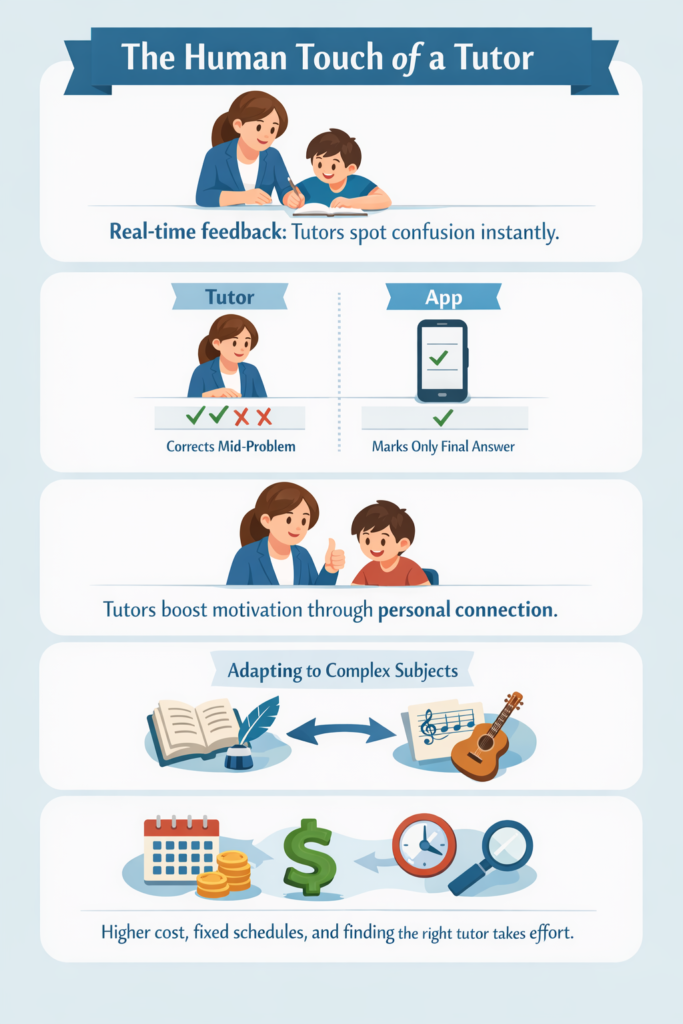
Then there’s the tutor. A good tutor doesn’t just teach a subject, they teach you. They watch your face, notice the pause in your voice, and respond to your confusion in real time. That human connection is their core strength and highlights the benefits of online English tutoring
If you make a mistake halfway through a math problem, a tutor can stop you right there, spot the gap, and explain it before you move on. An app usually just marks the final answer wrong.
This creates a different kind of motivation: accountability. Someone is expecting you to show up, and they care about your progress. Tutors shine with complex topics that need back-and-forth, like literature discussion, or physical guidance, like music. They can switch analogies or methods on the fly.
But it costs more, in money and time. Hourly rates are high, schedules are fixed, and travel or strict time slots can be limiting. And finding a tutor you really click with takes work.
Side-by-Side: A Real-World Comparison
Here’s how apps and tutors stack up when you’re making a real choice, not just a theoretical one.[2]
Cost is the clearest gap. Apps usually run on a monthly subscription, around ten to twenty dollars. Tutors charge per hour, often starting around twenty-five dollars and rising for advanced or in-demand subjects. Online tutoring platforms can soften this, but you still pay each session.
| Feature | Apps | Tutors |
| Cost | $10–$20/month | $25+/hour |
| Flexibility | Anytime, anywhere | Fixed schedule, may require travel |
| Personalization | Automated, data-driven | Tailored to your learning style |
| Feedback | Instant but automated | Real-time and explanatory |
| Engagement | Gamified rewards (points, streaks) | Interactive dialogue and encouragement |
| Best For | Language basics, foundational skills | Complex subjects, discussion-heavy topics |
On flexibility, apps win. You can study whenever you have a spare moment, on the train, in a waiting room, during lunch. Tutors need schedules. Sessions can be canceled, and even online, you’re locked into a time slot.
Tutors pull ahead on benefits of personalized English instruction. They respond to your thought process and adjust to your style, visual, auditory, or hands-on. Apps adapt using data from your answers, which helps, but it’s still a broad pattern, not a deep reading of you.
- Feedback Speed: Apps (instant but automated) vs. Tutors (real-time and explanatory).
- Engagement: Apps (game-like rewards) vs. Tutors (interactive dialogue and encouragement).
- Suitability: Apps (great for languages, foundational skills) vs. Tutors (best for complex, discussion-heavy subjects).
Making Your Choice

Which one fits you best really comes down to how you learn. Start by asking yourself a few blunt questions.
Are you a self-starter? If you’ll actually open an app and practice without anyone checking on you, an app might be all you need. If you tend to drift without structure, a tutor’s presence and expectations can keep you honest.
What’s your budget? If money is tight, apps are the clear entry point. If you see education as a long-term investment and have room to spend, a tutor’s personalized support can speed things up.
Then think about your goal. For basic language phrases or simple math review, an app usually works well. For complex essays, advanced theory, or fixing a persistent skill problem, see why you might choose online English tutoring to understand how a tutor’s nuance can help.
You can also blend both: start with an app to build a foundation, then bring in a tutor for the tricky parts you can’t untangle alone.
FAQ
How do learning apps and private tutors differ in cost and flexibility for students?
Learning apps are usually more affordable and support self-paced education, letting students study anytime. Private tutors often cost more per session but offer flexible scheduling and one-on-one mentoring.
Comparing per-session pricing, subscription-based learning, and geographic location costs helps parents balance financial savings, tutor quality variability, and investment in personalized instruction for optimal learning outcomes.
Can hybrid tutoring models combine online learning apps with private tutoring services effectively?
Hybrid tutoring models mix the scalability of online learning apps with human flexibility teaching from private tutors. Students gain real-time feedback apps and personalized instruction while maintaining learning independence.
This approach helps with knowledge gap identification, session scheduling constraints, and academic progress metrics, balancing affordable education options with confidence building tutors for better overall results.
What are the advantages of algorithmic personalization in virtual tutoring platforms?
Virtual tutoring platforms use algorithmic personalization and adaptive learning technology to create unique learning paths. Students access structured curriculum apps, content mastery apps, and practice problem generation.
Unlike in-person tutors, apps provide data-driven learning outcomes and granular analysis tools. They support consistent practice, student engagement methods, and transparent analytics dashboards, making learning more tailored and trackable.
How do private tutors support emotional and motivational needs compared to apps?
Private tutors provide human tutor motivation, emotional support, and relationship building. They help with frustration management, confidence building, and strategic guidance sessions.
While apps offer gamification features and algorithmic difficulty adjustment, tutors excel in subjective assessments and motivational coaching. They create customized lesson plans that strengthen comprehension, engagement, and sustained academic progress.
Are self-paced education apps sufficient for test prep versus one-on-one mentoring?
Self-paced education apps, like SAT preparation or math tutoring apps, offer unlimited access subscriptions and algorithmic personalization. One-on-one mentoring provides customized lesson plans, weak point targeting, and discussion-based learning that apps cannot replicate.
Combining apps’ active instruction benefits with tutors’ guidance improves accountability, learning style adaptation, and accelerated academic progress for stronger results.
The Final Lesson
There’s no universal winner between apps and private tutors, it’s about what fits you now. Apps give affordability and 24/7 access, perfect for independent learning. Tutors bring personalized guidance, accountability, and human insight apps can’t match.
The smartest approach may combine both. Start by defining your goals and learning habits, then choose the path that works. Take charge of your language journey today. Explore personalized options here.
References
- https://en.wikipedia.org/wiki/Tutoring
- https://en.wikipedia.org/wiki/M-learning