
Education
Topics for advanced English conversation help us explain our thoughts clearly, respond to different opinions, and discuss unfamiliar ideas. I learned this when I could follow a discussion but struggled to express my own views without pausing too often. Knowing vocabulary was useful, but putting it into words during a real conversation took practice.
I started with familiar subjects and gradually became more comfortable organizing my thoughts and responding naturally. At Ivy Languages International, we understand that progress takes patience and consistent effort. These 50 topics offer practical speaking practice. Keep reading to find questions that fit your interests and goals.
Quick Takeaways: Build Fluency Through Better Conversations
Advanced English conversation improves when you practise explaining ideas, considering different viewpoints, and responding naturally. These three habits can help you make each speaking session more useful.
- Choose topics that challenge your thinking. Discuss society, culture, technology, work, and ethics to practise explaining opinions with clear reasons and examples.
- Prepare ideas, not complete answers. Use key points to organize your thoughts, consider opposing views, and respond more naturally to follow-up questions.
- Practise consistently and review your progress. Combine independent speaking, recordings, debates, and real conversations to improve clarity, vocabulary, and confidence over time.
What Society and Culture Topics Encourage Deeper Discussion?
Society and culture provide useful starting points because our experiences influence how we understand the world. The following questions encourage us to explain personal experiences while examining wider social changes.
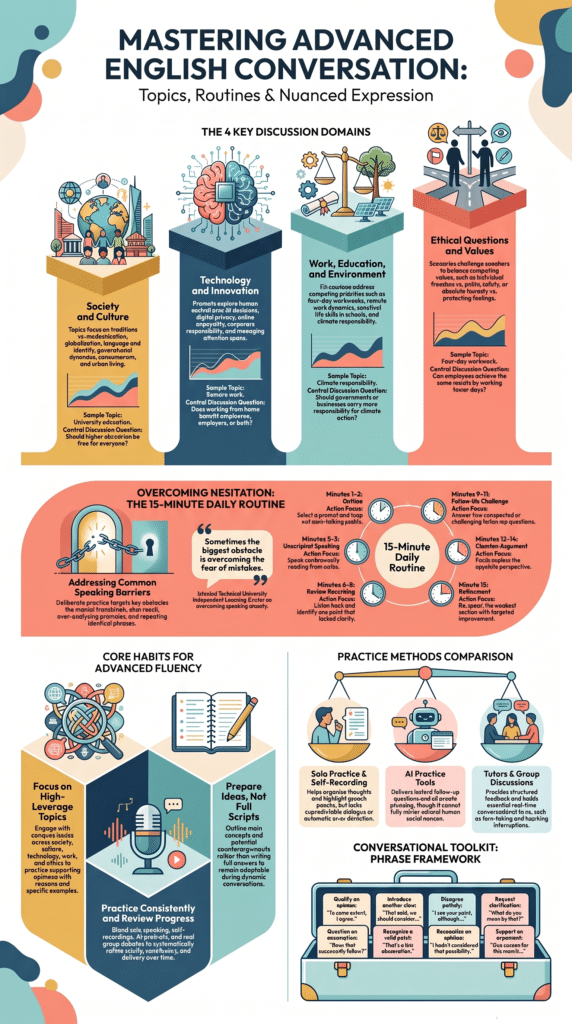
- Traditions and change: Should we preserve traditions when younger generations no longer value them?
- Globalization and identity: Does globalization strengthen cultural understanding or weaken local traditions?
- Language and identity: Do we express different parts of ourselves when speaking different languages?
- Generational differences: Are younger generations genuinely different, or do circumstances shape our judgments?
- Success and social status: Should success depend on happiness, financial security, or recognition?
- Privacy and public life: Should public figures have the same privacy rights as everyone else?
- Consumerism: Does buying more improve our lives or encourage unnecessary spending?
- Tourism and communities: Should popular destinations limit visitors to protect residents?
- Cultural appropriation: How can people appreciate cultures without disrespecting their traditions?
- Urban living: Does city life offer better opportunities than living in smaller communities?
Learners who want to discuss these topics with others can find where to practice English conversation online and choose settings to share opinions, ask follow-up questions, and hear different perspectives.
Which Technology Topics Challenge Advanced English Speakers?
Technology gives us practical ways to discuss changes in our work, relationships, and daily routines. These conversations become challenging when we consider both the benefits of innovation and its possible consequences.
- Artificial intelligence: Which decisions should remain under human control?
- AI and employment: Should productivity gains lead to higher wages or shorter working hours?
- Online privacy: How much personal information should we exchange for convenience?
- Social media: Has digital communication strengthened relationships or weakened meaningful interaction?
- Online anonymity: Should people be allowed to express opinions anonymously online?
- Misinformation: Who should determine whether information is reliable enough to share?
- Technology and attention: Do smartphones improve efficiency or make concentration harder?
- Corporate responsibility: Should technology companies be accountable for harm caused by their products?
- Digital education: Can online learning provide the same opportunities as classroom teaching?
- Automation: How should society support workers whose jobs become automated?
For stronger answers, avoid treating every question as a simple choice between right and wrong. Explain your reasoning, give a specific example, and acknowledge a possible limitation. If you support workplace automation, for instance, discuss its productivity benefits alongside the need to retrain affected workers.
Which Work, Education, and Environmental Topics Encourage Critical Thinking?

Work, education, and environmental issues often involve competing priorities. A policy may benefit one group while creating difficulties for another. I find these subjects useful because they allow us to connect everyday experiences with larger decisions about opportunity, responsibility, and resources.
| Topic | Central discussion question |
| Four-day workweek | Can employees achieve the same results by working fewer days? |
| Remote work | Does working from home benefit employees, employers, or both? |
| Professional identity | Should we define ourselves through our careers? |
| Ambition | Does success depend more on effort or opportunity? |
| University education | Should higher education be free for everyone? |
| Practical skills | Should schools teach more financial literacy and communication? |
| Career changes | Who should pay for workers to learn new skills? |
| Future employment | Which human abilities will remain valuable as AI develops? |
| Climate responsibility | Should governments or businesses carry more responsibility for climate action? |
| Sustainable cities | Should public transportation receive priority over private vehicles? |
When discussing these questions, I try to explain how a proposal would work in practice. Supporting a four-day workweek, for example, means considering staffing needs, productivity, and industries that require continuous coverage. Environmental discussions also benefit from practical examples involving transport costs, employment, and local access to services.
Which Ethical Questions Help Us Express Nuanced Opinions?
Credits: Max & Mia Podcast
Ethical discussions can be difficult because people often prioritize different values. Someone may focus on individual freedom, while another person places greater importance on safety or fairness. I have found that a useful discussion requires more than stating what feels right. We need to explain our reasons and consider how a decision could affect other people.
As highlighted by TESOL International Association
“Teachers are responsible for giving students opportunities to learn about important social, moral, and ethical issues and to analyze all sides of an issue.” – TESOL International Association
Consider these questions:
1. Is honesty always better than protecting someone’s feelings?
2. When should personal freedom give way to public safety?
3. Does treating everyone equally always produce a fair result?
4. Can breaking a rule sometimes be the right decision?
5. Should freedom of speech have limits when words cause serious harm?
6. How much of our success depends on luck rather than hard work?
7. Should individuals take more responsibility for their problems, or should governments provide greater support?
8. Should we prioritize loyalty or fairness when these values conflict?
Choose one question and identify the values involved. Then explain your position, consider a competing argument, and describe a possible consequence. I try to remain open to changing my mind when someone presents a convincing reason. A thoughtful answer does not require certainty; it requires clear reasoning and a willingness to examine different perspectives.
How Can We Overcome Speaking Difficulties With a Regular Practice Routine?
I used to assume that understanding advanced English meant I could discuss almost any subject comfortably. I often knew what I wanted to say but struggled to recall the right words quickly. The experience showed me that understanding a language and using it spontaneously require different kinds of practice.
Common difficulties include slow word recall, translating thoughts from another language, checking grammar too often, repeating familiar expressions, and losing track of an argument after an unexpected question. These problems can improve when we practise deliberately instead of trying to correct everything at once.
As noted by Istanbul Technical University Independent Learning Center
“Sometimes the biggest obstacle is overcoming the fear of mistakes.” – ITU ILC
Try this 15-minute routine:
- Minutes 1–2: Choose a discussion question and outline your main point.
- Minutes 3–5: Speak without reading a prepared answer.
- Minutes 6–8: Review your recording and identify one unclear point.
- Minutes 9–11: Answer two challenging follow-up questions.
- Minutes 12–14: Explain the opposing position fairly.
- Minute 15: Repeat your weakest section with one improvement.
The British Council’s C1 learning resources and the Council of Europe’s Common European Framework of Reference for Languages provide useful guidance on proficiency and communication. Use your practice sessions to build clearer explanations, more flexible responses, and greater confidence over time.
How Can We Choose Topics and Prepare for Natural Conversations?
I find it easier to speak when a topic connects with something I know. Personal experience gives me examples to explain, even when I cannot immediately recall every expression I need. However, familiarity alone does not guarantee a useful discussion. We also need questions that encourage us to examine causes, compare alternatives, and explain consequences.
Before practising, decide what you want to improve. You might want to explain opinions more clearly, use precise vocabulary, or respond to unexpected questions. Prepare a few ideas rather than memorizing complete sentences.
For example, when discussing remote work, note commuting time, teamwork, and employee flexibility as reminders. Regular English conversation practice online can help you apply these preparation techniques in discussions and become more comfortable expressing your ideas.
A simple structure can help organize your response. Start by stating your position, explain your main reason, acknowledge another factor, and consider a reasonable counterargument. You could say, “I would argue that remote work saves commuting time. That said, some teams depend on regular face-to-face collaboration.”
Keep three keywords and one example nearby if necessary. Then practise speaking without reading directly from your notes. Return to difficult topics later and try a different argument.
How Can We Practise Debating and Prepare for Real Conversations?

Practising alone gives me time to organize my thoughts, but real discussions require more flexibility. Other people may interrupt, challenge an assumption, or introduce information I have not considered.
AI tools can generate follow-up questions and suggest alternative expressions, while tutors and conversation groups provide opportunities to respond to different speaking styles. Knowing how to find English conversation partners can also make regular practice easier by helping learners connect with people who share their goals and interests.
Each method has strengths and limitations. Speaking alone helps organize ideas but offers no unexpected replies. Recording yourself reveals repeated words and long pauses, although self-review can miss mistakes.
AI practice provides quick questions but cannot reproduce every social situation. Tutors can offer focused feedback, while group discussions help develop turn-taking skills.
Useful expressions can make these conversations easier:
| Communication goal | Useful expression |
| Qualify an opinion | “To some extent, I agree.” |
| Introduce another view | “That said, we should consider…” |
| Disagree politely | “I see your point, although…” |
| Request clarification | “What do you mean by that?” |
| Question an assumption | “Does that necessarily follow?” |
| Recognize a valid point | “That’s a fair observation.” |
| Reconsider an opinion | “I hadn’t considered that possibility.” |
| Support an argument | “One reason for this view is…” |
I would combine these methods rather than depend on one. The aim is to communicate naturally, not deliver a perfect speech.
FAQ
How can I make advanced English conversation practice more challenging?
Choose advanced English conversation topics that require you to explain your reasons, compare opinions, and consider possible outcomes. C1 English discussion topics help you practise giving detailed answers, while C2 English conversation questions encourage you to explore complex ideas. After speaking, review your answers and identify where you paused, repeated words, or struggled to explain your thoughts clearly.
What topics can help me improve my critical thinking in English?
Choose deep conversation topics in English that involve different values, uncertain outcomes, or cultural differences. For example, meaningful English conversation questions about privacy, freedom, and personal responsibility can help you examine different viewpoints. Ask yourself, “What evidence could change my opinion?” These thought-provoking English discussion questions help you explain your reasoning, support your claims, and consider opposing arguments fairly.
Which English discussion topics can help me communicate at work?
Workplace discussion topics for English learners can cover teamwork, leadership, conflict, and changes in working habits. You can use future of work conversation prompts to discuss remote work, automation, and changing job skills. Leadership discussion questions in English can help you explain how people should make decisions and manage teams. Practising these subjects can prepare you to share ideas clearly during meetings and group discussions.
How can I discuss controversial issues in English without sounding rude?
Choose controversial topics for English discussion that have reasonable arguments on both sides. For example, freedom of speech discussion prompts and privacy and security debate topics can help you practise weighing different views. Use polite disagreement phrases in English, explain your reasons calmly, and acknowledge the other person’s point before responding. Focus on the issue rather than criticizing the person who disagrees with you.
How can I improve spontaneous English responses without a speaking partner?
Practise spontaneous speaking in English by choosing a question, taking 15 seconds to prepare, and speaking for one minute without stopping. Record yourself speaking so you can identify long pauses, repeated words, and unclear explanations. You can also answer hypothetical questions for advanced English learners, such as how you would respond to an unexpected problem. This practice helps you organize your thoughts and respond more naturally without memorizing answers.
Improve Your English Through Consistent Practice
Struggling to express your ideas in advanced English can be frustrating, especially when you understand the discussion but can’t find the right words. Progress takes time. Regular practice helps you explain your opinions more clearly and respond with greater confidence.
We believe steady practice makes a real difference. Start with one topic, share your ideas, and learn from each conversation. Ready to improve your speaking skills? Explore Ivy Languages International and take your next step today.
References
- Stohlman-Vanderveen, Maryellen. “Making Connections: The Art of Small Talk and Networking.” Smith College, February 28, 2017. Accessed October 14, 2026.
- “Overcoming Speaking Anxiety.” Istanbul Technical University Independent Learning Center. Accessed October 14, 2026.
Related Articles
- https://ivylanguagesinternational.com/where-to-practice-english-conversation-online/
- https://ivylanguagesinternational.com/english-conversation-practice-online/
- https://ivylanguagesinternational.com/how-to-find-conversation-partners/