
Tips
The most effective method for learning English online isn’t a single app or trick. It’s a balanced system combining structured platforms, daily immersion, and consistent speaking practice. This approach moves you from passive understanding to active conversation, preventing the common plateau many face.
We see it work every day. Our own journey into language education was born from personal struggle, not theory, and that lived experience shapes everything we do. If you’re tired of spinning your wheels, the real path forward is clearer than you think. Keep reading to see how to build it.
Key Takeaways
- Combine structured lessons with daily, real-world immersion.
- Prioritize active speaking practice over passive consumption.
- Build a consistent, sustainable routine focused on progress, not perfection.
Finding Your Path to English Fluency

My own English journey felt scattered for a long time. I’d try an app, then a textbook, never feeling like I was getting anywhere. The change happened when I stopped looking for one perfect solution and started combining tools with clear intentions.
First, I needed discipline. An app like Duolingo gave me that. It made practice a daily game, building a streak I didn’t want to break. It laid a basic foundation of words and patterns. But I couldn’t have a conversation.
To understand real English, I switched to BBC Learning English. Their lessons use actual news clips and interviews. I wasn’t just learning grammar rules, I was hearing how they worked in context, which made everything stick.
“BBC Learning English has audiences in most countries across the world helping them to develop and improve their English language skills.” – Wikipedia, BBC Learning English. [1]
The real shift was moving from understanding to using. Writing and speaking with language partners was awkward and slow. I made constant mistakes. But that messy, real-time practice was the only way the language started to feel like my own.
Finally, for the tricky details, I booked a tutor on Preply, and that’s where the real online English tutoring benefits became clear: personal feedback, natural phrasing, and the confidence to fix mistakes without guessing.
A Practical Roadmap
Credit: A.J. Hoge
Forget finding a single answer. Think of building fluency in stages, each with the right tool.
Start with habit-forming apps. Their strength is consistency. They turn practice into a daily ritual, which is half the battle. Next, immerse yourself in contextual learning. Platforms like BBC Learning English use real-world videos and articles. You learn the language by engaging with it, not just memorizing it.
Then, you must produce the language yourself. Language exchange apps connect you with real people. You’ll write messages, have voice chats, and make many errors. This uncomfortable step is non-negotiable for building speaking confidence.
Finally, invest in targeted guidance, because this is how online tutoring improves fluency, a tutor spots repeating errors, explains why something sounds unnatural, and helps you correct it in real time.
They listen, identify your unique weaknesses, and explain nuances that apps gloss over. This step refines your skills and accelerates progress. For specific goals like university admissions, a structured test prep course provides a clear framework. The key is to use each tool for its purpose, and to keep moving forward.
The Plateau I Couldn’t Escape
I was stuck. I could pass a grammar test, but in a real conversation, my mind went blank. For years, I treated English like a school subject, an hour of study, then back to my native language.
It got me to a basic level, but then progress just stopped. I hit a wall at the intermediate stage, understanding some text but freezing when I had to speak. The traditional, isolated method had taken me as far as it could.
That failure forced a change, and I finally understood the limits of studying alone by clearly seeing the difference between apps versus private tutors, one builds habits, the other fixes what keeps holding you back. I stopped “studying” and started building an English environment around my existing life. My goal was to make the language a normal, even boring, part of my day.
- I changed my phone and computer to English, creating frictionless daily interactions.
- I listened to podcasts about my hobbies during my commute, focusing on content over lessons.
- I watched shows with English subtitles, then re-watched scenes to catch the sounds.
This shift, from scheduled study to integrated immersion, was what finally moved me past the plateau.
Building a World in English
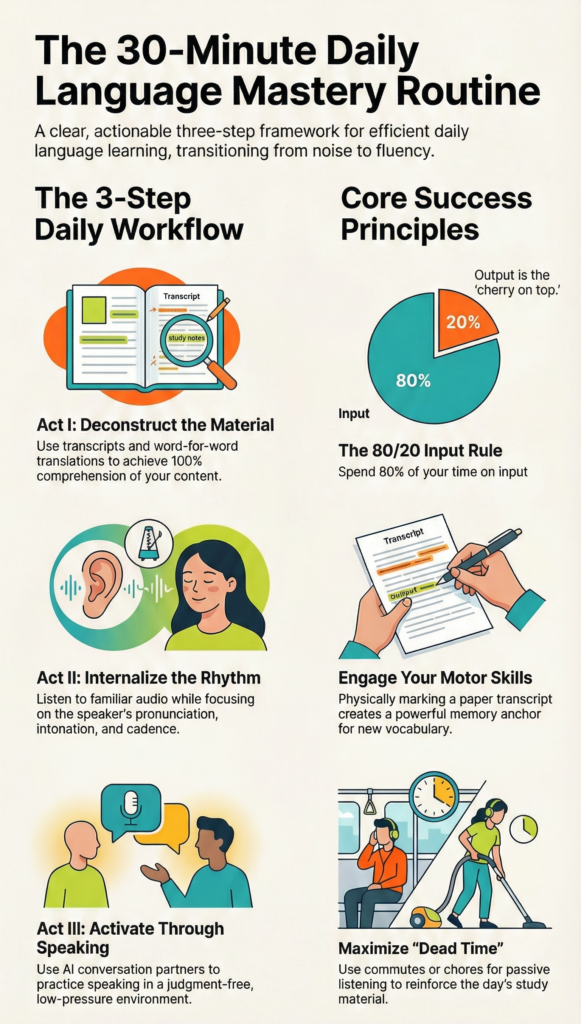
The immersion method is simple: weave the language into what you already do. It’s not about moving countries; it’s about changing your daily landscape. Consistency is the engine. Thirty minutes of integrated exposure each day builds fluency far better than a crammed weekend session.
Start with your media and digital spaces. The key is engagement and repetition.
- Listen Actively: Use podcasts or YouTube about your interests. Listen to a short segment, then try to shadow, repeat it aloud, matching the speaker’s rhythm.
- Watch Strategically: Use English subtitles. For a challenge, watch a scene twice: once with subtitles, once without, focusing purely on listening.[2]
- Read for Confidence: Use graded readers or leveled news sites. Understanding the material builds momentum and naturally introduces new vocabulary.
This approach mimics how we learned our first language: through curious, consistent exposure. It requires patience, but it builds a genuine, usable skill. The language stops being a subject and starts being a tool you simply use.
The Speaking Hurdle
My biggest obstacle was always speaking. I could understand a lot, but forming my own sentences in real time made my mind freeze. I’d search for the perfect grammar while the person waited. That silence felt like failure. Practicing alone was safe, but it didn’t prepare me for a real conversation. There was no pressure, no need to think quickly.
To improve, I had to create situations with gentle, real-time pressure. I needed the immediate feedback loop only another person provides, a confused look or a clarifying question that forces you to adjust on the spot.
- I scheduled short, 15-minute video calls with a conversation partner, talking about simple topics like our daily routines.
- I joined an online discussion group where I had to summarize a news article each week.
- I practiced giving detailed instructions to my voice assistant in English, just to form complete thoughts aloud.
This practice was uncomfortable but necessary. It trained my brain to retrieve words for communication, not perfection. The anxiety didn’t vanish, but it shrank. Fluency in speaking isn’t about knowing every rule; it’s about building the confidence to use the words you have, even when they aren’t perfect.
Practicing English at home

I remember the exact problem: understanding English was one thing, but speaking it felt impossible. The words were stuck. My first step was talking to myself. I’d record a short clip about my day, listen back, and cringe at the flat tone and awkward pauses.
To build a real practice rhythm, I focused on three simple methods:
- Recording myself to hear and correct my own mistakes.
- Using a language exchange app for 30-minute conversations, learning real phrases.
- Joining an online community, like a Discord server, to write posts and join casual voice chats.
I learned to avoid relying only on AI for conversation. It’s useful for words, but it misses the human rhythm, the awkward pause, the misunderstood joke. You have to force yourself to produce the language.
For a sustainable routine, try this structure for an hour: twenty-four minutes on speaking, twenty-four on reading and listening, twelve on review.
| Time Allocation | Skill Focus | Activity Example | Purpose |
| 24 Minutes | Speaking Practice | Video call with language partner or tutor | Builds confidence and real-time fluency |
| 24 Minutes | Reading & Listening | Podcasts, YouTube, graded articles | Expands vocabulary and listening comprehension |
| 12 Minutes | Review & Reflection | Note new phrases, record short summary | Reinforces learning and tracks progress |
Track your progress weekly to see patterns. Follow a supportive account, share a small win. Let your practice be a gentle, steady part of your life.
FAQ
What are effective online English learning methods for beginners studying alone?
Effective online English learning methods work best when learners combine several approaches. Use self-paced english online study with clear english grammar online tutorials and vocabulary building online english tools.
Add online English speaking practice through English language exchange apps. Support learning with free online english resources such as youtube english learning channels and podcast english practice online. Follow a daily English routine online to build steady progress.
How do effective English online courses improve speaking and listening skills?
Effective English online courses improve skills by focusing on real communication. Learners build english listening skills web through bbc learning english videos and voa learning english podcasts.
Speaking improves through guided practice in zoom english conversation groups, italki english conversation practice, and tandem language partner english sessions. These virtual english lessons techniques support strong digital english language acquisition.
What are the best ways to learn English on the internet without paid classes?
The best ways to learn English on the internet without payment rely on consistent use of free tools. Learners improve english reading comprehension digitally by using english news simplified reading.
Writing improves through English writing improvement online with journal english daily web activities. Speaking skills grow through discord english speaking servers and hellotalk english chat practice. These web-based English improvement tips require time, not money.
How can learners stay consistent and avoid burnout studying English online?
Learners stay consistent by building simple habits. Set a daily english routine online and track results using progress tracking english apps. Use gamified english learning apps and spaced repetition english apps like anki english vocabulary decks.
Apply english motivation online tips and follow clear english learning milestones online. Planned breaks help with English burnout recovery methods and prevent long-term learning stalls.
Which online tools help improve pronunciation, grammar, and test readiness?
English pronunciation online drills improve through shadowing technique English online and voice recognition English practice tools like Elsa speak pronunciation app. Grammar improves with structured english grammar online tutorials and grammarly english learning mode.
Learners preparing for exams benefit from English proficiency test prep online, including ielts online preparation courses and toefl web-based training with clear study goals.
Your Path Forward with Interactive English Learning
The online world offers many tools, but real fluency comes from combining smart structure with human connection. Apps help you start, but interactive tutoring turns knowledge into instinct. We believe real conversation matters, personal feedback, clear explanations, and a safe space to speak without fear.
That belief led us to build Ivy Language International. Effective online English learning isn’t magic; it’s consistency, conversation, and support. Start small this week, speak up, and keep going. We’re ready when you are.
References
- https://en.wikipedia.org/wiki/BBC_Learning_English
- https://www.mdpi.com/2227-7102/13/3/274
Related Articles
- https://ivylanguagesinternational.com/online-english-tutoring-benefits/
- https://ivylanguagesinternational.com/how-online-tutoring-improves-fluency/
- https://ivylanguagesinternational.com/comparing-apps-versus-private-tutors/