
Tips
How to overcome English learning plateaus usually starts with changing how we practice, not simply studying more. I remember reaching that stage after years of learning English. I could understand movies, follow meetings, and read articles without much difficulty, but speaking still felt slow and tiring.
For a long time, I thought I needed more grammar study. Later, I realized the problem was lack of active use and real interaction. Progress returned when I practiced more consistently in daily situations. Many learners experience this stage. Keep reading, and I will walk through the methods that helped me move forward again.
Plateau Reset: Small Shifts That Restart Progress
These habits reflect the biggest patterns behind long-term fluency growth and explain why some learners move forward while others stay stuck.
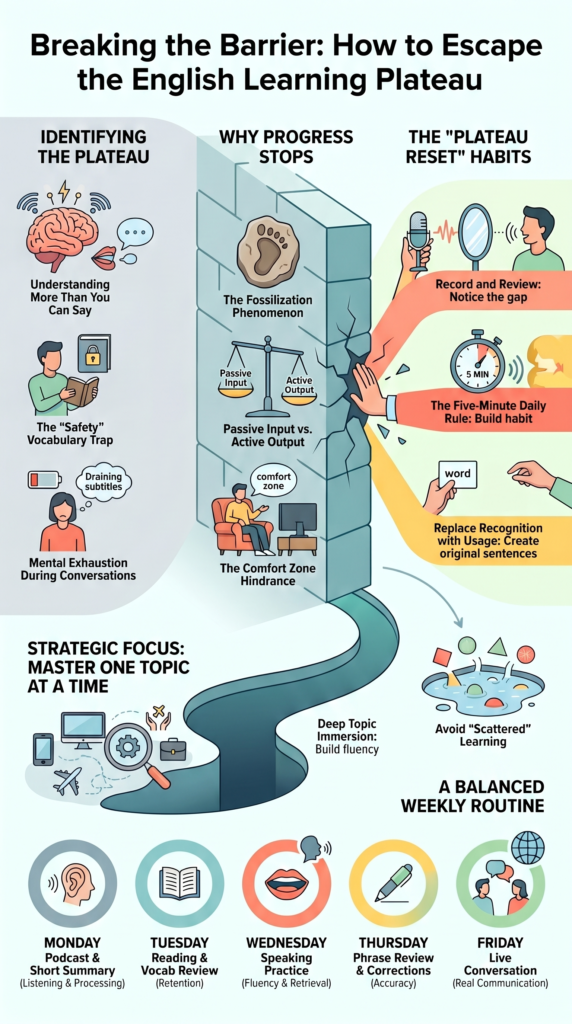
- Most English learning plateaus happen because learners rely too much on passive input instead of active output.
- Small weekly changes like recording speech, using topic based English learning, and deliberate speaking often restart progress faster than studying longer hours.
- Long term fluency grows through consistent discomfort, measurable routines, and real communication practice.
Quick wins to restart your English progress
I remember feeling frustrated during one period of my own learning because I studied almost every day but sounded exactly the same month after month. I listened to podcasts while driving, watched videos at night, and reviewed grammar books on weekends.
Insights from Salas indicate
“The plateau phenomenon is often a result of ‘fossilization’ where progress fails to continue despite effort. To restart, learners must move from a purely semantic analysis (understanding meaning) to a syntactic analysis (understanding structure). … The experience of being pushed to produce oral discourse can trigger a cognitive process that leads to ‘noticing the gap’ between the learner’s own spoken production and that of more experienced speakers.” – Redalyc
Many learners face the same problem. In my experience, learners improve faster when they create habits that force quicker thinking and real communication.
A few practical adjustments can restart progress within weeks:
- Record yourself speaking once a week
- Practice one topic deeply for several days
- Replace passive listening with conversation practice
- Review corrections and reuse them later
- Speak aloud for five minutes daily
- Track active vocabulary, not passive recognition
- Use difficult topics sometimes, not only easy ones
These habits feel uncomfortable at first. That discomfort usually means growth is happening again.
What causes an English learning plateau?
I noticed my own plateau began when my learning became too comfortable. I watched simple videos, listened to familiar podcasts, and avoided difficult conversations. My understanding improved a little, but my speaking stayed almost the same. Looking back, I realized I was protecting myself from mistakes instead of practicing real communication.
Many learners experience this after reaching an intermediate level. Daily English starts to feel manageable, so the brain stops working as hard. Familiar study habits feel productive because they are easy to repeat, but easy repetition rarely builds stronger speaking skills.
Another common problem is the gap between passive and active vocabulary. Many people understand hundreds of words while reading but cannot remember them during conversations. That gap creates hesitation and frustration.
These patterns appear often during plateaus:
| Common Habit | Result |
| Passive listening only | Slow speaking improvement |
| Easy study materials | Limited vocabulary growth |
| Avoiding mistakes | Weak confidence |
| Repeating old routines | Stalled progress |
Burnout also matters. I have seen learners push themselves too hard for months, then lose motivation completely. Sometimes the brain needs slower, more deliberate practice instead of endless study hours.
Signs you are stuck at an intermediate or advanced level
I remember a period when I understood almost everything around me but still struggled to respond quickly. During meetings, ideas formed in my head, yet my words came out slowly. I often reused the same expressions because they felt safe.
At the time, I thought I needed more grammar study. Later, I realized the real issue was communication pressure and lack of active practice. Many learners experience similar stages before reaching stronger intermediate English breakthroughs in speaking confidence and fluency.
Several signs usually appear during this stage:
- You understand more than you can say
- You repeat the same vocabulary often
- Long conversations feel mentally exhausting
- You avoid debates or deeper discussions
- Subtitles still feel necessary
- Humor and idioms feel difficult
- Speaking feels slower than thinking
I have also noticed that many learners stay stuck because they continue practicing only familiar situations. Small talk becomes comfortable, but more complex communication never develops. Real growth usually starts when learners move beyond predictable conversations and begin handling uncertainty, pressure, and spontaneous responses more often.
Why apps, grammar drills, and videos stop working
For years, I believed grammar exercises would eventually fix my speaking problems. I could explain grammar rules clearly, but during real conversations, I still hesitated. That was difficult to accept because I had already invested so much time studying. Eventually, I understood that knowing English and using English are two different skills.
Apps, videos, and drills still have value. They help beginners build a foundation. The problem appears when learners rely on them too heavily for too long. Passive exposure creates recognition, but real communication requires fast retrieval and confidence under pressure.
I started noticing more improvement when I replaced some passive study with active tasks. Speaking aloud forced me to organize thoughts quickly. Writing summaries helped vocabulary stay in my memory longer. Conversations exposed weaknesses I could not see while studying alone.
This shift made a major difference:
| Plateau Habit | Better Practice |
| Endless grammar review | Live conversation |
| Passive watching | Speaking summaries |
| Random vocabulary lists | Topic-focused vocabulary |
| Easy content only | Slightly difficult material |
The brain grows faster when it has to retrieve language actively instead of quietly recognizing it.
How to turn passive English into active fluency
One thing changed my learning more than anything else. I stopped collecting vocabulary and started using it immediately. Before that, I saved endless word lists but rarely spoke them aloud. I understood many expressions while reading, yet they disappeared during conversations.
The process itself was simple. After listening to a podcast or reading an article, I wrote down a few useful phrases. Then I used those phrases in my own sentences later that day. Sometimes I repeated them during conversations or short voice recordings.
Repetition inside real situations helped the language stay in my memory longer. Methods connected to how to practice English pronunciation alone helped me notice weak sounds and improve clarity.
A steady cycle usually works better than complicated systems:
- Notice useful phrases while listening or reading
- Save a small number of expressions daily
- Write original examples connected to real life
- Reuse phrases during conversations
- Review them regularly
- Repeat corrected sentences aloud
I have seen many learners improve after following this approach consistently. The goal is not memorization alone. The goal is moving language from recognition into natural use. That shift takes time, but it creates stronger fluency over the long term.
Why output practice works better than more input
I used to think listening longer would eventually improve my speaking automatically. For a while, I spent hours each week consuming English content without speaking much myself. My understanding improved, but conversations still felt stressful.
Research from Swain shows
“Comprehensible output is a necessary mechanism of acquisition. … Its role is, at minimum, to provide opportunities for contextualized, meaningful use, to test out hypotheses about the target language, and to move the learner from a purely semantic analysis of the language to a syntactic analysis of it.” – DigitalCommons@USU
Speaking forces the brain to retrieve vocabulary under pressure. Writing does the same thing. These activities reveal weaknesses passive study often hides. At first, active practice feels uncomfortable because mistakes become visible immediately. Over time, though, that discomfort becomes part of the learning process.
Several activities helped me more than endless listening:
- Voice recordings
- Daily journaling
- Conversation summaries
- Explaining ideas aloud
- Repeating corrected sentences
- Topic-based speaking practice
I also noticed that active practice improved confidence, not only vocabulary. The more often I spoke imperfectly, the less afraid I became of making mistakes. Many learners wait until they feel “ready” before speaking more. In reality, readiness usually develops through speaking itself, not before it.
Beat the plateau by mastering one topic at a time
At one stage, I tried learning vocabulary from every possible topic at once. Politics one day, travel the next, then technology after that. My knowledge became scattered. I recognized many words but struggled to discuss any subject deeply. Things changed when I focused on one topic for several weeks instead of constantly switching.
That slower approach helped vocabulary repeat naturally. I began hearing the same expressions again and again inside articles, podcasts, and conversations. Over time, those phrases became easier to retrieve without translation.
Many learners improve faster when they narrow their focus temporarily. Repetition becomes more meaningful because the language connects to one area consistently.
A focused routine often looks like this:
- Choose one topic for several weeks
- Read and listen only about that subject
- Practice discussing it regularly
- Save useful phrases connected to the topic
- Reuse vocabulary during conversations
- Move to a new subject gradually later
This method also reduces overwhelm. Instead of trying to sound fluent about everything, learners build confidence in one area first. I have seen this work especially well for professional English because workplace vocabulary often repeats inside similar situations and discussions.
Why speaking feels hard even when you know English
I remember understanding conversations clearly while still struggling to answer quickly. During meetings, my thoughts formed slowly in English even though I knew the vocabulary already. The pressure of real-time communication made everything feel harder. Reading never created that same stress because there was always time to think.
Many learners experience this gap between understanding and speaking. Comprehension usually develops earlier because listening is passive. Speaking demands faster recall, sentence building, pronunciation, and confidence all at once.
Fear also plays a large role. I spent years trying to avoid mistakes during conversations. That habit slowed me down even more because I searched for perfect sentences before speaking. For many learners, overcoming fear of speaking English becomes part of breaking through the plateau itself because hesitation limits real practice opportunities.
Several problems often appear together during this stage:
- Fear of speaking incorrectly
- Slow vocabulary retrieval
- Overthinking grammar
- Avoiding difficult conversations
- Weak confidence during debates
- Limited experience with spontaneous speaking
Progress became easier once I accepted imperfect conversations as part of learning. Small mistakes stopped feeling like failure. They became useful information instead.
How to practice complex English instead of small talk
For a long time, most of my English conversations stayed very predictable. I talked about work, weather, daily routines, and simple plans. Those conversations helped build comfort, but they did not prepare me for deeper discussions. The moment topics became more abstract or emotional, my speaking slowed down again.
I started improving faster after practicing more complex conversations intentionally. Discussing opinions forced me to organize ideas clearly. Explaining abstract topics exposed missing vocabulary. Even storytelling helped because it required emotional detail and stronger sentence structure.
Several activities helped strengthen deeper communication skills:
- Debates about current issues
- Explaining difficult ideas simply
- Storytelling with personal details
- Discussing books or documentaries
- Practicing humor and idioms
- Simulating professional meetings
These conversations felt mentally tiring at first. That reaction was normal. Harder speaking tasks create stronger growth because the brain must work faster and more carefully.
I also learned that advanced fluency is not only about grammar accuracy. It involves nuance, timing, confidence, and flexibility during unexpected moments. Those skills develop slowly through repeated real communication, not memorized answers or perfectly controlled practice exercises.
What does a plateau-breaking weekly routine look like?
I wasted a lot of time following inconsistent routines. Some weeks I focused only on listening. Other weeks I studied grammar heavily and ignored speaking completely. My progress stayed uneven because the skills were disconnected. Things improved once I created a simple structure that balanced input, output, and review together.
A good routine does not need to be extreme. In my experience, shorter focused sessions work better than exhausting study marathons. Many learners restart progress with only a few deliberate hours each week when the practice stays consistent.
This kind of structure helped me most:
| Day | Activity | Main Focus |
| Monday | Podcast and short summary | Listening |
| Tuesday | Reading and vocabulary review | Retention |
| Wednesday | Speaking practice | Fluency |
| Thursday | Phrase review and corrections | Accuracy |
| Friday | Live conversation | Real communication |
The routine matters because each activity supports another. Listening introduces vocabulary. Speaking tests retrieval. Review strengthens memory. Live conversation exposes weak areas honestly.
I also learned to treat English practice like an appointment instead of waiting for motivation. That small mindset shift made consistency easier during busy or stressful periods.
How to stay motivated when progress feels invisible
Credits: English Speaking School
There were long periods when I felt my English was not improving at all. I studied regularly, practiced conversations, and reviewed vocabulary, yet everything sounded the same to me. Then one day I listened to an old recording from several months earlier. The difference surprised me. My speech sounded smoother, faster, and calmer than before.
Advanced improvement often feels invisible because changes become smaller over time. Beginners notice growth quickly. Intermediate and advanced learners usually improve in quieter ways. Response speed becomes faster. Hesitation decreases. Pronunciation becomes clearer little by little.
I found it helpful to track smaller signs of progress:
- Faster responses during conversations
- Less dependence on subtitles
- Smoother pronunciation
- Shorter hesitation gaps
- Better understanding of humor
- Easier vocabulary recall
Comparison also creates unnecessary pressure. Some learners improve speaking quickly. Others improve listening first. Everyone develops differently depending on experience, personality, and practice habits.
Patience became one of the hardest lessons for me. Real fluency grew slowly through repetition, mistakes, and steady communication over many years.
Smarter systems for breaking an English plateau faster

Motivation changes constantly. Some weeks I felt excited to practice English. Other weeks I felt tired after work and wanted to avoid studying completely. I eventually realized that habits mattered more than motivation. Systems created stability during periods when enthusiasm disappeared.
Simple routines often work best because they fit into daily life more naturally. Complicated plans usually collapse after a few stressful weeks. I started connecting English practice to activities I already did every day, like walking, commuting, or reviewing notes before bed.
Several systems helped me stay consistent over time:
- Schedule speaking sessions weekly
- Connect practice to daily habits
- Set small measurable goals
- Review progress monthly
- Use accountability partners
- Rotate practice activities
- Keep study sessions realistic
I also noticed that learners improve faster when English becomes part of real life instead of only a school subject. Conversations connected to work, hobbies, or personal interests feel easier to sustain long term.
The goal is not perfect discipline every day. The goal is building routines strong enough to continue even during busy, difficult, or discouraging periods.
FAQ
Why does an English learning plateau happen after intermediate level?
An English learning plateau often happens when passive study replaces active use. I reached this stage when I could understand videos and articles but still struggled to speak naturally.
Many learners feel stuck at B1 English or stuck at B2 English because they repeat the same study habits for too long. Real progress usually returns through deliberate English practice, conversation, and regular real life English practice.
How can I break through the English plateau without studying longer hours?
To break through the English plateau, I had to change my study methods instead of adding more study hours. Intensive English practice, active English listening, and regular English conversation practice helped me more than repeated grammar review.
Short daily speaking sessions improved my fluency faster. A healthy English input and output balance keeps learning active and helps improve communication skills more naturally.
What helps when progress in English stalled for a long time?
When my progress in English stalled, I realized my routine lacked challenge and variety. I started using topic based English learning, English journaling practice, and English monologue practice to improve active thinking.
Tracking English progress also helped me stay focused and motivated. Small changes in study habits often restart English learning more effectively than completely changing your learning method.
How do I improve English fluency after an advanced English plateau?
An advanced English plateau usually requires more focused speaking and listening practice. I improved English fluency by working on advanced English speaking skills, English collocations learning, and English listening to native speakers every day.
The English shadowing technique also improved my rhythm and pronunciation. Over time, these habits helped me break English fluency barrier and communicate more naturally in meetings and discussions.
What are realistic ways to avoid English learning motivation loss?
English learning motivation loss often happens when expectations become unrealistic. I experienced English language burnout after trying to improve too quickly without enough rest.
What helped me was setting smaller goals and following realistic English learning expectations. A steady English self study routine, daily English speaking habit, and long term English fluency plan made progress feel more manageable and sustainable over time.
The Difference Usually Comes Down to Staying With It
I remember reaching points where learning English felt mentally exhausting. I studied regularly, but conversations still felt uncomfortable and progress seemed invisible for long stretches. The learners who continue growing are usually the ones who keep speaking, even when they feel unsure.
We understand those slower stages because we lived through them ourselves. Confidence takes time, repetition, and real communication. Progress is rarely fast, but it becomes real when we keep showing up. Continue learning with us at Ivy Languages International.
References
- https://www.redalyc.org/pdf/3057/305742130007.pdf
- https://digitalcommons.usu.edu/cgi/viewcontent.cgi?article=1928&context=gradreports
Related Articles
- https://ivylanguagesinternational.com/intermediate-english-breakthroughs/
- https://ivylanguagesinternational.com/how-to-practice-english-pronunciation-alone/
- https://ivylanguagesinternational.com/overcoming-fear-of-speaking-english/