Tips
Overcoming fear of speaking English begins with small, low-pressure practice and a shift in how you see mistakes. I learned this the hard way early in my career, when I had to speak English at work and suddenly felt my mind go blank, my face warm, and my confidence disappear.
That moment stayed with me because it was not about vocabulary or grammar, it was about pressure. Over time, both through my own effort and years of teaching, I saw the same pattern repeat. At Ivy League International, learners face this daily, and the solution is always steady, patient practice. If this feels familiar, keep reading to see how you can begin.
Quick Wins to Overcome Fear of Speaking English
These points reflect the core pattern behind speaking fear and how steady, low-pressure action helps you move past it.
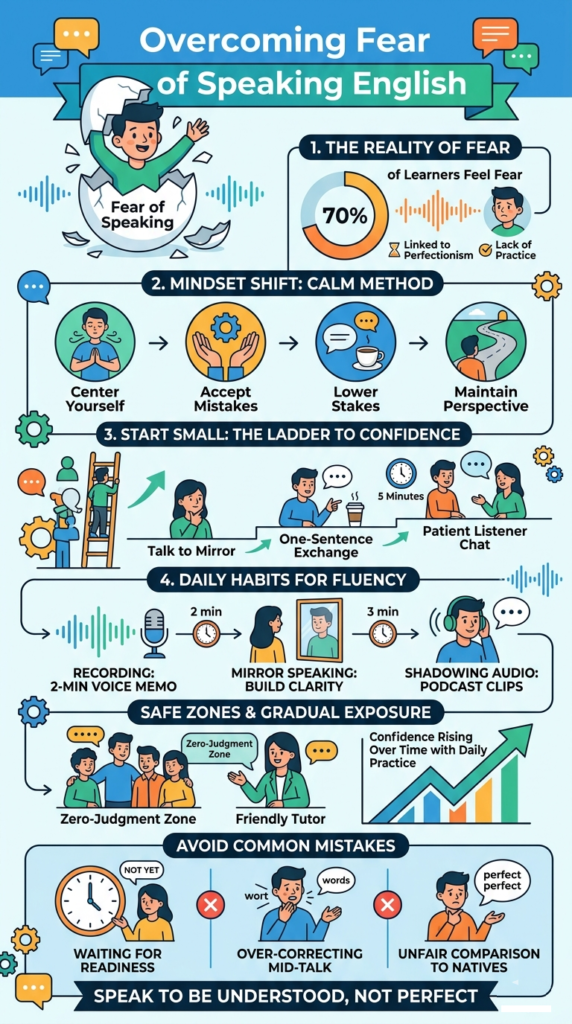
- Fear of speaking English is common and affects up to 70% of learners, often linked to perfectionism and lack of practice.
- Confidence grows through gradual exposure, not sudden performance in high-pressure situations.
- Daily speaking habits, even 10–15 minutes, lead to clear improvement within a few weeks.
Why Do People Feel Afraid To Speak English?

The fear usually starts inside your head. For me, it was a voice saying, “They’ll notice your accent” or “You’ll use the wrong word.” This is common. Research connects it to a fear of judgment and a desire for perfection. Up to 70% of learners feel this anxiety.
I’ve seen it come from specific moments, too. A student once told me about a time a cashier laughed when they mispronounced “bread.” That single moment made them avoid shops for weeks. It’s not just about grammar; it’s emotional.
The triggers are usually clear:
- Worrying about grammar mistakes.
- Remembering a past embarrassing moment.
- Not finding the right word fast enough.
This fear has two parts. One is emotional: shame, pressure, shyness. The other is skill-based: limited vocabulary, trouble with pronunciation. We treat speaking like a final exam, but it’s more like learning to ride a bike. You have to get on it to get better, and you will wobble at first.
What Mindset Shifts Actually Reduce Speaking Anxiety?
I used to think I had to be perfect before I could speak. That was my biggest mistake. The shift happened when I started focusing on whether the other person understood me, not on every tiny error. If they nodded, I kept going.
A simple method helped. I call it CALM.
- Center yourself with one deep breath.
- Accept that mistakes are part of learning, not failure.
- Lower the stakes. You’re just having a chat, not giving a speech.
- Maintain perspective. This is one conversation in a long journey.
I also began using quiet affirmations that felt true. “My goal is to be understood,” or “This is practice.” For many learners exploring how to start learning English online, this shift becomes the first real step forward.
Studies from places like Stanford show that this kind of realistic self-talk can improve performance. It turns a high-pressure test into a simple act of communication. That change alone takes a weight off your shoulders.
How Can You Start Speaking English Without Freezing?
You start very small. My first real attempt was talking to my reflection in the bathroom mirror. It felt silly, but there was no one to judge me. Then I moved to saying “thank you” clearly at a coffee shop. These tiny wins build a foundation.
Insights from University of Washington indicate
“Negative self-perception is probably the fundamental cause and the biggest enemy to overcoming foreign language speaking apprehension. The reason we feel so anxious about speaking in front of others is that we care too much about our grammar, pronunciation, sentence structure, and accents, but our audiences don’t.” – University of Washington
Here’s the progression I followed and now teach:
- Talk to yourself for 2-5 minutes daily. Describe making breakfast.
- Have one-sentence exchanges. Order a coffee, ask for the time.
- Have a short, planned chat with a patient friend.
The environment is key. You need a “zero-judgment zone.” This could be a language exchange where both of you are learners, or a tutor who focuses on encouragement. Many learners try to jump from step one to a business meeting. It’s too fast. Confidence builds slowly, like a plant growing. You water it with small, consistent actions.
Which Daily Exercises Improve Speaking Confidence Fastest?
Credits: English Fluency Journey
I found that short, daily exercises worked better than marathon weekend study sessions. Fifteen minutes every day built a habit. Within a month, I felt less resistance to speaking.
The most effective exercises were simple and repeatable.
- Recording: I’d record a 2-minute voice memo about my day and listen back. It was cringey at first, but I heard my progress.
- Mirror Speaking: This helped me see my own facial expressions and practice clarity.
- Shadowing: I’d play a short podcast clip and try to repeat it immediately after, matching the rhythm.
Many of these methods align with best tips for English beginners that focus on consistency over intensity. I practiced with ordinary topics to keep it grounded: describing my commute, explaining how to make tea, talking about a movie.
Cambridge English notes that combining this consistent speaking with listening leads to clearer fluency gains. I kept a simple log: “Spoke for 15 mins today. Used three new words.” Seeing that record proved I was moving forward, even on days it didn’t feel like it.
Is “Just Speak More” Actually Good Advice?
People told me to “just speak more” for years. It’s not wrong, but it’s incomplete. If you “just speak” in a situation that feels scary, it can make the fear worse. I tried forcing myself into loud parties to practice. I usually ended up quiet in a corner, feeling more anxious.
The advice works only under the right conditions. It needs a safe environment. Research on language anxiety shows that emotional safety affects over 60% of learners.
| Approach | It Works When… | It Fails When… |
| “Just speak more” | You’re in a patient, low-pressure setting. | You’re thrust into a fast, high-judgment situation. |
| Structured exposure | You gradually increase difficulty as you get comfortable. | You skip the basic steps and feel overwhelmed. |
A balanced approach is better. You speak more, but you choose where and how. You build a ladder of experiences, starting close to the ground. This way, practice builds confidence instead of reinforcing fear.
What Are The Best Low-Pressure Ways To Practice Speaking?

The best practice feels like a conversation, not a test. I looked for situations where the goal was connection, not correction. For me, this was a weekly language exchange at a library. We drank tea and talked about our hobbies. Making mistakes was expected.
Data from Journal of Bahasa dan Sastra demonstrates
“By shifting the focus from individual performance to collaborative engagement, cooperative learning enables students to practice language skills in a more relaxed and meaningful manner… working in groups allows learners to observe different communication strategies [and] build confidence through gradual participation.” – Journal of Bahasa dan Sastra
Here are the most effective low-pressure options:
- Language exchanges with a partner who also wants to learn.
- Online discussion groups focused on a shared interest, like cooking or films.
- Conversations with a friend who is a good, patient listener.
The topic matters. Talk about something you already love, soccer, music, gardening. When you’re interested, you focus on the topic, not on your fear. Over 65% of learners say they feel most comfortable in these peer-based, informal settings. They remove the spotlight. You’re just two people talking, and the English happens naturally along the way.
How Do You Build Long-Term Confidence In Spoken English?
Long-term confidence comes from routine, not magic. I didn’t wake up confident one day. It was the result of showing up most days for months. I built a simple three-part system: input, output, and reflection.
Input meant listening to English daily, podcasts, songs, the news in the background. Output was the speaking practice, the 15-minute sessions. Reflection was a quick Friday check-in: Did I speak more this week than last? Did I handle a situation better?
I used a basic checklist in my notebook:
- Spoke today? [Yes/No]
- Tried a new phrase? [Yes/No]
- Felt less hesitation? [Yes/No]
For learners following English for beginners starter strategies, this kind of simple tracking keeps progress visible and realistic. Tracking these small things made the progress visible. Confidence is the memory of past successes. When you face a new speaking task, you remember, “I handled the shop last week. I can do this.”
It aligns with language frameworks that measure improvement over consistent 3-month periods. The fear might not vanish, but your ability to speak despite it grows stronger.
What Mistakes Slow Down Your Speaking Progress?
I made all the classic mistakes. I delayed speaking until I felt “ready.” I spent hours on grammar books, thinking it would make me fluent. It didn’t. Learners who postpone speaking often progress 30-50% slower. Fluency is a skill you build by doing.
The most common slowdowns are:
- Waiting for readiness: You never feel 100% ready. Start at 40%.
- Over-correcting mid-conversation: Stopping to fix every error breaks your flow.
- Comparing to natives: This is an unfair benchmark. Compare yourself to your past self.
I corrected this by setting a rule: “Speak first, study later.” I would have a short conversation, note where I struggled, and then look up that specific grammar point or word. It made learning relevant. I also focused on communication.
If the person understood my request for directions, that was a success, even if my sentence wasn’t textbook-perfect. The goal is to be understood, not to be perfect. Perfection is the enemy of progress.
FAQ
What causes English speaking anxiety even when I understand grammar well?
English speaking anxiety often comes from pressure, not knowledge. Many learners struggle with grammar mistake fear, word recall anxiety, and judgment fear speaking. The brain tries to avoid errors, which leads to verbal hesitation in English and even speech blockage.
This is a form of foreign language anxiety, where stress blocks skills you already have. Reducing pressure often helps more than studying more rules.
How can I overcome speaking fear without feeling overwhelmed daily?
To overcome speaking fear, start with low-stakes practice in English and build slowly. Many shy English speaker habits come from perfectionism and low mistake tolerance. Use small, clear goals, such as short daily English conversations.
Over time, gradual exposure reduces conversation nervousness. Focus on consistency instead of performance, so your brain learns that speaking is safe and manageable.
Why do I freeze or feel tongue-tied during real conversations?
Verbal freeze moments often come from sudden pressure during real conversations. English fluency fear increases cognitive load and makes word recall harder. This creates verbal expression blocks and a tongue-tied feeling.
It is not a lack of ability, but a response to stress. Slowing down, pausing, and accepting small mistakes can reduce pressure and help you respond more clearly.
What daily habits help build speaking confidence naturally?
Simple habits can build speaking confidence over time. Try speaking in front of a mirror, practicing self-talk in English, and recording your voice regularly. These steps reduce pronunciation anxiety and improve comfort.
Add basic breathing techniques before speaking to calm your nerves. With daily practice, you reduce fear and develop stronger, more natural speaking confidence.
How do I handle fear of judgment when speaking English in groups?
Fear of judgment often comes from accent embarrassment and fear of criticism. Many non-native speakers worry about how they sound instead of focusing on their message. Shift your attention to clear communication, not perfect speech.
Practice in supportive groups when possible. Gradual exposure to group discussions helps reduce anxiety and builds long-term confidence in speaking English.
Speak Even When It Feels Uncomfortable
You want to speak but freeze when it’s your turn, and the words don’t come out right. It’s frustrating. That’s normal. We keep things simple at Ivy Language International with small daily speaking practice that helps you face that fear and build real confidence over time.
You don’t need perfect English, just the habit of speaking again and again. Ready to take that step with us? Start speaking English with confidence.
References
- https://csd.com.uw.edu/overcoming-foreign-language-speech-anxiety/
- https://citeus.um.ac.id/cgi/viewcontent.cgi?article=1163&context=jbs
Related Articles
- https://ivylanguagesinternational.com/how-to-start-learning-english-online/
- https://ivylanguagesinternational.com/best-tips-for-english-beginners/
- https://ivylanguagesinternational.com/english-for-beginners-starter-strategies/