
Tips
How to start learning english online begins with a simple routine: take a placement test, choose one main course, and study 30 minutes daily. I learned this sitting at my kitchen table here, a dictionary open, unsure of every form I filled. Back then, the words felt heavy and slow.
But staying with one steady plan changed everything. In a city where clear English shapes daily life and work, small effort adds up. I’ve seen this with my own progress and with students who kept showing up. If you’re ready for a calm, practical path, keep reading and walk through the steps with me.
Quick Wins to Start Learning English Online
These simple points capture the core ideas from the full guide and help you start with clarity.
- Take a free placement test before you choose any lessons.
- Practice for at least 30 minutes daily, and work on listening, speaking, reading, and writing.
- Mix structured lessons with real conversation from your very first week.
What is the Best Way to Start Learning English Online as a Beginner?

Take a placement test, choose one structured course, and practice for 30 minutes daily. Work on listening, speaking, reading, and writing each week.
When we first built our program at Ivy Languages International, I saw beginners waste months switching from one app to another. Research from the National Institutes of Health shows that short, daily practice helps you remember words better than cramming on weekends.
Consistent repetition strengthens how your brain holds information. That early experience also shaped how I think about why choose online english tutoring. Especially for learners who need structure and accountability from the start.
Most good beginner courses use the CEFR A1–A2 framework. It’s a system from the Council of Europe that organizes skills, starting with the alphabet and moving to simple talks.
To build a strong start, focus on the basics.
- Take a placement test, like the one on USA Learns.
- Pick one main course and maybe one extra app for support.
- Set a fixed time each day for study.
- Begin with the alphabet, greetings, and the simple present tense (like “I am,” “you are”).
- Don’t worry about advanced grammar yet.
Keeping it simple removes confusion and helps you build momentum.
How Do We Assess Our English Level Before Starting?
Use a free placement test to see if you are a beginner, elementary, or pre-intermediate learner. Then pick lessons that match.
Many people skip this and get frustrated later. VOA Learning English has good beginner tests and slow audio news. As noted by Edutopia,
“Effective assessment of English learners (ELs) at various levels of English proficiency will begin with a deep understanding of students’ strengths, what they can do, and will position students toward further linguistic growth.” – Valentina Gonzalez
Data from Education First’s English Proficiency Index shows that learners who use materials at their right level improve faster than those who guess. This is why I often return to simple frameworks like english for beginners (starter strategies), which emphasize starting small and building clarity early.
A short test shows if you struggle more with listening or grammar. If slow audio is hard, start with alphabet sounds and basic words. Before you choose any materials, do this.
- Take one online placement test.
- Look at your listening and grammar scores separately.
- Confirm if you are at CEFR A1 level.
- Select resources made for beginners.
This one step can save you months of frustration and keep you on track.
Which Free Apps Support Beginner English Lessons Online?
Use one or two apps for daily practice, but combine them with real conversation. Apps alone won’t make you speak.
On forums like Reddit r/EnglishLearning, users often show streaks of 200 days or more on vocabulary apps. But many also say they still couldn’t speak well after those streaks.
That tells us something important. It also reflects a bigger conversation around comparing apps versus private tutors. Especially when learners realize that tools alone rarely replace human interaction.
Apps are good for building a habit and remembering words. They don’t replace talking to a person.
Here’s a simple comparison to help you choose.
| App | Best For | Daily Time | Limitation |
| Duolingo | Grammar and vocabulary games | 10-20 minutes | Limited real conversation |
| Memrise | Remembering vocabulary | 15 minutes | Less structured lessons |
| HelloTalk | Chat with native speakers | 20 minutes | You need some confidence |
When you pick tools, be realistic.
- Don’t use more than two apps.
- Start speaking practice in your first week.
- Enjoy your streaks, but focus on communication.
Consistency over 200 days builds your vocabulary memory. Only conversation builds your fluency.
What are the Best Free Websites and Structured Courses?
When I first tried learning English online, I wasted weeks jumping between random videos. I felt busy, but I wasn’t really improving. What finally helped was choosing one clear, structured course and sticking with it. Having a simple path made the work feel calmer and more doable.
I started small. Just one program with videos and short quizzes, and a quiet goal: finish one or two units each week. Many courses helped because the lessons followed daily life, weather, neighborhoods, simple routines. Sites like BBC Learning English and the British Council added steady grammar and listening practice without feeling overwhelming.
What made the biggest difference was keeping a simple rhythm:
- Finish 1–2 units each week, no rushing
- Write short notes after every lesson
- Play the audio and repeat it out loud twice
- Review mistakes before moving forward
A structured path removes a lot of confusion. You stop guessing what to study next. Progress feels slow, but steady, and that steadiness builds confidence. Over time, the routine matters more than speed. If you’re just starting, give yourself that structure. It makes the journey feel possible, even on quiet, ordinary days.
Can We Learn English Effectively from YouTube?
Credits: The English path
When I first tried learning English online, YouTube felt like the easiest place to start. It was free, always available, and strangely comforting to hear real voices instead of textbook audio.
But I learned quickly that just watching videos wasn’t enough. I’d finish a lesson feeling productive, yet nothing really stuck the next day. That was the turning point. I realized progress only came when I slowed down and actually practiced along with the videos.
Over time, I found a rhythm that worked for me. Not perfect, just steady and repeatable.
Here’s what helped most:
- I kept sessions short, around 15–20 minutes a day, so I didn’t burn out.
- I paused often and repeated full sentences out loud, even when it felt awkward.
- I switched to English subtitles to train my ear and eyes together.
- I focused on simple, everyday words I could actually use.
One habit made a real difference: shadowing. I’d replay a line and speak right after the speaker, trying to match the tone and rhythm. It felt slow at first, but after a few weeks, my listening improved. Not overnight, just gradually, the way real learning usually happens.
What Daily Study Routine Prevents Burnout and Plateaus?
Follow a balanced weekly routine of 30 to 60 minutes daily. Consistency is better than exhaustion.
Burnout happens when you try to do too much too fast. In online groups, many learners say they quit after intense two-week study bursts. A little daily effort works better.
Here is a simple weekly rotation I recommend.
- Monday: Watch an English video for 20 minutes.
- Tuesday: Speak simple sentences out loud to yourself.
- Wednesday: Write a short journal entry.
- Thursday: Try to think in English during daily tasks.
- Friday: Review vocabulary with an app.
- Saturday: Have a short chat using a language exchange app.
- Sunday: Review your week’s words and plan the next week.
After a few months of this routine, you’ll notice you remember words more easily and feel more comfortable in conversation. Changing your phone’s language to English also gives you more daily exposure without extra time.
Small daily habits create lasting change.
Why Do Many Learners Plateau at Intermediate Level?
I remember the first time I noticed I wasn’t improving anymore. It was about six months in. I could follow videos, understand podcasts, even read short articles. But the moment someone spoke to me live, my mind went blank. That gap bothered me more than any beginner struggle.
A few habits quietly held me back:
- I relied too much on app-based learning that felt like games.
- I avoided real conversations, even when chances were there.
- I feared sounding wrong, so I stayed quiet.
- I rarely asked for honest feedback.
Without correction, the same mistakes kept repeating. I could recognize English, but I wasn’t building the muscle to use it. That’s when I understood something simple: passive learning can only take you so far. Research from Pearson highlights that,
“To overcome these plateaus, it’s crucial to set new goals, seek out challenging and immersive experiences, and employ diverse language learning resources and strategies that keep the language learning process engaging and dynamic.” – Charlotte Guest
Progress returned when I added small discomfort on purpose. I joined a language exchange, recorded myself speaking weekly, and asked for feedback every few months. I also read more to stretch my vocabulary.
How Do We Balance Listening, Speaking, Reading, and Writing?
I learned this the slow way. In the beginning, I kept chasing grammar because it felt safe. I could study alone, underline rules, and feel productive. But when real conversations came, I froze.
That was the moment I realized balance mattered more than perfection. Language doesn’t grow in one direction. It grows when all parts move together, even if each step feels small.
Over time, I started dividing my week across all four skills. Not perfectly, just consistently. I noticed that when one skill lagged, everything else felt heavier. So I kept a simple rhythm instead of a strict plan.
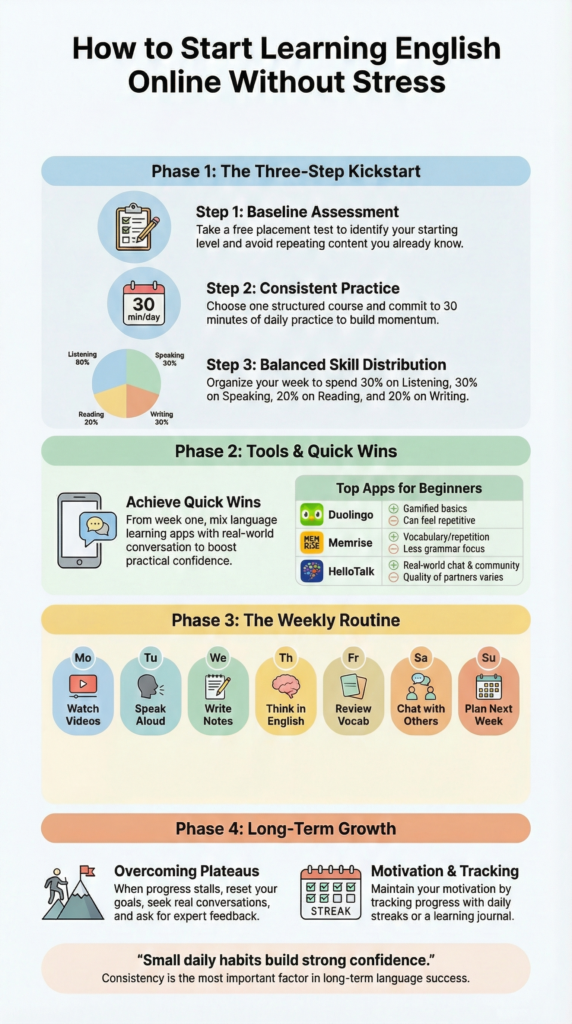
A simple weekly skill balance:
| Skill | Weekly Focus | Example Activity |
| Listening | 30% | Podcasts or slow news |
| Speaking | 30% | Shadowing or short conversations |
| Reading | 20% | Beginner stories |
| Writing | 20% | Daily journaling |
I kept the activities simple and repeatable:
- Podcasts or slow news for listening
- Shadowing and short chats for speaking
- Beginner stories for reading
- A few journal lines for writing
Progress felt steadier this way. Nothing dramatic, just small gains that stayed with me. Over months, the skills began supporting each other naturally, and learning stopped feeling forced.
FAQ
How do beginner english lessons online help absolute starters?
Beginner english lessons online give new learners a clear place to start. Most lessons begin with the english alphabet for non native learners, simple english sentences practice, and slow listening activities.
Many also include a beginner english placement test and CEFR A1 English resources. These tools guide you step by step so you can build confidence without feeling confused or overwhelmed early on.
What daily english practice routine works best for beginners?
A simple daily english practice routine works better than long, exhausting study sessions. Many beginners combine english listening podcasts free, journal in english daily habits, and short english pronunciation practice online drills.
Recording yourself with a voice recorder english practice tool helps you notice mistakes. Consistency matters more than intensity when you want steady progress and long-term confidence.
Are there free english courses for starters that actually work?
Yes, free english courses for starters can work if they follow a structured english course online format. Look for self-paced english lessons that include online english grammar basics, beginner english reading materials, and interactive english quizzes.
Many programs also offer a free english workbook PDF for review. These resources help you learn in a clear order without needing paid materials.
How can I practice speaking if I study English alone?
You can still practice speaking even if you study alone. Many learners use an english conversation practice app, try the english shadowing technique, or record short talks using a voice recorder english practice habit.
Some people also join a tandem language partner english exchange or language exchange chat english groups. These methods build confidence and help you speak more naturally over time.
What helps beginners stay motivated learning English online?
Motivation grows when you can see your progress clearly. Many learners try a 30 day english challenge, set weekly english goals beginners, or keep an english progress journal template.
Using a simple english habit tracker helps you stay consistent and avoid burnout language learning. Small, visible wins make the journey feel manageable and help you keep going.
Build Confidence as You Start Learning English Online
Starting English online is not about speed, it is about commitment. You will feel unsure, you may want quicker results, but real confidence is built when you show up daily and speak before you feel ready. Are you waiting to feel perfect, or are you willing to grow through practice? Small habits shape strong voices, and every ordinary day you continue, you become more capable.
At Ivy Languages International, we guide you step by step with structure, patience, and care. Do not let doubt delay your progress. Choose steady action, trust the process, and begin today with support that believes in you.
References
- https://www.edutopia.org/article/english-learners-primary-language-school/
- https://www.pearson.com/languages/community/blogs/overcoming-language-learning-plateaus-1-24.html
Related Articles
- https://ivylanguagesinternational.com/why-choose-online-english-tutoring/
- https://ivylanguagesinternational.com/english-for-beginners-starter-strategies/
- https://ivylanguagesinternational.com/comparing-apps-versus-private-tutors