
Tips
Establishing a daily English study routine works when it stays short, steady, and repeated, even on days when energy is low. I learned this during a time when I was balancing work, family, and limited time to study. I often planned long sessions, but I could not sustain them.
What finally helped was showing up for twenty minutes each day. Over time, that steady effort built real progress. At Ivy Languages International, we shaped our approach from this experience. We focused on simple routines that fit into daily life, not ideal schedules. If you are trying to build something that lasts, keep reading.
Simple Wins for a Daily English Study Routine That Lasts
These points reflect what actually works in real life when building a routine you can maintain over time.
- A daily English study routine works best at 15–30 minutes per day, repeated consistently.
- Combining listening, speaking, reading, and writing builds faster and more balanced fluency.
- Small, flexible routines survive busy schedules better than long, rigid plans.
What Is a Daily English Study Routine and Why Does It Work?

A daily English study routine is a short, repeatable plan you practice every day. It improves retention through consistent exposure and habit. I learned early that studying English once or twice a week never worked. I would forget words, lose confidence, and feel like I was starting over each time.
The British Council (2023) notes that consistent daily exposure improves retention by over 40%. This explains why short routines beat long, irregular sessions.
A repeatable routine means following the same structure daily, even if the content changes. It builds familiarity, cuts down on daily decisions, and strengthens memory through simple repetition. Before we look at the components, it helps to understand what makes a routine last in a real, busy life.
This structure matters because consistency depends on simplicity.
- A routine should take 20–30 minutes
- It should follow the same order daily
- It should fit into habits you already have
- It should not depend on feeling motivated
I saw progress only when I stopped trying to study perfectly and started showing up daily, even when my energy was low and I only managed ten minutes.
How Much Daily Study Time Is Actually Enough?
Most learners improve with 15–30 minutes daily, especially if broken into smaller sessions across the day. I used to think I needed one full hour every day. That belief made me stop after a few days because it never fit my actual schedule.
Research from Cambridge English (2022) shows that shorter, frequent sessions improve long-term recall by over 30%, particularly when spaced out.
I noticed the same thing. Ten minutes in the morning, ten during a lunch break, and ten in the evening felt manageable. It was something I could actually repeat. Before comparing study styles, it helps to see how sustainability affects results over weeks and months.
This comparison shows why shorter routines last longer and lead to better outcomes in the end.
| Study Style | Sustainability | Results |
| 1 hour/day | Low | Drop-off in 1 week |
| 20–30 min/day | High | Steady improvement |
| 10 min x 3 sessions | Very high | Strong retention |
I learned that the goal wasn’t to study more, but to study regularly without stopping. The habit itself was the victory.
What Should a Balanced Daily English Routine Include?
A strong routine includes listening, speaking, reading, writing, and vocabulary to build full communication ability.
For a long time, I focused only on reading and grammar. It felt safer. Over time, I realized I could understand English but couldn’t speak comfortably in a conversation. That gap often connects to hesitation, something I later understood better while working through the challenge of overcoming fear of speaking English in daily practice.
The CEFR framework indicates that balanced skill practice improves fluency development by about 35%. This matched what I experienced slowly over the years.
Each skill plays a different role. Skipping one creates gaps that slow everything down. Before breaking down each skill, it helps to understand why balance matters in something you do every day.
Each skill strengthens a different part of communication, so combining them builds real, usable fluency.
- Listening improves your understanding of real, fast speech.
- Speaking builds the confidence and muscle memory for fluency.
- Reading expands your vocabulary and sense of structure.
- Writing improves your accuracy and clarity of thought.
The biggest shift for me came when I started including even a tiny bit of speaking and writing practice every single day, not just on weekends.
What Does a 30-Minute Daily English Routine Look Like?
Credits: MyEnglishVeryBad
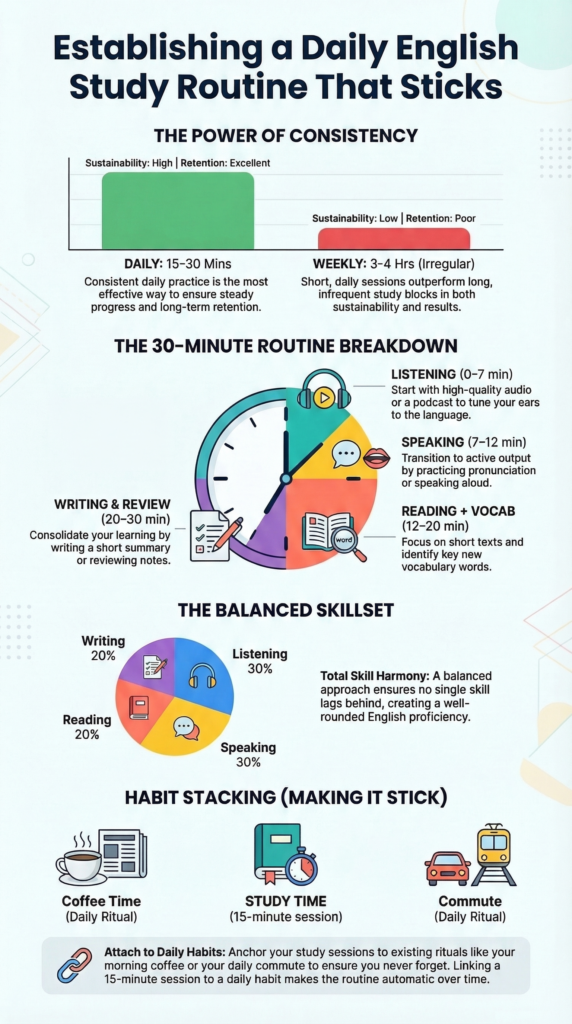
A simple 30-minute routine includes listening, speaking, reading, vocabulary, and writing in short, focused blocks.
I built my routine slowly. I started with just a few minutes per activity, then adjusted based on what I could actually sustain day after day. In the early stage, I needed a clearer structure. It came from applying simple ideas similar to English for beginners starter strategies that focus on small, repeatable actions instead of complex plans.
According to British Council learning models, structured routines increase engagement by about 25%, especially when the tasks are clear and repeatable.
I found that a clear structure removed the daily stress of deciding what to study. Before looking at the full routine, understand that flexibility matters more than perfect execution.
This example shows a balanced structure you can adjust based on your time and energy.
- 0–7 minutes: Listen to a short podcast or news clip.
- 7–12 minutes: Practice speaking or repeat sentences aloud.
- 12–20 minutes: Read a short article and learn 3–7 new words.
- 20–30 minutes: Write a short paragraph or review old vocabulary.
I focused on understanding the main idea rather than every single word. This reduced frustration and helped me stay consistent.
Why Do Most Daily English Routines Fail After a Few Days?
Most routines fail because they demand too much time or mental energy, making them hard to maintain. I experienced this many times. I would create detailed plans that looked perfect on paper, but they did not survive real life, a busy day, a headache, or simple tiredness.
At one point, I realized I had skipped an important step, which was understanding how to start learning English online in a way that actually fits daily life. Research from University College London (2021) shows that habit drop-off often happens within 3–7 days when routines exceed realistic limits.
I also noticed that routines without a fixed time often got postponed. “I’ll do it later” usually meant it didn’t get done. Before identifying solutions, it’s useful to understand the most common breaking points.
These patterns appear repeatedly across learners and explain why consistency breaks.
- Planning for 1–2 hours daily
- Having no fixed study time
- Relying only on textbooks
- Ignoring your own fatigue and schedule changes
I realized consistency depends on designing a routine for your most difficult days, not your perfect ones.
How Can You Design a Routine That Survives a Busy Schedule?

A sustainable routine fits into existing habits and uses fixed time blocks that don’t change. I stopped trying to magically create new time for English. Instead, I attached it to activities I already did daily, like my morning coffee or commute.
As highlighted by British Council
“The secret to learning a language when you’re busy, is to make sure you’re using all of your ‘dead time’ – in the car, on the metro, walking down the street. Spend some time gathering material that is perfect for those situations, and you’ll be able to spend much more time each day learning English.” – British Council
The habit-stacking method, discussed by James Clear, can increase consistency rates by 2–3 times.
I used this by connecting English practice to simple, automatic daily actions. Before building a routine, identify natural moments in your day where English can fit without much effort.
These anchor points make the routine automatic and reduce the need for willpower.
- Morning coffee → vocabulary review
- Commute → listening practice
- Lunch break → reading
- Evening wind-down → writing or speaking
I also treated one time block as non-negotiable. Even on the worst day, I’d do five minutes just to keep the chain going.
What Tools Actually Help Maintain a Daily English Routine?
Simple tools support repetition and tracking, making daily practice easier to maintain over time.
I tested many apps and platforms. I found that using one or two tools consistently worked far better than switching between ten different ones.
Insights from University of Cambridge indicate
“Use timetables and planners: These are useful tools for students to plan their day, keep track of what they are working on and know what’s coming next. […] Introduce time management techniques to support focus and reduce distraction. […] older students might like the Pomodoro Technique or to share strategies on how to manage distractions from devices.” – University of Cambridge
Spaced repetition systems like Anki and Quizlet can improve vocabulary retention by up to 80%, based on SuperMemo research.
I used a flashcard app to review words daily. Before choosing tools, focus on function over variety. Each tool should support one specific part of your routine.
- Vocabulary → a simple flashcard app
- Grammar → a book or site with structured exercises
- Speaking → your phone’s voice recorder
- Writing → a notepad for short daily paragraphs
For structured guidance, we built programs at Ivy League International on these same principles: consistency and simplicity, not complexity.
How Do Successful Learners Structure Weekly Variation Without Breaking Consistency?
There was a point when my routine started to feel too heavy. I was showing up every day, but the energy was fading. I realized the issue was not consistency, it was intensity. I was trying to do everything at full effort, every single day.
Over time, I made a small shift. I kept the habit, but I changed how hard each day felt. That made a quiet difference. Before adding variation, I learned one thing matters most: the routine itself should stay stable. The time, the place, the trigger, those do not move.
Here is what my week began to look like:
- Monday to Thursday → full routine, focused study and speaking practice
- Friday → lighter session, mostly listening and simple review
- Weekend → relaxed exposure, like watching a movie or casual conversation
This approach gave me space to breathe without breaking momentum. I stopped dreading study time. The routine felt steady again, something I could carry forward. If your routine feels heavy, you may not need less discipline. You may just need a rhythm that you can live with, day after day.
How Do You Combine Active Study With Passive Exposure Effectively?
I remember a time when I relied only on podcasts. I would listen during my commute and expect my English to improve on its own. After a few weeks, I noticed something was missing. I could understand more, but I still struggled to speak.
That was when I realized listening alone was not enough. I needed to balance it with active effort. I started to see my day differently. English was not just a study session anymore. It became something I stayed close to throughout the day.
Here is how I began to separate the two:
- Active study → speaking out loud, writing short sentences, reviewing vocabulary with focus
- Passive exposure → listening to podcasts, watching videos, playing English audio in the background
At first, I treated them as equal, but that was not quite right. Passive exposure helped me get familiar with the sound and rhythm. Active study helped me use the language.
Over time, I made sure they supported each other. What I listened to during the day often came back in my practice later. If you are building your routine, try not to choose one over the other. Use both, and let them grow together.
What Is The Simplest Routine You Can Start Today?
I remember coming home late one evening, too tired to study. I almost skipped it. That moment made something clear to me. If the routine felt too big, I would keep avoiding it.
So I made it smaller. Much smaller than I thought was “enough”. I stopped trying to do everything at once. Instead, I focused on showing up every day, even on the worst days. The goal was not progress in one session, but continuity over time.
Here is the simple routine I started with:
- 5 minutes → listen to a slow English podcast, just to get used to the sound
- 5 minutes → speak out loud, even if I only repeated simple phrases
- 5 minutes → review a few words from the day before
At first, it felt almost too easy. I even questioned if it would work. But I kept going. What changed was not my skill overnight, but my consistency. I no longer had to force myself to begin.
If you are starting today, keep it small enough that you cannot say no. You can always grow it later, but the habit comes first.
FAQ
How do I build a daily english study routine that fits my schedule?
Start with a daily English study routine that fits your real schedule, not an ideal one. Choose a fixed time each day and keep it short. You can use micro English sessions during breaks if needed. A simple language learning schedule works better than long, irregular sessions. Focus on consistent English practice so the habit becomes part of your daily routine.
How can I stay consistent with my english learning routine every day?
You stay consistent by making your English learning routine easy to start. Keep each session short and clear. Use an English study tracker to monitor your progress and stay motivated. Set realistic English study goals and follow a simple plan. A steady daily English habit builds stronger results than long sessions that you cannot maintain.
What should I include in a balanced english study plan each day?
A balanced English study plan should include both active English practice and passive English listening. Practice speaking, listening, reading, and writing in small parts. Add a vocabulary routine and do grammar practice daily. This structure supports your overall progress and keeps your English study schedule practical and clear.
When is the best time to study english every day?
The best time depends on your daily energy and schedule. Some people prefer a morning English routine, while others choose evening English study after work. You can also include short English practice during breaks. The key is to choose a time you can follow every day so your English study discipline becomes consistent.
How do I use passive and active methods in daily english practice?
Use passive English listening during simple activities such as commuting or doing chores. Then include active English practice by speaking, writing, or reviewing vocabulary. This combination creates daily English immersion and improves both understanding and response. Over time, this method strengthens your English study system and helps you progress steadily.
Build a Routine You Can Actually Keep
You sit down to study, then miss a day and feel like you’re starting over again. It’s frustrating. That’s normal. We keep things simple at Ivy Language International with routines that fit your real day, so you can stay consistent without pressure.
You don’t need long study hours, just steady effort that builds over time. Ready to start small and keep going with us? Start building your daily English routine.
References
- https://englishonline.britishcouncil.org/blog/articles/how-to-learn-english-busy-schedule/
- https://blog.cambridgeinternational.org/overcoming-distraction/
Related Articles
- https://ivylanguagesinternational.com/overcoming-fear-of-speaking-english/
- https://ivylanguagesinternational.com/english-for-beginners-starter-strategies/
- https://ivylanguagesinternational.com/how-to-start-learning-english-online/