
Tips
Essential vocabulary for English beginners can carry you through most daily conversations with just 100 to 300 words. I learned this slowly, after months of trying to memorize long lists that never stayed with me.
I remember standing at a small café, knowing many words on paper but struggling to order a simple drink. That gap showed me what really mattered. When I shifted to words people actually use every day, progress felt steady and less heavy. Small, useful words began to work in real moments. If you want a path that feels practical and sustainable, keep reading.
Core Insights: Essential Vocabulary for English Beginners
These points capture the main idea: focus on useful words, use them often, and build skill through real practice.
- Knowing 100 to 300 core words can cover up to 70–90% of daily conversations, which matches the CEFR A1-A2 guidelines.
- Grouping words into categories, like food or actions, helps you build sentences faster with less confusion.
- Practicing words inside simple sentences improves your memory much more than staring at a list.
What Are the Most Essential English Words for Beginners?

The most useful words are the ones you hear and use every single day. According to the CEFR, these high-frequency words let beginners manage 70–90% of basic conversations.
I made the mistake of skipping them. Early on, I wanted to sound smart, so I memorized words like “approximately” and “nevertheless.” When I tried to talk, my mind went blank. I couldn’t say what I needed. Progress only happened when I went back to basics.
These core words are simple, but they carry the conversation. “House,” “eat,” “go,” “thank you.” You will use them constantly. They help you speak sooner, even with limited knowledge.
We also found that learning fewer words with a clear purpose helped us remember them. Instead of memorizing two hundred random terms in a week, we focused on thirty words about food, then used them to order lunch. That made them stick.
A few principles guide this:
- Start with greetings, common verbs, and everyday nouns.
- Choose words you will actually use today or tomorrow.
- Practice putting them into a sentence immediately, not just remembering the translation.
This approach keeps learning practical. It’s grounded in real communication, not just memorization.
Which Vocabulary Categories Should Beginners Learn First?
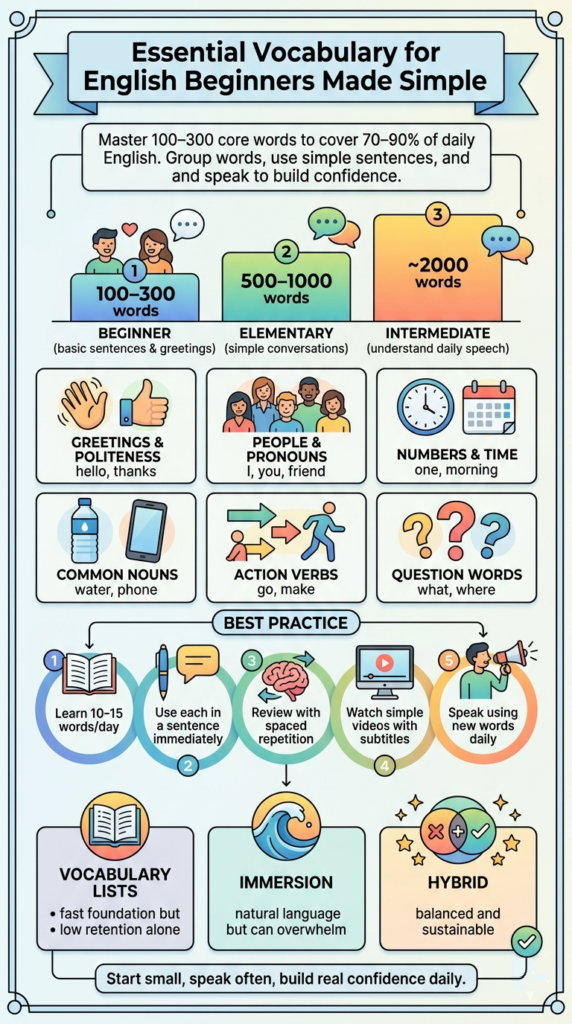
Start with six basic categories. This method, supported by BBC Learning English, lets you build sentences with fewer than 300 words.
I learned this through messy trial and error. My notes were full of random words, “elephant” next to “insurance.” It was confusing and hard to use. When I began sorting words into groups, everything became clearer. Over time, I realized this approach aligns closely with proven methods found in practical tips for English beginners.
Each category has a job. Together, they let you form complete thoughts, even simple ones. This structure helps you stop translating word-by-word in your head.
Here is why grouping matters: it creates patterns. Your brain starts to connect “I” with “eat” with “food.” The categories work because they cover daily life.
- Greetings and politeness: hello, thanks, excuse me, sorry.
- People and pronouns: I, you, we, she, friend, teacher.
- Numbers and time: one, ten, today, morning, now.
- Common nouns: water, home, book, phone, money.
- Action verbs: go, see, make, have, want.
- Question words: what, where, who, how.
With just these groups, you can greet someone, ask a simple question, and understand the answer. Over time, this builds real confidence and cuts down on hesitation.
How Many Words Do You Actually Need to Start Speaking English?
You can start basic communication with about 100 to 300 words. For broader understanding, aim for 2000 words, a common topic in Reddit language learning communities.
In a recent analysis by Oxford University Press (OUP)
“Corpus analysis shows that about 800 to 1,000 lemmas [word families] are enough to understand 75% of everyday English… Knowledge of the 3,000 most frequent words in English gives learners a very high coverage of the words they are likely to see and hear.” – Teaching English with Oxford
I thought I needed thousands of words before I could say anything. That belief held me back for months. In reality, I had my first real conversation knowing maybe 150 words. It was slow and simple, but it worked. That moment changed my approach completely.
To see the path clearly, look at these general milestones:
| Level | Word Count | What You Can Do |
| Beginner | 100–300 | Basic sentences and greetings |
| Elementary | 500–1000 | Simple conversations |
| Intermediate | ~2000 | Understand most daily speech |
A common problem happens here. People memorize words but still can’t speak. The issue isn’t the number, it’s the practice.
- Memorizing a word is different from using it.
- Context, hearing and using the word in a sentence, is what builds recall.
- Using words, even incorrectly, builds more confidence than perfect flashcards.
This perspective keeps expectations real. Focus on progress, not on knowing every word.
Why Do Most Vocabulary Lists Fail Beginners?
Credits: linguamarina
Most lists fail because they teach words in isolation. Without context, learners forget over 50% of those words within days, a frequent topic in YouTube learning communities.
The problem wasn’t my effort. It was the method. A word like “expensive” on a flashcard is just a definition. But the sentence “This coffee is expensive” gives it life and connection. Without that, memory fades.
Another issue was passive repetition. I’d review flashcards but never say the words aloud or try to use them. They remained separate from my ability to speak.
The main causes are usually the same for many learners:
- Memorizing without ever using the words in your own sentences.
- Treating vocabulary as a separate task from listening and speaking.
- Relying only on apps that focus on recognition, not production.
I’ve heard the same stories from others.
- “I knew the word for ‘menu’ but froze when the waiter asked for my order.”
- Burnout from trying to maintain a perfect daily streak on an app.
- A drawer full of flashcards that never translated to real conversation.
The shift happens when you start using words, even clumsily, in real situations. That’s when vocabulary becomes yours.
What Is the Best Way to Practice Beginner Vocabulary Daily?
The best method mixes spaced repetition, making your own sentences, and getting real input. This can improve retention by up to 80%, a finding seen in Anki-based learning studies.
My own routine came from trial and consistency. It wasn’t perfect, but it became reliable. Small daily steps made a clear difference. I later found that many of these habits reflect common English for beginners starter strategies.
At first, I tried to learn 30 new words a day. I burned out quickly. Cutting it to 10 or 15 made the task manageable and let me focus on using them.
A clear structure removes the daily guesswork. Here’s a simple process:
- Learn 10 to 15 new, useful words.
- Immediately use each one in a simple sentence you write or say.
- Review them using a spaced repetition system to fight forgetting.
- Watch a short, simple English video to hear the words used naturally.
I used a few basic tools to support this.
- A flashcard app like Anki for smart review scheduling.
- Short YouTube videos with subtitles for listening practice.
- Speaking exercises where I’d describe my day using my new words.
The key lesson was that frequency beats difficulty. The words I used most often, like “need,” “work,” “good”, stayed with me without effort.
Should You Learn Vocabulary Lists or Through Immersion?
A hybrid approach works best. Beginners need a base of 100–300 words before pure immersion becomes helpful, as Preply tutors and experts often note.
I tried both extremes. Lists alone felt rigid and disconnected from real life. Jumping into English movies with no foundation was overwhelming and discouraging. Combining them created balance. This kind of balanced path also reflects how many learners begin learning English online step by step, starting small before expanding exposure.
Lists gave me a starter toolkit. Immersion showed me how those tools were actually used by people. Together, they supported steady, understandable progress.
To see the difference, compare the methods.
| Method | Pros | Cons |
| Vocabulary Lists | Builds a fast foundation | Low long-term retention alone |
| Immersion | Teaches natural language | Can be confusing and frustrating at first |
| Hybrid Approach | Balanced and sustainable | Requires you to be consistent |
Before applying this, focus on practical habits.
- Start with a structured list of high-frequency words.
- Add simple listening practice, like songs or slow news, very early on.
- Don’t stay in the memorization phase for too long; force yourself to speak or write quickly.
This balance keeps learning active and connected to real communication.
How Can Beginners Turn Vocabulary Into Real Conversations?
You can form real conversations using simple sentence patterns and about 150 words, which aligns with CEFR A1 speaking goals.
Research from ResearchGate / Journal of Applied Linguistics shows
“One strategy to teach speaking skills is using minimal responses. Very shy students or beginners can gain confidence by this strategy. A stock of minimal responses must be built and provided to the students to use in different types of exchanges… like greetings, compliments, [and] invitations which follow a pattern.” – ResearchGate
I remember my first full sentence. It was “I need water”. That moment showed me that vocabulary only becomes useful when you apply it.
We practiced a few basic patterns over and over. With time, they became automatic. This reduced the long pauses in conversation.
Structure matters much more than complexity. Start with these frames:
- I + verb + object → I eat bread.
- This is + noun → This is my bag.
- Question word + verb → Where is the station?
We practiced with simple examples every day.
- I am tired.
- She has a cat.
- What is that?
- How much is this?
Saying these sentences out loud was crucial. It trained my memory, my mouth, and my confidence all at once.
What Tools Help Beginners Retain Vocabulary Without Burnout?
Tools that focus on context and smart repetition reduce burnout. This is a common concern among Duolingo users who chase streaks. I felt that burnout early. Maintaining a 100-day streak felt good, but soon I was just tapping screens to keep the number going, not really learning. The pressure took the joy out of it.
We adjusted by choosing tools that supported understanding, not just gamification. This made learning sustainable.
First, recognize common mistakes.
- Prioritizing a perfect streak over actual comprehension.
- Only using apps and ignoring listening or speaking.
- Setting a daily goal of 50 new words, which is unrealistic.
We shifted to more balanced tools.
- Flashcards like Anki for efficient review.
- Video lessons from sources like BBC Learning English for context.
- Simple speaking practice, even just talking to myself.
We also changed our daily approach.
- Learn fewer words, but use them repeatedly.
- Always mix listening, reading, and speaking in a session.
- Value consistency, 10 minutes daily, over marathon weekend sessions.
This created a stable habit I could maintain for the long term, without dreading it.
FAQ
What basic English words should beginners learn first?
Start with basic English words that appear in daily life. Focus on high frequency words such as greetings in English, simple English nouns, and essential verbs for beginners. Add pronouns for beginners, articles English a an the, and question words English. A strong beginner vocabulary list should include common English terms used in simple sentences English for clear, everyday communication.
How do I build a beginner vocabulary list that works?
Build a beginner vocabulary list by grouping high frequency words into clear themes such as family vocabulary English, food words beginners, and house items English. Include everyday English phrases, an action verbs list, and beginner adjectives English.
Use word lists printable or flashcards vocabulary, and review them using spaced repetition words to improve memory techniques words through consistent daily practice.
Which everyday English phrases help in daily conversations?
Everyday English phrases such as greetings in English, polite expressions English, and small talk phrases help you speak more naturally. Add conversation starters English, asking directions, and ordering food phrases for real situations.
Practice yes no answers, polite requests, and thanks expressions. These common English terms support simple sentences English during daily routine words and real conversations.
How can I remember essential verbs for beginners easily?
Use context learning words and the immersion technique English to remember essential verbs for beginners more effectively. Practice with simple sentences English using present tense verbs, past simple words, and future going to forms.
Apply spaced repetition words, mnemonics memory English, and grouping words themes. Shadow technique vocab and speaking practice terms help you use verbs actively and retain them longer.
What tools help learn core vocabulary English faster?
Use flashcards apps English, anki decks beginners, or quizlet sets English to study core vocabulary English efficiently. Combine audio pronunciation beginners with clear pronunciation guides to improve accuracy.
Try picture dictionaries, graded readers vocab, and subtitle learning English for context. Spaced repetition words, visual aids learning, and association techniques support long-term retention of a1 level words and cefr beginner terms.
Keep Going, Even When It Feels Slow
You can feel stuck when new words don’t come out right and you keep repeating the same mistakes. It gets frustrating fast. But that’s how this works. If you want progress that actually lasts, Ivy Language International helps you build simple habits through daily use.
We don’t need speed, we need consistency that fits real life. Ready to move forward with us? Start now with Ivy Language International and turn small practice into real confidence.
References
- https://teachingenglishwithoxford.oup.com/2021/02/04/assessment-word-lists/
- https://www.researchgate.net/publication/393607766_New_Strategies_for_Developing_and_Enhancing_English_Speaking_Skills_among_Students_An_Exploratory_Study
Related Articles
- https://ivylanguagesinternational.com/best-tips-for-english-beginners/
- https://ivylanguagesinternational.com/english-for-beginners-starter-strategies/
- https://ivylanguagesinternational.com/how-to-start-learning-english-online/