
Tips
How to practice English pronunciation alone begins, in my experience, with a simple daily loop: listen, repeat, and check. We learned this after months of sitting in a small room, replaying the same words, unsure if We was improving or just repeating mistakes. That uncertainty stayed with me for a while.
At Ivy League International, we often see learners face the same quiet doubt. What helped me was narrowing the focus to one sound and one short recording each morning. Progress felt slower, but it became clearer and more steady over time. Keep reading to see how this approach can support your practice.
Daily Pronunciation Habits That Actually Work
A simple daily system, built on repetition and feedback, helps you improve pronunciation alone with steady, realistic progress.
- Short daily practice of 10–30 minutes builds stronger pronunciation habits than long, irregular sessions
- Combining shadowing, recording, and mirror work creates a complete feedback loop
- Tracking mistakes and repeating targeted drills leads to steady improvement over time
What Is the Most Effective Way to Practice English Pronunciation Alone?

The best method is a short daily loop. You listen, you mimic, and you listen to yourself. Aim for 10 to 30 minutes. Research and our students’ results show that 15 minutes every day improves clarity more than an hour once a week.
At Ivy League International, we focus on this repetition. It’s not glamorous. You copy a short audio clip, record your own voice, and compare. You do it again the next day. Over weeks, the awkwardness fades. The rhythm starts to stick.
This loop becomes even more effective when paired with a strong foundation in essential vocabulary for English beginners. Since familiar words are easier to pronounce accurately and repeat with confidence.
Each one trains a different skill.
- Shadowing trains your ear and your flow. You learn how sentences connect.
- Recording is your honest mirror. It shows you the gap between what you feel and what you hear.
- Mirror work fixes the physical part. You see if your tongue is in the right place.
Your focus scatters. A brief, focused practice embeds the memory deeper. Learners in online forums often say the same thing: consistency with ten-minute drills changed their speech more than any weekend marathon.
How Does Shadowing Improve Pronunciation Fast?
Shadowing trains the music of English, the rhythm, the stress, the ups and downs. Many learners notice better fluency in about a month.
We first tried it with a news broadcast. It was a mess. The speaker was too fast, and We gave up after a minute. We learned to start much smaller. A thirty-second clip from a podcast was manageable. I’d listen once just to hear it. Then I’d play it again and try to speak along, almost like an echo.
This kind of repetition works best when combined with solid English for beginners (starter strategies), because clear structure helps you follow the rhythm without feeling lost.
Our approach at Ivy League International is to keep it simple and sustainable.
- Pick a very short clip, just 30 to 60 seconds long.
- Listen to it once all the way through.
- Play it again and try to speak with it, immediately after you hear each phrase.
- Repeat this 3 to 5 times, and record your last attempt.
To stay engaged, switch your source material. Use a slow podcast one day, a clear YouTube teacher the next, or a bit of movie dialogue you like.
Why Recording Yourself Is the Most Critical Feedback Tool
Recording your own voice is the fastest way to see your real mistakes. Learners who do this regularly improve their clarity much quicker, sometimes up to 30% faster, because they can compare directly to a native model.
We’ll never forget the first time I listened back to a recording. That moment was uncomfortable, but it was the truth We needed. Without the recording, I would have kept making the same error, unaware.
You speak, you listen, you see the gap. It turns practice from a guessing game into targeted work. Research from the National Institutes of Health supports the power of auditory self-feedback for improving speech accuracy.
At Ivy League International, we make recording a non-negotiable daily step. This becomes even more effective when paired with a clear understanding of sentence structure, as seen in mastering basic English grammar rules.
The process is straightforward:
- Read a paragraph aloud for a few minutes each day.
- Record it on your phone.
- Listen back immediately, and then listen to a native speaker reading the same text.
The biggest traps to avoid are only practicing out loud without recording, or listening to your recording once and moving on without comparing. The value is in the side-by-side comparison.
How Can Mirror Practice Fix Difficult Sounds?
Mirror practice helps you correct sounds by showing you what your mouth is doing wrong. For tricky sounds like “th” or the American “r,” many learners see improvement after two or three weeks of focused visual checks.
We struggled with the “th” sound for years. We could hear it was wrong, but We couldn’t feel how to fix it. Standing in front of the bathroom mirror, We finally saw the problem.
Pronunciation is physical. The mirror gives you direct feedback on that mechanics. At Ivy League International, we break it down into simple movements. For the “th” in “think,” the tip of your tongue must lightly touch your top teeth. For the American “r,” your lips need to round slightly and pull back. It feels exaggerated at first.
One day, watch your lip shape for long vowel sounds like “ee.” Another day, focus on how wide your jaw opens for a sound like “ah.” With daily repetition, these conscious movements become automatic, and the correct sound starts to come out without you thinking about it.
What Are the Best Daily Drills for Pronunciation?
The best daily drills are minimal pairs, tongue twisters, and narrating your day. Spending five to ten minutes on each one sharpens your accuracy.
We built my routine slowly. We used to try drilling every problem sound in one sitting. It was overwhelming and ineffective. I learned to pick just one, like confusing “ship” and “sheep”, and work on it for a week.
Drills give you control. They isolate a sound so you can repeat it until it feels natural. Before you start, choose your single target for the day. This makes the practice manageable and clear.
- Minimal pairs (like “bat” vs. “bet”) train your ear and mouth to hear and produce tiny differences.
- Tongue twisters (like “She sells seashells”) build agility and clarity when sounds are packed together.
- Daily narration is the practical test. Describe what you’re doing as you make coffee or commute.
We also encourage learners to weave practice into life. Talk to yourself about what you see out the window. Retell a simple story from your day, focusing on speaking slowly and clearly. These exercises bridge the gap between drill practice and real, flowing speech, turning knowledge into a reliable skill.
Are Apps Helpful or Overrated for Pronunciation Practice?
Apps like ELSA Speak can give quick feedback, but they have limits. Many learners find the AI helpful for initial correction, but say it can’t replace the deep awareness you get from self-recording and consistent practice.
We’ve tested several apps over the years. Some gave me a confidence boost with instant scores. Others would mark my clear pronunciation as wrong because of my accent’s rhythm. We realized they are tools, not teachers. They support practice but shouldn’t be the core of it.
At Ivy League International, we see apps as useful supplements. They’re good for getting started or for a quick check-in, but the real work happens in your own disciplined listening and repetition.
Here’s a simple comparison of the methods:
| Method | Strength | Limitation |
| Apps (ELSA) | Instant feedback | Can misjudge accent flow |
| Recording | Accurate self-analysis | Requires honesty |
| Shadowing | Builds natural rhythm | Less precise correction |
The most balanced approach is to use an app for a few minutes, then rely on your own recording and comparison for the main part of your practice session. This combines external feedback with your own developing critical ear.
What Does a 30-Minute Daily Practice Routine Look Like?
Credits: English with Yuliya
A balanced 30-minute routine splits time between reading aloud, shadowing, and mirror work. Consistent effort with this structure leads to noticeable improvement in about a month.
We built my routine through trial and error. Long sessions were unsustainable. This simple half-hour frame, broken into chunks, made daily practice something I could actually stick to.
As noted by Development of Foreign Language Learning Skills: Listening, Speaking, Reading and Writing
“Observe a clear exercise routine. For example, set aside 30 minutes in the morning to study vocabulary and grammar, practice listening at lunchtime, repeat the material that you mastered in the morning after work… it is better to practice for half an hour every day than 2 times a week for 1.5 hours.” – Neliti
First, set a fixed time. I do mine in the morning. The consistency removes the daily decision of “when.”
- First 10 minutes: Read a short article aloud and record it. Listen back once.
- Next 10 minutes: Shadow a 60-second audio clip. Repeat it 3-4 times until your version feels smoother.
- Last 10 minutes: Mirror practice. Focus on one difficult sound from your earlier recording. Watch your mouth form it correctly.
Once a week, I do a progress check. I listen to a recording from Monday and compare it to one from Friday. The small improvements, like a clearer “th” or better sentence rhythm, become the motivation to keep going. This routine builds progress steadily, without feeling like a burden.
Why Do Learners Struggle Practicing Alone (and How to Fix It)?
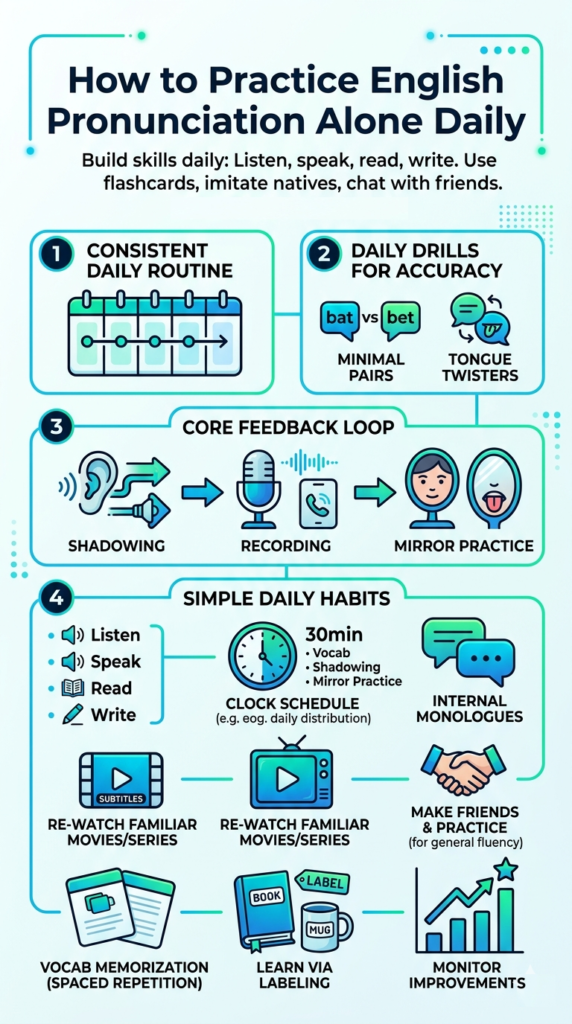
The main struggles are a lack of feedback and a clear plan. Without a teacher, it’s easy to feel lost or to practice mistakes without knowing. Combining self-recording with targeted drills solves this.
We know this frustration well. Speaking into the silence of my room, We had no idea if I was getting better. We’d hit a plateau and feel like giving up. The fix wasn’t finding a partner; it was building a personal system that provided its own feedback.
Insights from ELSA Speak Blog indicate
“One of the biggest challenges in how to learn pronunciation by yourself is not knowing whether you are pronouncing words correctly. Without feedback, it’s easy to repeat mistakes without realizing it… Record yourself reading a short paragraph or practicing a dialogue once a week. Save your recordings and listen back after a few weeks.” – ELSA Speak
The common challenges are universal:
- No one to correct you.
- Feeling silly speaking alone.
- Progress stalling after the first few weeks.
The solutions are practical:
- Create your own feedback loop: Listen (to a native), Mimic, Record, Compare. This cycle replaces the teacher.
- Focus narrowly: Work on only one pronunciation problem each week.
- Track it: Keep a simple log. Note the sound you’re working on and play last week’s recording.
This approach turns the solitude of solo practice into its greatest strength. You become your own most observant teacher.
Do You Need IPA to Improve Pronunciation Alone?
The International Phonetic Alphabet (IPA) can boost your accuracy by giving you a precise map of sounds. Learners who use it often fix stubborn errors more effectively, but it’s not essential for everyone.
We came to IPA late. At first, the symbols looked like a secret code. But when We was constantly mixing up sounds like /ɪ/ (in “sit”) and /i:/ (in “seat”), the IPA chart showed me the exact difference. It gave me a name and a target for each sound.
IPA helps you see what you can’t always hear. It provides a clear structure, removing the guesswork. However, it adds a layer of study.
Consider using IPA when:
- You have a persistent sound you can’t fix by ear alone.
- You want to understand the exact mechanics of vowel positions.
You can likely skip it for now if:
- You’re a complete beginner focused on basic conversation.
- Your goal is general fluency, not perfect phonetic accuracy.
Think of IPA as a powerful reference tool. You don’t need to memorize the whole chart on day one. Look up the specific symbols for the two sounds you’re confusing. Used this way, it becomes a precise helper, not an obstacle.
FAQ
How can I build English pronunciation practice without a partner?
I built English pronunciation practice by following a short, consistent daily routine. I used self-practice speaking methods such as the shadowing technique in English and simple solo pronunciation drills. I also recorded short clips to track progress and notice changes over time. This clear structure helped me stay focused and gradually improve fluency.
What are the best ways to check mistakes during self-practice speaking?
I checked mistakes by using record playback pronunciation to hear my speech clearly. I compared my voice with native audio through audio comparison native samples. I also kept a pronunciation journal to write down recurring errors. This self-feedback pronunciation method helped me improve stress rhythm practice and sentence intonation with better accuracy.
How do I fix difficult sounds like th sound or r l distinction alone?
I focused on a problem sounds list and practiced th sound practice and r l distinction step by step. I used mirror mouth movements and paid attention to tongue placement sounds. I also trained with minimal pairs training to hear small differences. This process helped me improve sound clarity and reduce repeated mistakes.
Can shadowing technique English improve fluency building alone?
I found the shadowing technique in English very effective for fluency building alone. I repeated short audio clips using podcast shadowing English and focused on intonation patterns and word stress. This method trained my listening and speaking at the same time. It improved my pacing and helped my speech sound more natural.
How do I stay consistent with a daily speaking routine alone?
I stayed consistent by following a simple 10 minute pronunciation plan each day. I tracked my progress in a pronunciation journal and used clear speech exercises and pacing speech practice. I focused on small, repeatable solo pronunciation drills. This approach helped me avoid burnout and maintain steady improvement over time.
Keep Practicing Until It Feels Natural
You record your voice and it doesn’t sound right, so you repeat the same words and still feel unsure. It’s frustrating. That’s normal. We keep things simple at Ivy Language International with daily pronunciation practice you can do on your own, so you build clarity and confidence over time.
You don’t need a perfect method, just steady repetition that works. Ready to keep improving with us? Start practicing your pronunciation today.
References
- https://media.neliti.com/media/publications/686763-development-of-foreign-language-learning-f5164aac.pdf
- https://blog.elsaspeak.com/en/how-to-learn-pronunciation-by-yourself-a-complete-guide/
Related Articles
- https://ivylanguagesinternational.com/essential-vocabulary-for-english-beginners/
- https://ivylanguagesinternational.com/english-for-beginners-starter-strategies/
- https://ivylanguagesinternational.com/mastering-basic-english-grammar-rules/