
Tips
Where to practice English conversation online depends on how much speaking time I need and what feels comfortable. I learned this after spending hours studying grammar and vocabulary, then freezing when someone asked me a simple question. I knew the words, but saying them was harder. I tried different online options and noticed that some gave me useful speaking time, while others did not.
Practicing alone also helped me feel less nervous before live conversations. Over time, I found that short, regular sessions worked best. With guidance from resources such as Ivy Languages International, I could build a routine that felt manageable. Keep reading for practical ways to practice consistently.
Quick Reads: Better English Speaking Habits
The main lesson is simple: consistent speaking practice matters more than finding one perfect platform.
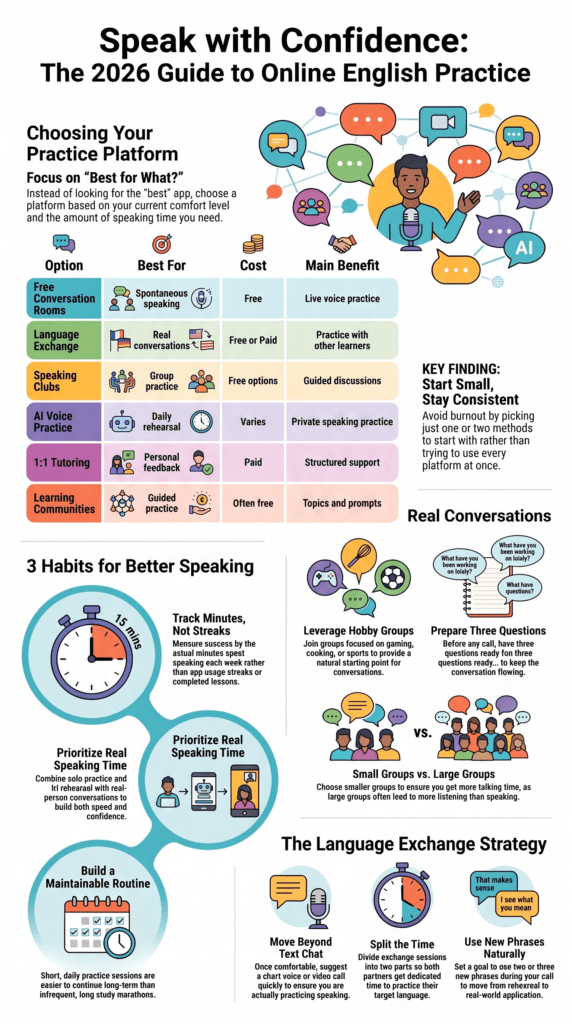
- Prioritize real speaking time: Combine solo practice, AI rehearsal, and conversations with real people to build confidence and speaking speed.
- Track the minutes you speak: Weekly speaking time gives me a clearer picture of my progress than app streaks, completed lessons, or exercises alone.
- Build a routine I can maintain: Short daily practice, regular conversation sessions, and useful topics make online English practice easier to continue.
Which online option is best for practicing English conversation?

The best option depends on how comfortable I feel speaking and how much time I can give to practice each week. I do not need to use every available platform or method. The right choice is the one that gives me regular chances to speak.
As noted by EdTechReview
“The honest question is not ‘which app is best?’ but ‘best for what?’” – EdTechReview
| Option | Best for | Cost | Main benefit |
| Free conversation rooms | Spontaneous speaking | Free | Live voice practice |
| Language exchange | Real conversations | Free or paid | Practice with other learners |
| Speaking clubs | Group practice | Free options | Guided discussions |
| AI voice practice | Daily rehearsal | Varies | Private speaking practice |
| 1:1 tutoring | Personal feedback | Paid | Structured support |
| Learning communities | Guided practice | Often free | Topics and prompts |
I usually start with one or two methods instead of trying everything at once.
My starting point is simple:
- Pick one place to speak.
- Set a weekly speaking target.
- Add feedback when I need it.
Then I focus on showing up regularly rather than constantly searching for a better platform.
Where can you practice English with real people for free?
Free conversation rooms, hobby groups, and online communities can give me real speaking practice without paying for lessons. They are useful when I want to get comfortable talking with people instead of only studying English.
When I first searched for online practice, finding English content was easy. Finding people who actually wanted to talk was harder. A good community can make that first step easier. It can also become a useful place for English conversation practice online when I want regular speaking time.
Hobby groups are especially useful because I already have something to discuss. I can talk about games, books, cooking, sports, technology, or other interests. The topic gives the conversation a natural starting point.
Before joining a group, I can prepare a few simple questions:
- What have you been working on lately?
- How did you get interested in this hobby?
- What would you recommend to a beginner?
I also look for groups with active voice channels or regular speaking sessions. Text chat can help, but it cannot replace time spent speaking.
Large groups have one drawback: I may spend most of the session listening. Smaller groups can give me more chances to talk.
Are language exchange communities useful?
Yes, especially when I want to practice English with real people. Language exchange communities give me a simple reason to start talking because everyone is there to learn or practice.
I can discuss hobbies, work, travel, food, or everyday life. Familiar topics make it easier to keep a conversation going, especially when I am still building confidence. Having a few questions ready also helps me keep conversations going when the discussion starts to slow down.
If my goal is speaking, I should not stay in text chat for too long. Once I feel comfortable, I can suggest a short voice or video call.
A simple approach is:
- Choose one familiar topic.
- Prepare three questions before the call.
- Ask the other person to correct important mistakes.
- Try to use two or three new phrases naturally.
I can also divide the conversation into two parts, with each person getting time to practice their target language.
The biggest challenge is consistency. Finding a good partner is useful, but regular practice matters more. I try to schedule conversations during the week instead of waiting until I feel motivated.
That way, speaking becomes part of my routine rather than something I do only when I happen to find a partner.
Which speaking clubs give more talking time?
Credits: Deliberate English
Smaller speaking groups can give me more opportunities to talk. That matters because joining a one-hour session does not mean I will speak for an hour.
In a large group, I may spend most of the session listening to other people. Listening is useful, but I still need enough time to form sentences, answer questions, and explain my ideas.
I usually compare groups by their format before joining. Different setups can work for different goals.
| Club type | Format | Best use |
| Speaking club | Group discussion | Regular practice |
| Small group | Guided talk | More speaking |
| Voice room | Open conversation | Spontaneous practice |
| Online session | Scheduled meeting | Regular interaction |
I also pay attention to whether everyone gets a chance to participate. A group with clear turns or discussion prompts may be easier for quieter speakers.
One or two club sessions each week can provide useful live practice. I can fill the gaps with shorter sessions on other days.
If I notice that I barely speak during a session, I do not automatically blame my English. I look for a smaller group where I can participate more.
Can structured lessons help me speak more confidently?
Yes. Structured lessons can help when I know English but struggle to decide what to say. Having a topic, prompt, or situation gives me something specific to work with.
I find topic-based practice useful because I can think about an answer before speaking. I can also record myself and listen for pauses, unclear sentences, or words I keep repeating. This kind of practice can support improving conversational English skills online when I need more structure around regular speaking.
A simple routine looks like this:
- Listen to a topic.
- Write down a few ideas.
- Record my answer.
- Listen to the recording.
- Try the answer again.
My first attempt may contain long pauses or awkward sentences. That is normal. The second attempt usually feels easier because I already know what I want to say.
I can also use structured lessons to prepare for situations I expect to face in real life, such as introductions, interviews, meetings, or everyday conversations.
This type of practice works best when I eventually take the language into real conversations. Preparation helps me feel ready, but actual interaction teaches me how to respond when the conversation changes unexpectedly.
Should you use AI before talking to real people?
Yes, especially when I feel nervous about making mistakes. AI gives me a private place to rehearse without worrying about another person’s reaction.
I can repeat an answer, change the situation, and try again until I feel more comfortable. This makes it useful when I know what I want to say but struggle to say it quickly.
I might use AI to practice situations such as:
- A job interview
- Small talk
- Ordering food
- Explaining my work
- Talking about a hobby
I can also ask for follow-up questions so the practice feels more like a real conversation.
Still, AI should not replace conversations with people. Real speakers interrupt, change subjects, use different accents, and sometimes speak faster than I expect. Those situations are harder to rehearse alone.
That is why I treat AI as preparation rather than my complete speaking routine. A short AI session can warm me up before a real call.
Then I can take the same topic into an actual conversation and see how well I handle it.
Why should you track speaking time?
I prefer tracking speaking minutes over app streaks because minutes tell me more about what I actually did. A streak can show that I opened an app, but it cannot tell me whether I spent five minutes speaking or fifty minutes listening.
Research from Frontiers in Education shows
“The correlation between classroom activity kinds and the duration of student speaking time is essential for enhancing fluency in spoken English.” – Frontiers in Education
I keep a simple record of my weekly practice:
| Practice type | Sessions | Approx. time |
| Solo speaking | 5 | 50 minutes |
| AI conversation | 4 | 60 minutes |
| Language exchange | 2 | 60 minutes |
| Speaking club | 1 | 45 minutes |
| Total | 12 | 215 minutes |
The numbers do not need to be perfect. I mainly want to see whether I am creating enough opportunities to speak.
I also record myself from time to time. Listening to an older recording can reveal changes I might not notice from one day to the next.
For example, I may notice fewer pauses, clearer sentences, or better use of everyday expressions.
Tracking practice also helps me spot weak weeks. If my speaking time drops, I can adjust my routine before several weeks pass without much practice.
How can you practice phrasal verbs through conversation?
I learn phrasal verbs more easily when I use them in situations that make sense to me. Memorizing long lists can help with recognition, but using the expressions in conversation makes them easier to recall later.
Instead of trying to learn twenty phrases at once, I choose a few common ones and build a short conversation around them.
For example, I might talk about a problem at work and use expressions such as “figure out,” “run into,” or “find out.” Because the phrases connect to a real situation, they are easier to remember.
A practical routine is:
- Pick three to five common phrasal verbs.
- Create personal examples.
- Use them in a short story.
- Repeat them during another conversation.
I do not worry about forcing every phrase into one conversation. The goal is to use them naturally.
I can also write down phrases I hear during real conversations and practice them later.
Over time, this helps turn passive vocabulary into language I can actually use when speaking instead of words I only recognize while reading.
What weekly routine can turn practice into progress?
I keep my speaking routine short enough to repeat. I do not need several hours of study every day. Regular speaking is more useful when I can actually maintain it.
A simple week might look like this:
- Monday to Friday: 10 minutes of solo speaking
- Three days: 10–15 minutes of AI conversation practice
- Two days: 30-minute language exchange
- One day: 45-minute speaking session
- Sunday: Review one short recording
I can also start smaller if this feels like too much. Even two minutes of speaking aloud is a useful first step.
For example, I can record myself talking about my day, rehearse the same topic with AI, and then use it in a real conversation. This gives me a clear path from private practice to live speaking.
If I miss a day, I do not need to start over. I simply continue the next day.
The goal is not to create a perfect schedule. It is to build a routine that gives me regular chances to speak, notice problems, and try again.
How should you choose a conversation platform?
I choose a conversation platform based on my current speaking level and how much support I need. A beginner may need clear prompts and slower conversations, while an advanced speaker may benefit from open discussions and unfamiliar topics.
My needs can change as my speaking improves, so I do not expect one platform to work forever.
| My need | Useful practice | Main goal |
| Beginner | Guided prompts | Build confidence |
| Shy speaker | Solo, AI, voice | Reduce hesitation |
| Intermediate | Exchanges, clubs | Extend conversations |
| Advanced | Open discussions | Handle harder topics |
| Busy schedule | Short sessions | Keep practicing |
I also check how much time I will actually get to speak. A large group may look active, but I might say very little.
Before committing to a platform, I think about whether its format matches my goal. If I need conversation practice, I want opportunities to answer, ask questions, and respond naturally.
Ivy Languages International can support learners who want more structure alongside independent practice. Still, I would judge any learning format by the actual speaking time and guidance it provides.
What should you do if online practice keeps failing?
I do not assume that poor progress means I am bad at English. Sometimes the practice method simply does not match what I need.
I might spend too much time messaging instead of speaking. I may join groups that are too large, or I might keep studying grammar because writing feels safer than talking.
When that happens, I change the setup instead of giving up.
A few simple changes can make practice more useful:
- Prepare one topic before a conversation.
- Keep three backup questions ready.
- Try smaller groups.
- Limit the number of platforms I use.
- Record short speaking sessions.
I also look at how much I actually speak. If I only talk for two minutes during an hour-long group, the problem may be the format rather than my ability.
Grammar still matters, especially when I need to correct repeated mistakes. But studying grammar should support speaking, not become a reason to avoid it.
The most useful change is often simple: create more opportunities to speak. A shorter conversation where I talk often may teach me more than a long session where I mostly listen.
How can Ivy Languages International support your next step?
Ivy Languages International can fit into a speaking routine when I need more structure, guidance, and practice around situations that feel difficult.
The first step is understanding what makes speaking hard for me. Maybe I struggle to form basic sentences. Maybe I understand English well but freeze when someone asks an unexpected question.
I can focus on practical situations that come up in everyday communication:
- Introducing myself
- Explaining a problem
- Asking for clarification
- Keeping a conversation going
These situations matter because real conversations rarely follow a script. I need to respond to what another person actually says.
I can also combine structured lessons with independent practice. A lesson can introduce useful language, while real conversations give me a chance to use it naturally.
I do not expect every session to feel easy. Some days I may speak smoothly, while other days I may pause or forget simple words. That does not mean I am moving backward. Progress can feel uneven when I am learning to speak more comfortably.
What matters is having a routine, using what I learn, and returning to practice regularly.
FAQ
How should I prepare for my first English conversation practice online?
Before my first session, I keep my preparation simple. I choose a familiar topic and write down a few useful words or phrases. I also prepare two or three questions in case the conversation slows down. For beginners, this can make English speaking practice online without a teacher feel less stressful. I focus on communicating clearly rather than sounding perfect.
How do I find English conversation partners who match my level?
I look for English conversation partners who have similar interests, goals, or speaking levels. A good match should make the conversation feel balanced rather than like an interview.
Beginners may prefer patient partners, while advanced learners can choose people who enjoy deeper discussions. I also consider time zones and availability. Regular practice is easier when both people have compatible schedules.
What should I do when I cannot remember a word while speaking?
I try not to stop the conversation when I forget a word. Instead, I explain the idea using simpler words, examples, or descriptions. This is an important part of English speaking practice techniques because real conversations rarely give me time to find the perfect word. After the session, I write down the missing words and practice using them in new sentences.
Is English speaking practice with native speakers necessary to improve?
Not always. English conversation practice with native speakers can help me hear natural expressions, different accents, and everyday phrases. However, I can also improve by speaking with other learners who communicate clearly. What matters most is getting enough speaking time and useful feedback. I choose conversation partners based on my goals rather than assuming one type of speaker is always better.
How can I make English speaking practice daily without getting bored?
I vary my English speaking practice daily so it does not feel repetitive. One day, I might describe my daily routine. Another day, I can discuss a familiar topic or retell a short story. I also switch between speaking drills, questions, and free conversation. Keeping sessions short helps me stay consistent without making practice feel like another task.
What Should We Remember About Building an English Speaking Routine?
A speaking routine works best when we can maintain it without feeling overwhelmed. We can start with a few minutes, use AI to rehearse, then practice with real people as our confidence grows.
Mistakes are normal, and each conversation gives us a chance to notice what needs work. The goal isn’t perfect practice, but steady use that fits our week. Ready to speak more consistently? Build your routine with Ivy Languages International
References
- https://www.edtechreview.in/reviews/best-english-speaking-apps-in-2026-which-one-fits-your-goal/?amp=1
- https://www.frontiersin.org/journals/education/articles/10.3389/feduc.2025.1639602
Related Articles
- https://ivylanguagesinternational.com/english-conversation-practice-online/
- https://ivylanguagesinternational.com/how-to-keep-conversations-going/
- https://ivylanguagesinternational.com/improving-conversational-English-skills-online/


Comments(03)