
Education
Improving conversational English skills online takes regular speaking practice, active listening, and patience. I learned that understanding English was easier than answering questions when I had little time to think. I often knew what I wanted to say but struggled to find the right words.
With practice, I began to see that speaking clearly takes time and repeated effort. Short daily sessions helped me build a routine without putting too much pressure on myself. At Ivy Languages International, we value steady progress and practical learning. Keep reading to find simple ways to make English speaking practice part of your daily life.
Quick Wins for Better English Conversations
Improving conversational English skills online becomes easier when we practice regularly, use practical phrases, and learn from our mistakes. These three habits can help us speak more clearly and feel more confident in everyday conversations.
- Build a daily speaking routine: Spend 15 minutes listening, speaking aloud, and reviewing one area for improvement.
- Use practical phrases and follow-up questions: Learn expressions for sharing opinions, asking for clarification, and keeping conversations going.
- Practice with different methods: Combine solo exercises, AI conversations, language exchanges, or online tutors to build fluency and receive useful feedback.
What Is the Most Effective Way to Improve Conversational English Online?
I have noticed that understanding English does not always make speaking easier. We might follow a video or read an article comfortably, yet struggle when someone asks what we think. I see this as a reminder that speaking needs its own practice. We cannot expect reading and listening alone to prepare us for every conversation.
I start with familiar subjects because they leave more room to focus on speaking. Work, family, meals, hobbies, and weekend plans are useful topics when we are building confidence.
A balanced routine can include several activities:
- Listen actively: Notice how speakers connect ideas, express opinions, and respond to questions.
- Speak aloud: Explain an idea without writing every sentence beforehand.
- Practice conversations: Answer unexpected questions and ask for clarification when needed.
- Review mistakes: Identify recurring problems and work on one at a time.
EnglishClub also discusses recording speech and narrating everyday activities as ways to practice independently. These exercises give us something useful to do between conversations.
I recommend starting with one minute of speaking about a familiar subject. Listen to the recording and try again with clearer wording. We need to express our ideas clearly and keep practicing.
Why Can We Understand English but Freeze When Speaking?

I understand how frustrating it feels to know what someone is asking but struggle to form an answer. We may recognize the words immediately, yet need several seconds to organize a response.
I have found that certain habits make speaking more difficult. We may translate every sentence from our first language, search for individual words, or worry about grammar before finishing an idea. Limited experience with unexpected questions can also leave us unsure about what to say.
Instead of trying to fix everything at once, I focus on familiar sentence patterns. One useful structure is to state an opinion, explain the reason, and add an example.
For instance, we might say, “I enjoy working from home because it’s quieter. I can usually focus better when I write reports. What about you?” We can use the same structure when discussing travel, education, or daily routines.
I also remind myself that speaking quickly is not the main goal. A clear answer matters more than a perfect sentence delivered immediately. When I make a mistake, I finish my thought and review it afterward. This approach helps me stay focused on communication rather than judging every word as I speak.
How Can a 15-Minute Daily Routine Improve Our Speaking?
Credits: Speak English with David & Alice
I prefer a short routine that fits into an ordinary day. Long study sessions can be useful, but they are difficult to maintain when work, family, and other responsibilities compete for our attention. Fifteen minutes gives us a realistic starting point and enough time to practice several connected skills.
I use a simple routine that moves from listening to speaking and review:
- Listen for five minutes. Choose a short interview, conversation, or audio clip. Focus on the main idea and notice one useful expression.
- Shadow for three minutes. Repeat selected sentences after the speaker. Pay attention to rhythm, word stress, and pronunciation.
- Speak for five minutes. Summarize what you heard or answer a related question in your own words.
- Review for two minutes. Notice one issue, such as repeated filler words, unclear pronunciation, or unfinished thoughts.
Speaking aloud is important because listening alone cannot show us how easily we form our own sentences. Recording our voices can reveal habits that we might otherwise overlook.
I recommend keeping each review simple. Choose one problem to address during the next session instead of correcting every sentence. As the routine becomes familiar, try new topics and gradually speak with fewer notes.
How Can We Practice Speaking English Without a Partner?
I used to think meaningful speaking practice required another person. Over time, I realized that individual exercises could help me prepare for conversations and identify where I needed more practice. They cannot replace every benefit of speaking with another person, but they make useful practice possible when schedules do not match.
As noted by University of the People
“Otherwise, you can always find someone online to digitally connect with and practice your conversation skills.” – University of the People
The main principle is simple: produce English aloud rather than rehearsing everything silently. We can describe ordinary activities, explain our opinions, or retell something we watched.
These exercises are easy to fit into a normal day:
- Describe your day: Explain what happened at work, what you are doing now, and what you plan to do later.
- Record a short answer: Speak for one minute about food, travel, family, or a hobby.
- Repeat a recording: Follow a speaker’s rhythm and pronunciation without trying to copy every detail perfectly.
- Practice voice notes: Ask yourself a question, pause briefly, and answer aloud.
- Use speaking prompts: Choose a topic and explain it through a personal example.
I make these exercises more useful by adding a follow-up question. For example, after explaining weekend plans, I might describe why I chose a particular activity and ask what someone else enjoys doing.
Changing the answer each time is important. Memorized scripts can help us begin, but flexible responses prepare us for real conversations. We can also explore where to practice English conversation online to find opportunities to speak with others when independent exercises are no longer enough.
Which English Conversation Phrases Should We Learn First?
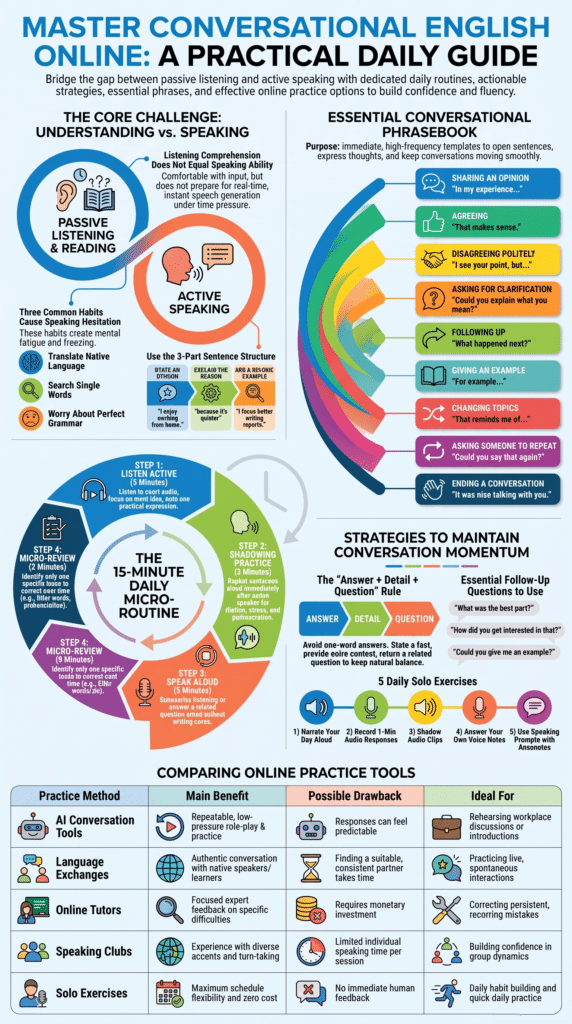
I have found that familiar expressions make conversations easier because they reduce the effort needed to begin a sentence. When we are searching for every word individually, even a simple response can feel difficult. Learning a few practical phrases gives us a starting point while we organize the rest of our thoughts.
| Conversation purpose | Useful phrase |
| Sharing an opinion | “In my experience…” |
| Agreeing | “That makes sense.” |
| Disagreeing politely | “I see your point, but…” |
| Asking for clarification | “Could you explain what you mean?” |
| Following up | “What happened next?” |
| Giving an example | “For example…” |
| Changing topics | “That reminds me of…” |
| Asking someone to repeat | “Could you say that again?” |
| Ending a conversation | “It was nice talking with you.” |
We can write an original example for each expression, say it aloud, and use it in different situations. Context matters, too. For instance, we might use “find out” when discussing new information or “give up” when explaining why we stopped an activity.
The aim is to recall expressions naturally, not simply recognize them in written exercises. As our confidence grows, we can use these phrases to discuss more complex subjects and explore topics for advanced English conversation.
How Can Follow-Up Questions Make Conversations Easier?
I have noticed that conversations often lose momentum when people give short answers and wait for someone else to speak. This can happen even when both people are interested. Sometimes, we simply need a little practice showing interest and building on what the other person has shared.
A useful approach is to answer a question, add a detail, and ask something related. Consider this example:
Person A: How was your weekend?
Person B: It was relaxing. I finally finished a book I started months ago. What did you do?
Person A: I visited my family. What kind of book were you reading?
Both people contribute information and give the other person a reason to respond. The exchange feels more natural because the questions relate to what has already been said.
When I practice, I keep a few follow-up questions in mind:
- “What was the best part?”
- “How did you get interested in that?”
- “Could you give me an example?”
- “Why do you think that happened?”
- “Have you always felt that way?”
These questions are useful at work, while traveling, and when meeting new people. Regular English conversation practice online can help us become more comfortable asking follow-up questions, responding to different answers, and keeping discussions going. Listening to the answer helps us choose a relevant response instead of changing the subject too quickly.
We do not need complicated grammar to show interest. We need to notice details, respond thoughtfully, and give the other person enough space to speak. Practicing this habit can make conversations easier to maintain over time.
Should We Use AI, Language Exchanges, or Online Tutors?

I would not depend on one method to improve every speaking skill. Different approaches help with different problems, and our needs can change as we gain experience. When I choose a practice method, I consider whether I need repetition, real interaction, or feedback from someone who can identify a recurring problem.
Research from Humanities and Social Sciences Communications shows
“AI conversation bots hold promise as a valuable tool for EFL instruction, promoting L2 speaking proficiency and mitigating FLSA.” – Humanities and Social Sciences Communications
Each option has advantages and limitations.
| Method | Main benefit | Possible drawback |
| AI conversation tools | Repeatable role-play and practice | Responses may feel predictable |
| Language exchanges | Real conversations with other learners or speakers | Finding a suitable partner takes time |
| Online tutors | Focused feedback on speaking difficulties | Lessons may cost money |
| Speaking clubs | Practice with different speakers and accents | Individual speaking time may be limited |
| Solo exercises | Flexible practice around our schedules | No immediate human feedback |
I choose the method according to the skill I want to improve:
- Use AI to rehearse familiar situations, such as introductions or workplace discussions.
- Join a language exchange to practice responding to another person.
- Work with a tutor when repeated mistakes need more focused attention.
- Try a conversation group to practice taking turns and following different accents.
- Use solo exercises when time is limited.
Before a tutor session or conversation exchange, I find it helpful to choose one clear goal. I might practice explaining my job, making small talk, or describing a past experience.
I also pay attention to how much time I spend speaking. A long session may offer limited practice if I spend most of it listening. The best approach is one I can maintain and adapt as my needs change.
FAQ
How can I improve my English speaking skills if I feel nervous?
Start with short conversations about familiar topics, such as your hobbies, work, or daily routine. Practice speaking aloud before joining a conversation with someone else. If you make a mistake, finish your sentence instead of stopping to correct every word. Set small goals, such as speaking for two minutes without notes. Regular practice and helpful feedback can gradually reduce anxiety and make speaking feel more comfortable.
Is an online English tutor worth it for speaking practice?
An online English tutor can help you correct repeated mistakes, improve pronunciation, and practice conversations that match your goals. Individual lessons also give you more time to speak and receive direct feedback. Before choosing a tutor, consider your budget, schedule, and current English level. Set a clear goal for each lesson, such as improving small talk or explaining your ideas at work, so you can track your progress.
How can I practice English conversation with native speakers online?
You can meet English speakers through language exchange websites, virtual conversation groups, and online discussion communities. Start with a familiar topic and prepare a few questions to keep the conversation going. Focus on understanding the other person rather than speaking perfectly. If you cannot find a suitable conversation partner right away, practice speaking alone while looking for regular opportunities to communicate with others.
Why has my English speaking progress slowed despite daily practice?
Your progress may slow when you repeat the same exercises without addressing your weaknesses. You might speak comfortably about familiar subjects but struggle with unfamiliar topics or longer answers. Try recording yourself, discussing new subjects, and asking someone to correct specific mistakes. Review your recordings every few weeks to check your pronunciation, vocabulary, and ability to explain ideas clearly. Adjust your routine based on the areas that need improvement.
How can I measure my spoken English progress without taking a test?
Record yourself answering the same questions every few weeks and compare the recordings. Notice whether you explain ideas more clearly, pause less often, use more varied expressions, and respond more naturally. You can also ask a conversation partner for specific feedback on your pronunciation and sentence structure. These simple checks help you see where you have improved and identify the skills you still need to practice.
Keep Improving Your Conversational English
Improving conversational English takes time, and some days, finding the right words can feel harder than others. That’s normal. Consistent practice helps us express ideas more clearly and respond with greater confidence.
We can improve by choosing one topic, speaking for 15 minutes, and reviewing what needs work. Small steps matter. Ready to speak with more confidence? Explore Ivy Languages International and take your next step today.
References
- Writers of UoPeople. “How to Improve English Speaking Skills and Become a Great Communicator.” University of the People, June 18, 2025. Accessed October 14, 2026.
- Ding, Dongliang, and Ahmad Muhyiddin B. Yusof. “Investigating the Role of AI-Powered Conversation Bots in Enhancing L2 Speaking Skills and Reducing Speaking Anxiety: A Mixed Methods Study.” Humanities and Social Sciences Communications, August 1, 2025. Accessed October 14, 2026.
Related Articles
- https://ivylanguagesinternational.com/where-to-practice-english-conversation-online/
- https://ivylanguagesinternational.com/topics-for-advanced-english-conversation/
- https://ivylanguagesinternational.com/english-conversation-practice-online/