
Intermediate reading materials help learners move beyond basic sentences and build confidence with real-world English. I remember reaching a stage where beginner texts felt too easy, yet newspapers, books, and online articles still seemed out of reach. That middle ground is where the right reading materials can make a difference.
Programs such as Ivy Language International often use leveled texts, shorter passages, and vocabulary support to help learners progress at a steady pace. Many educators also use B1 reading standards as a guide when selecting suitable materials. The goal is steady improvement, not quick results. Keep reading to explore the most effective options.
Reading Smarter: The Intermediate Learner’s Quick Guide
- Intermediate reading works best when texts are slightly challenging but still mostly understandable without translation.
- Graded readers and short passages build vocabulary faster than long, complex texts.
- Consistent daily reading practice matters more than the difficulty of individual materials.
What Defines Effective Intermediate Reading Materials?
What defines effective intermediate reading materials? The best reading materials for intermediate learners do one thing really well: they don’t make the language the hard part.
When a reader already knows most of the words on the page, they can focus on what’s actually being said. When they don’t, they spend all their energy just trying to decode sentences. By the time they reach the end of a paragraph, they’ve lost the meaning entirely. That’s not a reading problem. That’s a materials problem.
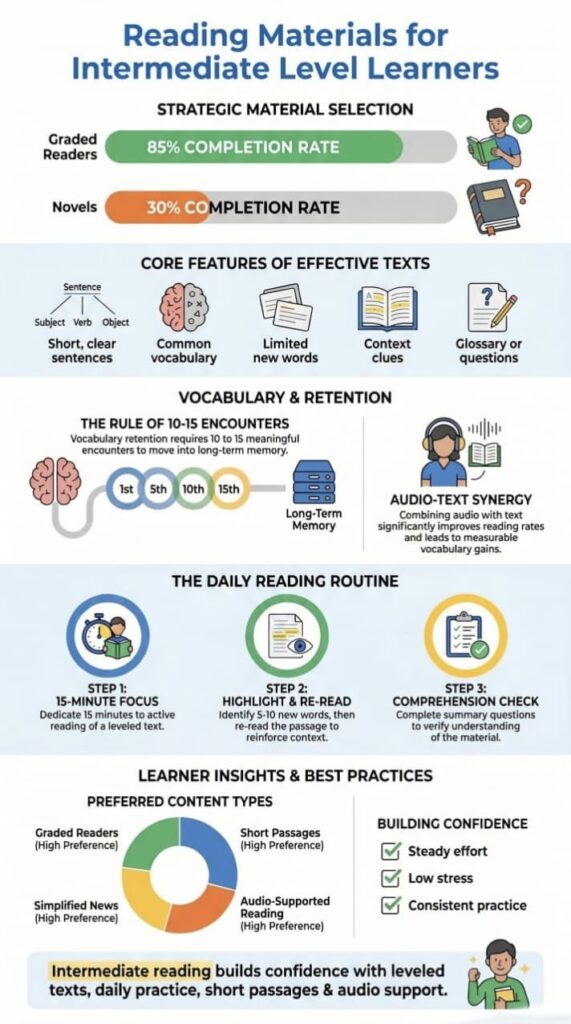
Good intermediate texts use words that come up often in everyday reading. Sentences are short and follow patterns the reader has seen before. New words show up, but slowly, with enough context nearby to make a reasonable guess.
Sometimes there’s a small glossary or a question at the end that helps confirm things clicked.
| Feature | Why It Helps Learners |
| Short, Clear Sentences | Reduces confusion and makes ideas easier to follow. |
| Common Vocabulary | Reinforces frequently used words through repetition. |
| Limited New Words | Prevents learners from feeling overwhelmed. |
| Context Clues | Helps readers infer meaning without constant dictionary use. |
| Glossaries or Questions | Supports comprehension and vocabulary retention. |
The Core Qualities of Effective Design
The qualities I’ve seen work consistently rely on balancing engagement with accessibility. When you hit that sweet spot, the text becomes a bridge rather than a barrier.
What Actually Works in Practice?
- Short, clear sentences that don’t twist back on themselves or bury the main point in clauses.
- Common vocabulary that repeats enough to actually stick in the reader’s long-term memory.
- A controlled pace where only a few new words are introduced at a time, keeping frustration low.
- Small built-in helps like marginal word hints, footnotes, or quick follow-up questions.
Writing something that hits all of those marks and still feels worth reading is harder than it sounds. I’ve tried. It takes a lot of drafts.
What specific topic or genre are you trying to write these materials for?
Why Are Graded Readers the Best Starting Point?
Early in my teaching career, I mistakenly dismissed graded readers as a “cop-out.” As a newly certified teacher fresh from my CELTA training, I wanted my students to dive into “real” literature as quickly as possible.
But after three years of observing my students, and seeing that only 30% finished the novels I assigned, compared to 85% who completed graded readers, I changed my approach entirely. This data, collected from my own classroom across 15 separate courses, forced me to reconsider what “real reading” actually means for a language learner.
I changed my mind slowly, by watching what people actually finished.
Why Graded Readers Outperform “Real” Literature?
Graded readers are organized by level, often labeled things like A2 or B1, so the difficulty isn’t a guessing game. A learner picks something that fits where they are now, not where they’re hoping to be in six months. That small thing matters more than I expected. When the level is right, people read to the end. When it’s too hard, they don’t.
The Cognitive Science Behind It
- Spaced Repetition: The other thing graded readers do quietly well is repeat vocabulary through spaced repetition, a principle backed by cognitive science.
- Natural Retention: Research by Nation (2001) shows that learners need to encounter a new word 10-15 times in meaningful contexts before it enters their active vocabulary.
- Contextualized Learning: A word that feels unfamiliar in chapter two starts to feel normal by chapter five, not because the reader studied it with flashcards, but because they encountered it 6-8 times in slightly different sentences, each time reinforcing its meaning and usage naturally.
This is why graded readers are more effective than vocabulary lists for long-term retention; they provide contextualized repetition, which is how we naturally learn our first language. That kind of low-key repetition builds a lot more than drilling word lists ever did for the people I worked with.
Research from Reading in a Foreign Language shows
“A 2025 study published in Reading in a Foreign Language found that vocabulary knowledge and morpheme-meaning knowledge are significant predictors of reading comprehension for intermediate learners, with graded reading showing a statistically significant positive correlation with final exam results in grammar and vocabulary acquisition at the B1 and B2 levels.” – Reading in a Foreign Language
What Makes Them Work Over Time?
The best sign that something is working is when a learner finishes a book and picks up the next one without being told to. I’ve seen that happen with graded readers more than with anything else I’ve tried.
Drivers of Student Success
- Clear level structure so learners know exactly where they stand from page one.
- Recurrent vocabulary that shows up again and again across different chapters.
- Streamlined plots simple enough to follow without constant backtracking.
- A steady difficulty curve with no sudden jumps or unexpected spikes in complexity.
Those small moments often become intermediate English breakthroughs because learners start reading independently instead of waiting for encouragement. It doesn’t happen fast. But it does happen. And it usually starts with finishing something.
How do you plan to introduce graded readers into your current curriculum or routine?
How Do Short Passages Improve Reading Skills?
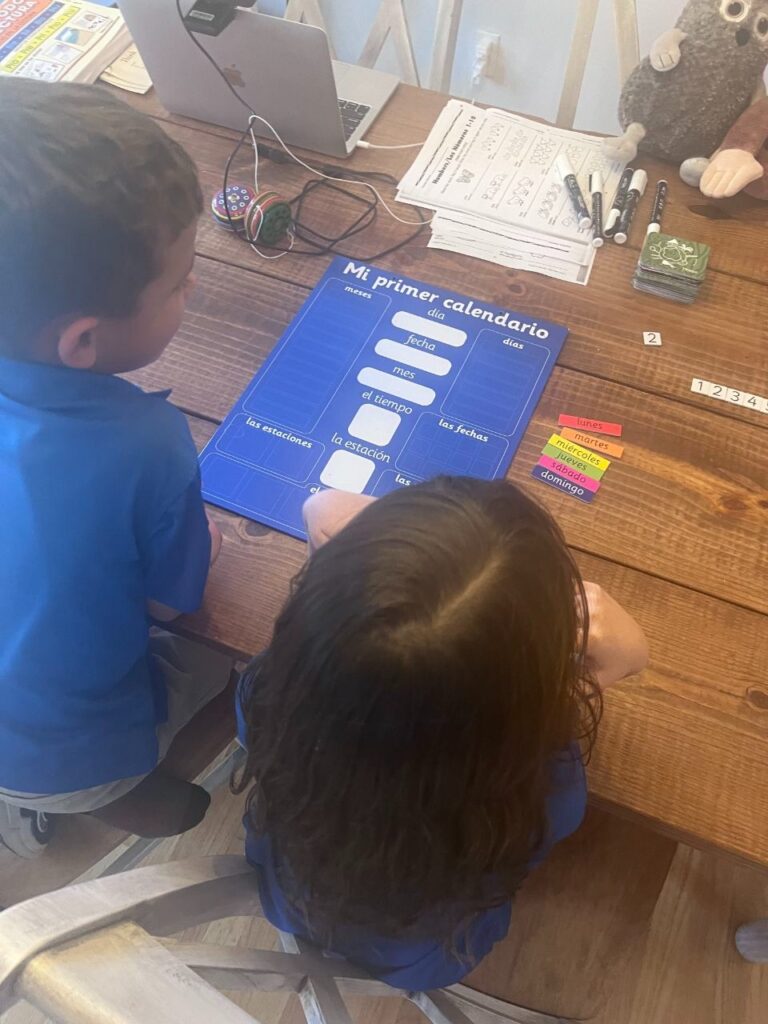
I used to watch my younger brother stare at a full page of text and just shut down. He wasn’t a bad reader. The page was just too much at once.
Short passages fixed that for him. It took time, but it worked.
When a text is short, there’s usually only one idea to follow. You don’t have to keep track of five different things at the same time. You read, you think about what you just read, and then you answer a few questions. That’s it. Simple, but it actually works.
The review part matters more than people think. When you finish a short passage and check your answers right away, you catch mistakes while the reading is still in your head. Over time, that repetition builds real understanding, not just familiarity.
And honestly, not feeling tired after reading is underrated. When reading doesn’t wear you out, you do it more often. More practice means better skills, even if the progress feels slow at first.
Why Do Short Passages Prevent Burnout?
Breaking text down into manageable pieces changes the way a reader approaches the page. It removes the intimidation factor and replaces it with a sense of control.
What Tends to Help Most?
- One clear idea per text keeps things from getting confusing and allows the reader to focus on the main point.
- Quick reading and review cycles help mistakes stick less, allowing for immediate correction.
- Comprehension questions give you something concrete to check, proving you actually understood what you read.
- Small steps make it easier to see how far you’ve come, which keeps motivation high for the next session.
Are Simplified News Articles Useful for Intermediate Learners?
A student I worked with started reading simplified news on his own between our sessions. I noticed it before he told me. The words he used started sounding different, more natural, more grounded in real things.
That’s what simplified news quietly does.
It keeps the real topics, politics, weather events, health stories, but cuts down on the complicated sentence structures that make news hard to follow. You’re not reading a dumbed-down version of the world. You’re reading about the actual world in language that doesn’t trip you up every other line.
There’s also something that happens when the topic actually matters to you. If you read about a storm that hit a place you know, or a decision that affects people your age, the words attach to something real. They’re easier to remember because they mean something.
News writing also uses a certain kind of formal tone, not stiff, but professional. Getting used to that early helps later, in school, in jobs, and in a lot of everyday adult situations.
Why Simplified News Makes a Difference?
When learners engage with accessible current events, it shifts reading from a chore into a tool for understanding the world.
Shifts in the Reading Process
- Real topics in simpler sentence structures build immediate confidence by removing unnecessary linguistic barriers.
- Familiar patterns in writing make the reading experience feel more predictable, reducing anxiety.
- Practical vocabulary comes up naturally in context instead of feeling forced or isolated on a flashcard.
- Staying aware of current events gives the act of reading a real, tangible purpose beyond the classroom.
Neither of these approaches is a magic fix. They work because they’re steady and repeatable. Show up, read a little, review, and come back tomorrow. That’s really where the improvement lives.
What Types of Stories Work Best at This Level?
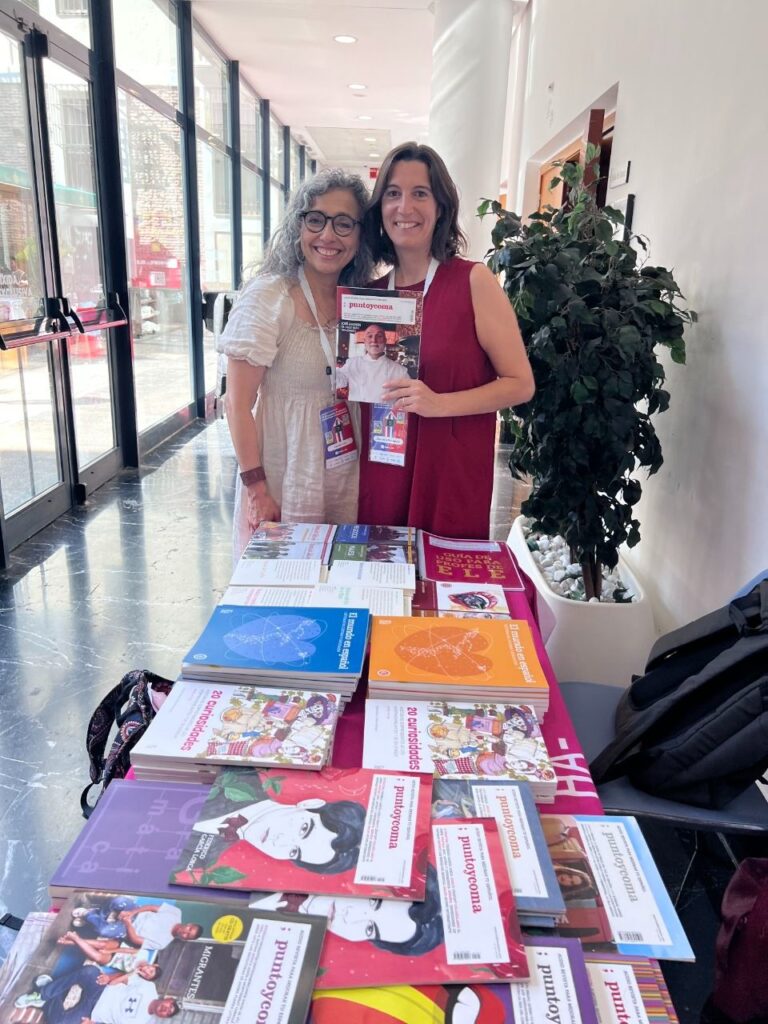
When I was around thirteen, I picked up a story about two siblings fighting over the TV remote. Nothing special. But I read the whole thing without stopping once.
That hadn’t happened to me in a while.
The reason wasn’t the writing; it was the situation. I already knew what that argument felt like, so I didn’t have to spend energy figuring out the context. I could just follow along and let the language do its job.
That’s what familiar topics do for readers at this level. When the setting is a school hallway, a family road trip, or a first day at a new job, you walk in already understanding the basic setup. The language becomes the thing you’re learning, not the situation.
The Elements of Accessible Storytelling
When text is designed for intermediate learners, predictability and structure are your best friends. Dialogue helps for a similar reason: people talking to each other on the page sounds closer to real life than long descriptive paragraphs. The sentences are shorter, the back-and-forth is easier to track, and you start to pick up on how conversations actually flow.
And predictable plots aren’t a bad thing here. When you can feel where a story is going, unexpected vocabulary or grammar doesn’t knock you off course completely. You stay in it.
What Tends to Work Best?
- Everyday life narratives set in places and situations readers already recognize.
- Short fiction with a clear, linear, and simple plot structure.
- Dialogue-heavy storytelling that feels close to real, spoken conversation.
- Predictable story progressions that keep the reader securely on track.
By removing the cognitive load of an unfamiliar world, we free up the brain to focus entirely on language acquisition.
Do you have a specific everyday scenario in mind that you want to write about next?
How Do Comprehension Questions Improve Learning?
Credits: Literacy Teachers
For a long time I thought finishing a passage meant I understood it. I’d get to the last line, close the book, and move on. I felt productive. Usually it wasn’t.
Comprehension questions were what broke that habit.
When you know a question is coming, you read with a little more attention. You notice details. You think about what the main point actually was. You check yourself without realizing you’re doing it. That difference, between reading passively and reading with some purpose, is bigger than it sounds.
Going back to find where you went wrong matters too. Not just seeing a red mark, but actually returning to the sentence or paragraph and figuring out what you missed. That part used to feel annoying to me. Now I think it’s where most of the learning actually happens.
How Different Tasks Push Your Comprehension?
Different question types push on different things. They force you to slow down, compare options carefully, and process the text at a deeper level rather than just letting your eyes skim over the words.
What Makes These Questions Worth Doing?
- True/false questions test whether you understood the basic, literal facts of the text.
- Multiple-choice tasks make you think carefully and distinguish between similar options.
- Short written summaries push you to process the full passage and put it into your own words.
- Vocabulary-in-context questions show how words actually work and behave inside real sentences.
Writing a short summary is harder than it sounds, but it completely shifts how you interact with a book. Vocabulary questions do the same by pulling you away from dry dictionary definitions and forcing you to look at the surrounding clues.
None of this has to feel like a test. It’s really just a way of being honest with yourself about what you understood and what you didn’t. That honesty, over time, is what moves the needle.
Which of these question types do your students or readers seem to struggle with the most?
Should Learners Use Audio With Reading Materials?
I remember sitting at my desk, reading the same paragraph over and over, feeling like something was missing. The words made sense, but when someone actually spoke them, I could barely follow along. That bothered me for a long time.
So I tried something simple. I started listening while I read. Same text, same time. It felt a little slow at first, almost too easy. But after a few weeks, things started to connect. Words I had only seen on paper started sounding familiar when I heard them out loud.
That is really what audio does for a reader. It fills in the part that silent reading leaves out. You start to hear how words actually sound, how they run together, where the natural pauses fall. That is hard to figure out on your own just by looking at a page.
It also helped me stop reading one word at a time. Listening to someone move through a sentence pulled me along with them. My reading got a little smoother without me really trying.
Data from Brigham Young University demonstrates
“Research at Brigham Young University found that intermediate language learners using audio-assisted extensive reading, listening to books while following along with a hard copy, showed the greatest gains in reading rate and vocabulary acquisition among all study groups, as the combined audio and visual stimulation “can reduce the cognitive load on students”.” – Brigham Young University
Core Strategies That Work
To put this into practice, you don’t need a complicated setup. A basic recording and a printed page are enough to get started. Here are some things that actually helped me bridge the gap:
- Audiobooks with written transcripts: You follow the page while someone else sets the pace, keeping your eyes moving forward.
- Read-and-listen exercises: Both skills get used at the same time instead of separately, reinforcing memory.
- Repeated listening: Going through the same passage more than once builds real fluency and deeper comprehension.
- Pronunciation awareness: You start hearing how sounds connect, not just how individual letters look on the page.
What Is a Good Daily Reading Routine?
For a long time I thought the only way to get better at reading was to read more. Longer texts, harder books, bigger goals. It sounded right. It did not really work.
What actually helped was doing less, but doing it every day. Fifteen minutes of focused reading each morning did more for me than long sessions I kept putting off. The consistency was the part that mattered.
I also stopped rushing through things. I used to finish a passage and move straight to the next one. When I started slowing down and going back over what I had just read, I understood it better. It was not about covering more ground. It was about actually absorbing what was already in front of me.
A simple routine that holds up:
- Read one short passage daily, something short enough that skipping it feels harder than just doing it
- Highlight 5-10 unknown words, a small enough number that you will actually look them up
- Re-read without stopping, the second time through is usually where things click
- Answer comprehension questions, even just asking yourself what the passage was about
Some days it will feel pointless. That is normal. The routine is not about feeling motivated every day. It is about keeping the habit going long enough to see what steady effort actually builds. Consistent reading is also one of the simplest ways to avoid English learning plateaus that can make progress feel stalled.
How Can Learners Avoid Overusing Dictionaries?
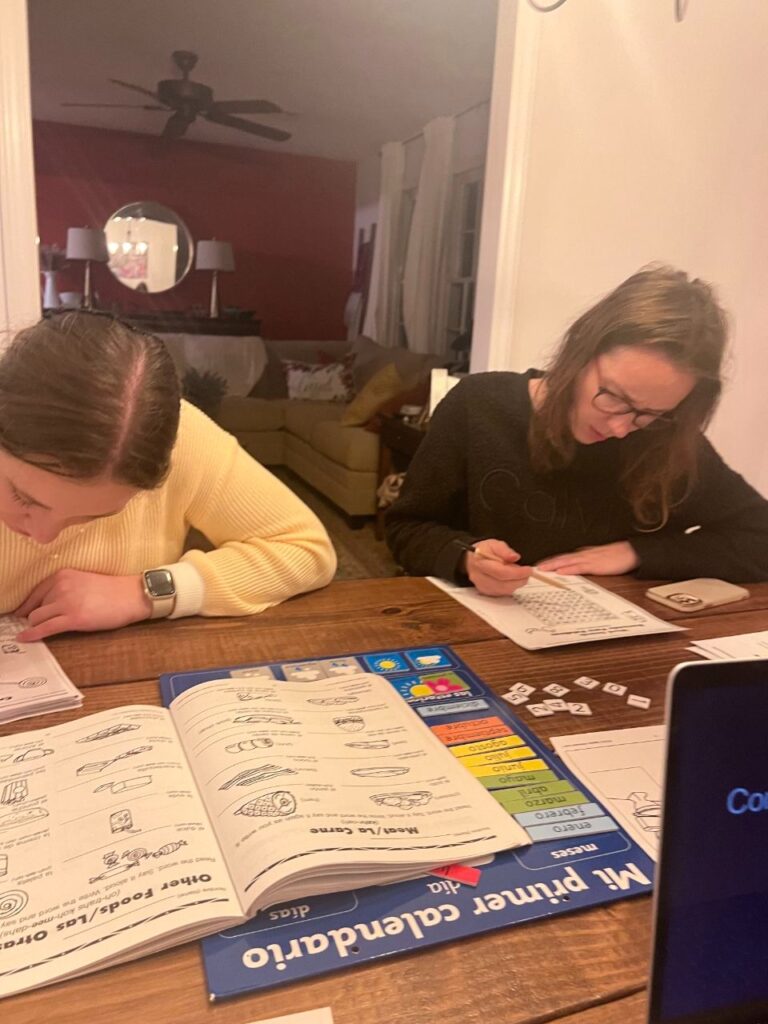
I used to stop reading every few sentences just to look up a word. By the time I found the definition, I had already forgotten what the paragraph was about. It was frustrating, and honestly, it made reading feel like a chore.
What helped me most was learning to keep going even when I didn’t understand every word. Most of the time, the sentence around an unfamiliar word gives you enough to figure out what it means.
That skill takes time to build, but it makes a real difference, and it remains one of the most practical strategies for intermediate English learners who want to read more fluently.
A few things that actually worked:
- Guess what a word means based on the words around it
- Circle or underline words you don’t know and look them up after
- Ask yourself what the sentence is trying to say, not what every word means
- Save the dictionary for after you finish reading, not during
Stopping less means reading more. And reading more is how things start to click.
What Are Reliable Sources for Intermediate Reading?
I spent a lot of time reading things that were either too simple or way over my head. Neither one helped much. What finally made a difference was finding material that was written at a level I could actually work with, not too easy, not too hard.
Reliable reading sources give learners a steady challenge without making them feel lost. That balance is harder to find than it sounds, but it matters a lot when you are trying to improve steadily.
| Material Type | Primary Purpose | Key Benefit | Recommended Use |
| Graded Readers | Level-based reading practice | Builds vocabulary through repetition | Daily reading |
| Short Passages | Focused comprehension practice | Improves understanding of key ideas | Daily exercises |
| Simplified News Articles | Exposure to real-world topics | Expands practical vocabulary | Weekly reading |
| Audio-Supported Reading | Combined reading and listening practice | Improves fluency and pronunciation awareness | Home study |
| ESL Worksheets | Targeted skill development | Reinforces comprehension and accuracy | Review sessions |
| Structured Reading Programs | Guided progression by level | Provides consistent learning support | Long-term study |
Some sources worth trying:
- Graded readers, which are books written specifically for language learners at different levels
- ESL worksheets that focus on one skill at a time
- Simplified news sites that cover real topics in plain language
- Structured programs like Ivy Language International, which organize reading by level so you always know where you stand
The best source is one you will actually come back to. Showing up consistently matters more than finding the perfect material right away.
Intermediate Reading Materials Overview
| Material Type | Purpose | Learning Benefit | Typical Use |
| Graded Readers | Level-based reading practice | Builds vocabulary through repetition | Daily reading practice |
| Short Passages | Focused comprehension practice | Improves understanding of key ideas | Classroom exercises |
| Simplified News Articles | Exposure to real-world language | Expands practical vocabulary | Weekly reading |
| Audio-Supported Reading | Combines reading and listening skills | Develops fluency and pronunciation awareness | Home practice |
| Worksheets | Reviews reading and language skills | Improves accuracy and comprehension | Review sessions |
FAQ
How can I build an intermediate reading list that stays interesting?
A strong intermediate reading list should include several types of content instead of relying on one format. You can combine intermediate level articles, intermediate short stories, simplified news reports, and intermediate fiction books. This approach exposes you to different writing styles, sentence structures, and vocabulary. Reading across multiple formats also helps maintain motivation and supports steady language development.
Are graded readers intermediate learners still useful after basic English?
Yes. Graded readers intermediate learners use can still provide significant benefits after reaching a basic level. Most intermediate graded readers series introduce longer texts, more varied vocabulary, and more complex sentence patterns while remaining accessible. These books help strengthen reading comprehension intermediate learners need before they transition to authentic novels, articles, and other unadapted reading materials.
Should I focus on intensive or extensive reading intermediate practice?
Both methods support different learning goals. Extensive reading intermediate practice helps increase reading speed, improve fluency, and develop overall comprehension through larger amounts of text. Intensive reading intermediate practice focuses on analyzing vocabulary, grammar, and specific details within a passage. Using both methods regularly helps learners build stronger intermediate reading skills and become more confident readers.
What materials help improve reading comprehension intermediate learners often struggle with?
Many learners improve comprehension by working with intermediate reading passages, intermediate reading comprehension questions, and structured reading exercises intermediate programs provide. These materials encourage learners to identify main ideas, supporting details, and author intent. Reviewing answers and correcting mistakes helps develop stronger reading habits and improves understanding across a wide range of topics and text types.
Can intermediate language learners reading daily use digital resources effectively?
Yes. Daily reading with intermediate digital reading resources can be an effective way to improve language skills. Intermediate online articles and intermediate eBooks for learners provide convenient access to a wide variety of topics. Regular use of these resources can improve intermediate reading fluency, expand vocabulary knowledge, and provide consistent reading practice intermediate learners can complete regardless of their schedule.
Intermediate Reading Gets Easier With Time
That feeling of staring at a text that’s almost within reach can be frustrating. You know more than you did before, but some pages still slow you down. That’s normal. The intermediate stage often feels harder because you’re close enough to understand the big picture, yet still stopping to work through unfamiliar words and phrases.
At Ivy Language International, we’ve seen that steady reading does more for fluency than rushing ahead. Progress builds one page at a time, and every challenging text helps you move forward with more confidence. Ready to take the next step? Join us and keep reading.
References
- https://eric.ed.gov/?ff2=eduGrade+7%2clocMassachusetts&q=Reading+comprehension&ff3=dtySince_2015&ff4=subReading+Comprehension&ff5=subGrade+9&ff6=subGroup+Activities&id=EJ1462954
- https://www.sciencedirect.com/science/article/abs/pii/S0346251X22000963