
Strategies for intermediate English learners often become necessary when B1/B2 learners reach a point, but noticeable progress slows. I remember that stage clearly. Over time, I realized that moving beyond this plateau required a different mindset: less focus on doing more and more focus on practicing with intention.
At Ivy Languages International, we have seen many learners mistake slower progress for failure when, in reality, they are developing more sophisticated skills that simply take longer to notice. The plateau is not permanent. Keep reading for practical strategies that can help you continue building confidence and lasting fluency.
Your Next Steps Beyond the B1/B2 Plateau
If you only remember a few things from this article, let them be these: meaningful progress comes from consistent, intentional practice rather than doing more for longer periods.
- Active learning methods produce stronger results than passive exposure alone.
- Vocabulary growth depends on learning phrases, collocations, and real-world language patterns.
- Consistent speaking, listening, and progress tracking help learners move beyond the B1/B2 plateau.
Why are so many intermediate learners stuck at the B1/B2 plateau?

Over the years, I have spoken with many students who believed they had stopped improving. Most could communicate comfortably in English. They could participate in meetings, order food, ask questions, and manage daily life without major problems. On the surface, everything seemed fine. Yet they felt frustrated because they no longer experienced the rapid progress they saw during the beginner stages.
I remember feeling something similar during my own language-learning experience. In the beginning, every week brought noticeable improvements. New words appeared everywhere, and basic conversations felt like major achievements. Later, growth became slower and less visible.
This stage often happens because learners move from building basic communication skills to refining details. Listening requires processing faster speech and unfamiliar expressions. These improvements take time.
Many learners also fall into routines that no longer challenge them. They consume familiar content, rely on subtitles, or avoid situations where mistakes are likely. Understanding why your English progress has stalled can help learners recognize that this experience is both common and temporary.
What looks like a lack of progress is often something different. The learner is still developing, but the gains are smaller, more advanced, and harder to measure from day to day.
Why your 3-hour Netflix routine may be holding you back
I enjoy watching English-language content, and I often encourage students to do the same. The problem is not the content itself. The problem is how it is used.
Many intermediate learners spend hours watching shows and movies every week. They understand the story, recognize familiar vocabulary, and feel productive. I have met students who watched English content almost every day but struggled to remember useful phrases or use new vocabulary in conversation.
The difference usually comes down to attention. Watching three hours of television can expose you to a lot of English. However, exposure alone does not guarantee learning. During passive viewing, the brain often focuses on the plot rather than the language.
A shorter session with a clear purpose can be far more useful. For example, I often recommend choosing a short clip, listening carefully, repeating key sentences, and recording useful expressions.
Many learners are surprised by how much they learn from fifteen focused minutes compared with several hours of casual viewing. Entertainment has value. It can support motivation and provide exposure. Still, meaningful improvement usually comes when learners actively engage with the language rather than simply consuming content.
How can you upgrade vocabulary beyond individual words?
One lesson I learned through years of language study is that knowing individual words is not enough. Communication becomes easier when words are learned together.
Many intermediate learners build long vocabulary lists. They memorize definitions and review flashcards. Yet when they speak, their English can still sound unnatural. I experienced this myself. I knew many words, but I often struggled to combine them in ways that sounded natural.
Native speakers rarely think one word at a time. Instead, they rely on patterns they have heard thousands of times.
Because of this, I encourage learners to focus on:
- Collocations
- Common phrases
- Language chunks
- Phrasal verbs in context
- Complete example sentences
For example:
- Heavy traffic
- Grave mistake
- Bring up a topic
- Look into a problem
- On the other hand
Learning these combinations provides immediate benefits. Conversations become smoother because the language is stored as larger units rather than isolated pieces. Many of these small adjustments eventually contribute to the kind of Intermediate English breakthroughs.
A phrase used during a conversation or writing assignment is usually easier to remember than a word copied from a list. Over time, these language patterns become automatic and help learners express ideas with greater confidence.
How do you use Google as a personal linguistic corpus?
One habit that helped me become more aware of natural English usage was comparing phrases online. Whenever I was unsure about a particular expression, I looked for examples used by native speakers.
Today, learners can do something similar with a simple search. When you place a phrase inside quotation marks, you can quickly see how often it appears across websites, articles, and other published material. While this method is not perfect, it can provide useful clues about common usage.
I often suggest a simple process:
- Search for the exact phrase.
- Review several examples.
- Compare similar expressions.
- Notice differences in tone.
- Save useful examples.
For instance, a learner might compare:
- “heavy traffic”
- “fast traffic”
The first appears much more frequently because it reflects natural usage.
Another comparison could be:
- “grave mistake”
- “big mistake”
Both exist, but they carry slightly different meanings and levels of formality. This habit develops awareness over time. Instead of memorizing rules, learners begin noticing patterns through repeated exposure.
Language learning often improves when curiosity replaces guesswork. Small observations collected consistently can lead to a much stronger sense of what sounds natural and what does not.
What is the best listening strategy for intermediate learners?
Many students tell me they understand English when reading but struggle when listening. In many cases, the issue is not vocabulary. It is processing speed.
I remember listening to native speakers years ago and feeling as though I knew the words but could not keep up with the pace. Everything seemed to move too quickly. That experience taught me that listening requires a different kind of practice.
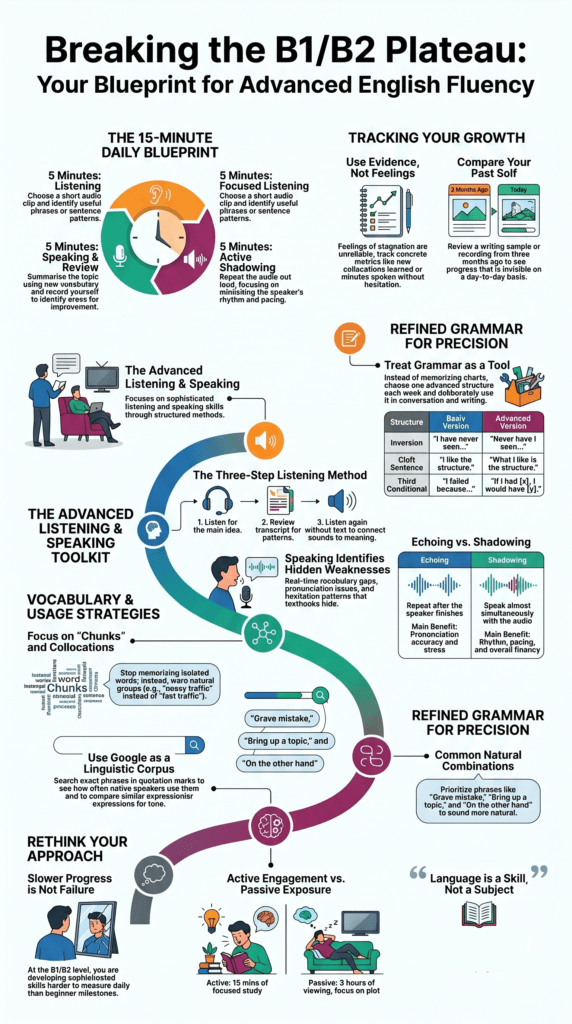
One method I continue to recommend is a three-step listening process.
First listening
Listen without subtitles or transcripts. Focus on understanding the main idea.
Transcript review
Read the transcript carefully. Look for unfamiliar words, useful phrases, and pronunciation patterns.
Second listening
Listen again without reading. Notice what sounds clearer after reviewing the text. This process encourages active engagement with the audio. Instead of relying on subtitles, learners train themselves to connect sounds directly with meaning.
Repeated exposure also helps learners become familiar with connected speech, reductions, and natural pacing. Listening improves gradually. Most learners do not notice dramatic changes after one session. However, after several weeks of consistent practice, many discover that conversations feel easier and less overwhelming than before.
How can shadowing and echoing improve fluency?
When I first began paying attention to pronunciation, I realized that understanding English and speaking English were two different skills. I could follow conversations reasonably well, but producing natural speech required additional practice. Shadowing and echoing helped address that gap.
Echoing is straightforward. You listen to a sentence and repeat it after the speaker finishes. This allows you to focus on pronunciation, stress, and individual sounds. Shadowing adds another challenge. Instead of waiting, you speak almost at the same time as the recording. Both methods offer different benefits.
| Method | How it works | Main benefit |
| Echoing | Repeat after the speaker | Pronunciation accuracy |
| Shadowing | Speak alongside the audio | Rhythm and fluency |
I often recommend using short recordings rather than long lessons. A one-minute clip can provide enough material for meaningful practice. The goal is not perfection. The goal is increased familiarity with natural speech patterns.
Many learners find that regular repetition builds confidence. They become less hesitant, their rhythm improves, and speaking begins to feel more automatic. Small sessions completed consistently often produce stronger results than occasional intensive practice.
How do advanced grammar structures make you sound more fluent?
Grammar becomes more interesting at the intermediate stage because learners usually understand many rules already. The challenge is using those structures naturally.
I have met learners who could explain advanced grammar perfectly but rarely used it when speaking. Their communication was accurate, yet repetitive.
Rather than studying dozens of new rules, I prefer focusing on a small number of structures that appear frequently in advanced communication.
Examples include:
| Structure | Basic version | Advanced version |
| Inversion | I have never seen | Never have I seen |
| Cleft sentence | I like the structure | What I like is |
| Third conditional | I failed because | If I had, I would have |
These structures help learners express ideas with greater precision.
The key is practice in context. Memorizing a grammar chart rarely changes speaking habits. Using the structure repeatedly in conversations and writing does.
I often encourage students to choose one structure each week and deliberately use it several times. Fluency develops when grammar becomes a tool rather than a subject. Over time, these patterns become familiar enough to appear naturally without conscious effort.
Why is speaking practice more important than studying more grammar?
Credits: Max & Mia Podcast
One of the most common patterns I have seen over the years is learners spending months studying grammar while avoiding speaking opportunities.
Grammar matters. It provides structure and accuracy. Yet grammar knowledge alone does not create fluency. Speaking exposes weaknesses that textbooks often hide.
When learners speak in real time, they discover:
- Vocabulary gaps
- Pronunciation issues
- Hesitation patterns
- Grammar mistakes
- Listening challenges
I experienced this personally. There were moments when I felt confident after studying, only to realize during a conversation that I struggled to respond quickly. Speaking creates immediate feedback.
A few activities can be particularly useful:
- Self-recording
- Daily self-talk
- Conversation exchanges
- Structured debates
- Speaking prompts
Recording yourself is especially valuable. Hearing your own speech often reveals habits that are difficult to notice in the moment.
Progress can feel uncomfortable because mistakes become visible. Yet those mistakes provide valuable information.
As highlighted by Masaryk University Thesis / Thornbury (1999)
“If you take the language-is-skill point of view, then it follows that, like bike riding, you learn it by doing it, not studying it.” – Masaryk University Thesis
Every weakness identified through speaking becomes a target for improvement. Over time, that process leads to stronger fluency than grammar study alone.
What is the 15-minute active reps blueprint?
One lesson I learned through teaching and language study is that consistency usually matters more than intensity.
Many learners begin with ambitious plans. They schedule long study sessions and attempt to cover multiple skills at once. A few weeks later, life becomes busy and the routine disappears.
A shorter plan is often easier to maintain. I frequently recommend a simple fifteen-minute routine.
Five minutes of listening
Choose a short audio clip. Listen carefully and identify useful phrases, vocabulary, and sentence patterns.
Five minutes of shadowing
Repeat what you hear. Focus on pronunciation, rhythm, and pacing rather than perfection.
Five minutes of speaking and review
Talk about the topic using newly learned language. Review mistakes and save useful expressions for future practice. Many learners searching for practical methods on how to overcome English learning plateaus discover that sustainable daily habits often produce better long-term results than occasional bursts of intensive study.
Many learners find it easier to repeat daily because it fits naturally into busy schedules. The results may seem small at first. However, consistent practice accumulates over time. Months of steady effort often produce stronger improvements than occasional periods of intensive study followed by long breaks.
How can you track progress without feeling stuck?

One reason many learners become discouraged is that they rely on feelings rather than evidence. Progress can be difficult to notice from one day to the next. I have experienced this myself. There were periods when I felt stagnant, only to discover later that my skills had improved considerably.
Useful measures include:
- New collocations learned
- Minutes spoken without hesitation
- Listening comprehension scores
- Monthly writing samples
- Vocabulary retention rates
I encourage learners to keep records and review them regularly. A writing sample from three months ago often reveals progress that would otherwise remain unnoticed. The same is true for recordings of speaking practice.
Language learning rarely follows a straight line. Some weeks feel productive. Others feel slow. Tracking provides something more reliable than emotion. It provides evidence.
Research from Teaching English Language journal (Mirzaei, Zoghi, & Davatgari Asl)
“To get out of learning plateau, extra practicing linguistic items plays a crucial role. Moreover, teaching learners to use chunk and formulaic expressions which are prefabricated phrases can help them produce more effortless and automatic speech.” – Teaching English Language Journal
When learners can see concrete improvements, they are often more willing to continue through periods. Patience becomes easier when growth is visible.
FAQ
What are the most effective strategies for intermediate English learners?
The most effective strategies for intermediate English learners combine regular practice with active use of the language. Intermediate English learning tips often include speaking every day, reviewing useful phrases, and using English in real situations.
Effective English learning strategies intermediate learners follow usually involve setting clear goals, tracking progress, and practicing listening, reading, writing, and speaking consistently.
How can I improve intermediate English without studying for hours?
If you want to know how to improve intermediate English, focus on short and consistent study sessions. Daily English practice strategies intermediate learners use may include listening to short audio clips, reviewing vocabulary, and speaking out loud for a few minutes each day.
Strong English learning habits intermediate learners can maintain over time often lead to better results than occasional long study sessions.
Which vocabulary learning strategies help intermediate learners remember new words?
Vocabulary learning strategies English learners use successfully focus on understanding words in context. Memory strategies English vocabulary learners apply may include creating mental associations with English vocabulary techniques, studying English collocations learning strategies, and practicing English phrasal verbs learning strategies.
Vocabulary building strategies intermediate English learners use regularly often improve both recall and natural language use.
What listening and speaking strategies build English fluency?
Listening strategies for intermediate English learners should help improve comprehension and processing speed. Focused listening English conversations and English listening comprehension strategies train learners to recognize meaning in natural speech.
Speaking strategies for intermediate English, along with English speaking confidence strategies and English conversation strategies intermediate learners practice often, can strengthen fluency and reduce hesitation.
Which study strategies support long-term English improvement?
English self study strategies intermediate learners use effectively often combine metacognitive strategies English learning with cognitive strategies English learning. Social strategies English learning and effective strategies English learning can help learners stay motivated and manage frustration.
English progress tracking strategies and realistic English learning goals intermediate learners set for themselves can support steady and lasting improvement.
Keep Going, Even When Progress Feels Slow
The move beyond B1 and B2 isn’t built on dramatic breakthroughs. It’s shaped by small actions repeated over time, especially when results aren’t immediately visible. That’s when consistency matters most.
We understand this journey because we’ve experienced it too. Keep practicing, trust the process, and let each conversation build your confidence. Ready for your next step? Learn with Ivy Languages International.
References
- https://theses.cz/id/9eqvqo/Bakalarska_prace_-_Muzikantova_Jana.pdf#page=18
- https://www.teljournal.org/article_53188_8e8659e823344a3dc4ddc7227e0531c7.pdf?lang=fa#page=9
Related Articles
- https://ivylanguagesinternational.com/why-your-english-progress-has-stalled/
- https://ivylanguagesinternational.com/intermediate-english-breakthroughs/
- https://ivylanguagesinternational.com/how-to-overcome-english-learning-plateaus/