
Tips
Why your English progress has stalled often has less to do with effort and more to do with relying on study habits that no longer challenge you. I have gone through this myself and have seen it repeatedly while working with learners at Ivy League International. Later, progress becomes harder to notice, even when the hours of study remain the same.
In the beginning, improvement feels obvious. Over time, I learned that moving forward usually requires stronger feedback, more active use of English, and the patience to try different approaches. Keep reading to explore what may be holding you back and how you can start making progress again.
Progress Reset: What This Article Really Means
If your English feels stuck, it usually does not mean you lack ability. More often, it means your current methods are no longer creating enough challenges to help you grow.
- Most cases of english fluency stagnation causes come from relying on comfortable study habits that no longer create growth.
- Active speaking, writing, and error correction produce greater improvement than passive English consumption alone.
- Consistent practice focused on specific weaknesses can break the broken English progress barrier within weeks.
What is the intermediate plateau in English learning?

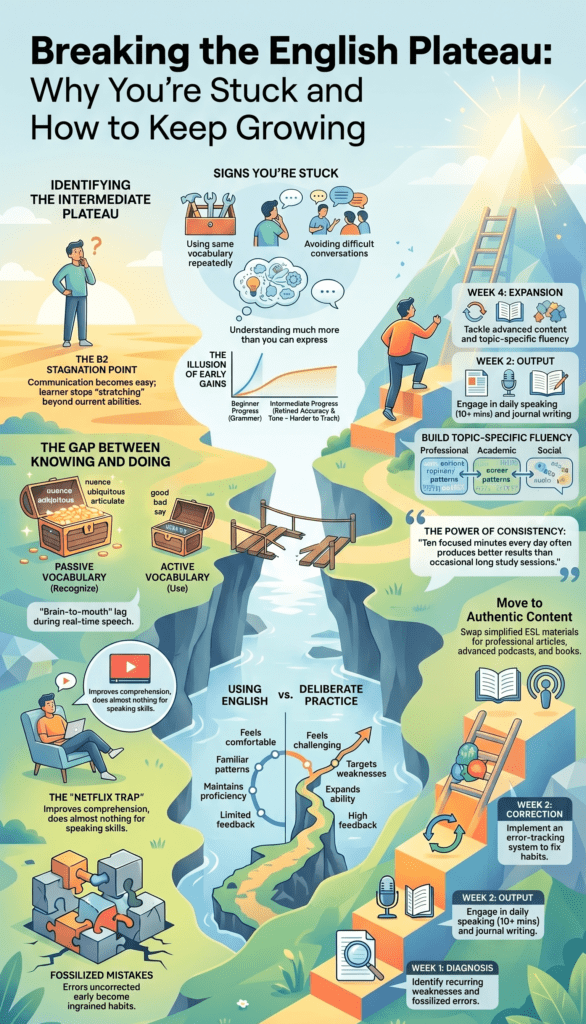
In many cases, they have reached what teachers commonly call the intermediate plateau. This usually happens around the B2 level. At this stage, communication becomes much easier than it was as a beginner. Learners can participate in conversations, understand a wide range of content, and handle many daily situations.
The learner is still using English, but not stretching beyond current abilities. Recognizing this stage is often the first step toward moving beyond it. Also understanding how to overcome English learning plateaus can help learners identify the adjustments needed to continue progressing.
Several signs often point to an intermediate plateau:
- Using the same vocabulary repeatedly.
- Discussing familiar topics only.
- Avoiding difficult conversations.
- Feeling comfortable but not improving.
- Understanding more than you can express.
How early progress creates false expectations
Early gains in language learning are easy to notice. Learning basic vocabulary and grammar can quickly improve communication. Later improvements are smaller and more specialized, which makes them harder to recognize.
Why improvement becomes less visible over time
As proficiency grows, learners spend more time refining accuracy, pronunciation, and fluency. These changes matter, but they are often less obvious than the improvements made at beginner levels.
Why does understanding English not automatically improve speaking?
One of the most common frustrations I hear from learners is that they can understand English but struggle to speak it. They watch videos, listen to podcasts, and follow conversations with little difficulty. Then someone asks a question, and the words do not come out as smoothly as expected.
Understanding and speaking depend on different skills. Listening allows us to recognize language. Speaking requires us to retrieve vocabulary, organize ideas, choose grammar, and respond in real time. That process happens quickly and often under pressure.
Many learners build large passive vocabularies through reading and listening, but those words remain difficult to access during conversation. I have seen learners who understand advanced content yet continue relying on a small group of familiar words while speaking. More often, it is a lack of practice turning knowledge into active communication.
As highlighted by Cambridge University Press & Assessment
“There is a gap between receptive and productive competence. The learner may have made considerable progress in listening comprehension and reading, but still feels inadequate when it comes to speaking skills.” – Cambridge University Press & Assessment
Several factors contribute to this problem:
- Passive vocabulary grows faster than active vocabulary.
- Speaking requires instant recall.
- Grammar decisions happen in real time.
- Fear of mistakes increases hesitation.
- Mental translation slows communication.
Passive vocabulary vs. active vocabulary
Passive vocabulary includes words we recognize when reading or listening. Active vocabulary includes words we can use naturally in speech and writing. Growth happens when words move from one category to the other.
The brain-to-mouth connection problem
The connection between understanding and speaking develops through repeated use. Regular speaking practice helps learners access language more quickly and with greater confidence.
Why is passive immersion keeping you stuck?
I enjoy English movies, podcasts, and television programs, and I often encourage learners to use them. The problem appears when passive exposure becomes the only form of practice. Many learners spend hundreds of hours consuming English content but rarely use the language themselves.
Over time, comprehension improves while speaking remains largely unchanged. I have seen learners who understand nearly everything they watch yet struggle to express simple opinions in conversation. Passive immersion can support language growth, but it usually does not create advanced speaking skills on its own.
Without active engagement, vocabulary often remains passive and difficult to recall. The learner becomes comfortable receiving English but gains little experience creating it. This is why some learners feel trapped in a cycle where they understand more each month but do not feel more fluent. Exposure matters, but active participation matters as much.
The Netflix trap
Watching Netflix can increase exposure to English, but entertainment alone does not guarantee progress. Many learners watch without reviewing vocabulary, noticing language patterns, or practicing what they hear.
Common passive immersion habits include:
- Watching without note-taking.
- Ignoring unfamiliar expressions.
- Relying heavily on subtitles.
- Consuming content without review.
- Avoiding speaking afterward.
How to turn entertainment into active learning
After watching or listening, try summarizing the content aloud, writing a short response, collecting useful expressions, and practicing pronunciation. These simple actions help transform passive exposure into active learning.
Are you using English or actually practicing English?
Credits: English Speaking School
During my years working with language learners, I noticed that many people confuse using English with practicing English. A learner might spend an hour chatting with friends each day and still make little progress if the conversations remain predictable.
Comfortable communication often relies on familiar vocabulary and familiar sentence patterns. Practice works differently that includes correction, repetition, and measurable goals. It often feels slower because it requires concentration.
Some of the strongest improvements I have seen came from learners who spent a week focusing on one recurring problem rather than trying to improve everything at once. Growth rarely comes from repeating what we already do well.
| Using English | Deliberate Practice |
| Comfortable | Challenging |
| Repetitive | Targeted |
| Maintains level | Expands ability |
| Limited correction | High feedback |
Several characteristics separate practice from maintenance:
- Practice targets weaknesses.
- Practice includes feedback.
- Practice feels challenging.
- Practice measures results.
- Practice requires concentration.
Examples of deliberate practice that works
A learner struggling with phrasal verbs might spend an entire session collecting examples and using them in original sentences. Someone working on pronunciation might record speech and compare it with native speakers.
How do fossilized mistakes prevent further progress?
One pattern I have seen repeatedly is that learners continue making the same mistakes long after they understand the correct rule. Over time, those mistakes become habits. The learner has used the incorrect form so many times that it feels natural.
Communication still succeeds, so there is little pressure to change. I have worked with learners who used the same incorrect preposition for years. Others consistently omitted articles or repeated the same pronunciation errors. These mistakes were not caused by a lack of knowledge.
The longer an error remains uncorrected, the more deeply it becomes part of a learner’s routine. Improvement often begins when learners stop treating mistakes as isolated events and start tracking them as recurring habits.
Research from Universidad Tecnológica Nacional (Argentina) shows
“Fossilisation occurs when the interlanguage ceases to progress towards the structures of the target language. This phenomenon signifies a cessation in advancement towards the grammar of the target language, regardless of the external input received by the learner.” – Universidad Tecnológica Nacional (Argentina)
Common fossilized errors include:
- Incorrect verb tenses.
- Missing articles.
- Incorrect prepositions.
- Pronunciation substitutions.
- Word order mistakes.
Common fossilized errors in English
Articles, prepositions, collocations, and pronunciation patterns are among the most common areas where fossilization occurs. These errors often remain hidden because listeners still understand the message.
Building an effective error-correction system
Keep a record of recurring mistakes. Review it regularly and practice corrected versions in speaking and writing. A small system used consistently is often more effective than occasional correction.
Why have you outgrown traditional learning materials?
At a certain point, many learners continue using resources that no longer challenge them. I understand why. Familiar materials feel comfortable, and success feels reassuring. The problem is that growth usually slows when the material becomes too predictable. I have seen learners complete lesson after lesson without encountering much new language.
Standard ESL resources are valuable, especially at lower levels. Progress often returns when learners move toward authentic content connected to their interests, careers, or academic goals. Learners searching for practical examples of Intermediate English breakthroughs often discover material that requires deeper engagement and critical thinking.
Several signs suggest materials have become too easy:
- Almost everything feels familiar.
- New vocabulary appears rarely.
- Grammar lessons feel repetitive.
- Reading requires little effort.
- Listening feels predictable.
Signs your current resources are too easy
If you rarely encounter unfamiliar language, your current materials may be maintaining your level rather than helping you advance.
How to choose more advanced content
Look for authentic books, professional articles, advanced podcasts, and discussions connected to your interests. Challenging material often creates stronger learning opportunities than simplified resources.
How can you build topic-specific fluency faster?
One lesson I learned over time is that fluency develops more quickly when learners focus on specific topics rather than trying to improve everything at once. General English is useful, but real communication often happens within particular contexts.
Someone preparing for daily conversations may need stronger speaking skills in social situations. When learners focus on one area, vocabulary, expressions, and communication patterns begin to repeat. Instead of collecting random words, learners build language that serves a specific purpose.
For many learners, moving from intermediate to advanced English becomes more achievable when they develop confidence and precision within the topics they use most often. Progress becomes easier to notice because the language learned is used immediately and regularly.
Professional English
Before focusing on workplace communication, identify the situations you encounter most often.
- Collect industry vocabulary.
- Study common expressions.
- Practice presentations.
- Record explanations.
- Review corrections.
Academic English
Academic communication requires different language patterns than everyday conversation.
- Read academic articles.
- Summarize key ideas.
- Learn subject-specific terms.
- Practice structured writing.
- Expand formal vocabulary.
Everyday conversation beyond small talk
Many learners stay within familiar topics and rarely stretch their speaking skills.
- Discuss current events.
- Share opinions.
- Explain complex ideas.
- Tell detailed stories.
- Practice spontaneous responses.
What is a 30-day plan to break through an English plateau?

When learners feel stuck, I often recommend a short period of structured practice instead of searching for another course or another textbook. A focused thirty-day plan can reveal weaknesses, create new habits, and restore momentum. The purpose is not to transform your English overnight.
I have seen learners benefit from a simple schedule that combines speaking, writing, correction, and vocabulary development. The plan works because it gives each week a clear purpose. Rather than jumping between random activities, learners spend time strengthening one area before moving to the next.
Consistency matters more than intensity. Ten focused minutes every day often produces better results than occasional long study sessions. The goal is to create a routine that can continue after the thirty days end. Lasting improvement usually comes from habits rather than short bursts of motivation.
| Week | Primary Focus | Key Activity |
| Week 1 | Diagnosis | Identify weaknesses |
| Week 2 | Output | Daily speaking and writing |
| Week 3 | Correction | Error tracking system |
| Week 4 | Expansion | Advanced content and topic fluency |
Daily actions should include:
- Speak for at least ten minutes.
- Write a short journal entry.
- Review recurring mistakes.
- Learn lexical chunks.
- Read challenging content.
FAQ
Why has your English progress stalled even though you study every day?
Many learners wonder why your English progress has stalled despite studying every day. Common English learning plateau reasons include repeating the same activities, relying on English study habits ineffective for your current level, and having no English progress tracking system. Progress often slows when practice becomes too comfortable and no longer challenges you to develop new skills.
Why did I stop improving English after reaching an intermediate level?
If you keep asking, “Why i stopped improving english?” you may have reached a point where familiar routines maintain your current ability instead of expanding it.
Common English fluency stagnation causes include using the wrong English learning method, having English learning goals unclear, and avoiding activities that push you beyond your comfort zone. Breaking this pattern often requires targeted practice and regular feedback.
Why is my English vocabulary not growing anymore?
English vocabulary not growing is a common frustration for intermediate learners. Memorizing English words ineffective without using them in real situations can limit retention.
Passive English learning problem habits, such as reading without review or listening without follow-up practice, also slow vocabulary growth. Using new words in speaking and writing helps turn passive knowledge into active vocabulary.
Why are my English speaking confidence and conversation skills stuck?
English speaking confidence often happens because of fear of making English mistakes and English overthinking before speaking. English mental translation slow and english brain freeze speaking can make it difficult to respond naturally during conversations. Regular speaking practice in low-pressure situations can improve fluency and help you build confidence over time.
Why does it feel like my English study efforts are too slow?
Learning English too slowly can be discouraging, especially when English motivation drops after months of effort. English study schedule is inconsistent, English practice time too little, and English habits not formed can all affect progress. Small daily routines and realistic goals usually lead to stronger results than occasional bursts of intensive study.
Keep Moving Forward
Feeling stuck doesn’t mean you’ve stopped growing. It often means your current approach has taken you as far as it can. Real progress comes from pushing beyond familiar habits, working on weak spots, and showing up consistently, even when results aren’t obvious. Small gains add up.
If English feels harder right now, don’t give up. With patience and the right support, momentum can return. Ready for your next breakthrough? Start with Ivy Language International.
References
- https://www.cambridge.org/elt/blog/2015/08/26/moving-beyond-plateau-lower-upper-intermediate/
- https://ria.utn.edu.ar/server/api/core/bitstreams/68a83b3a-05a9-46b3-a9af-415de426ab5a/content#12#2
Related Articles
- https://ivylanguagesinternational.com/how-to-overcome-english-learning-plateaus/
- https://ivylanguagesinternational.com/intermediate-english-breakthroughs/
- https://ivylanguagesinternational.com/moving-from-intermediate-to-advanced-english/