
Tips
Expanding vocabulary for intermediate students is less about memorizing longer word lists and more about using new language regularly in everyday situations. I learned this after reaching a point where my own progress slowed. Conversations felt easier, reading required less effort, yet the words I recognized rarely appeared when I needed them.
Over time, I found that small, consistent habits mattered more than collecting vocabulary. Through my work with students at Ivy Language International, I have seen the same pattern repeat itself. Growth at this stage takes patience, practice, and realistic expectations. Keep reading to explore the strategies that helped us build a stronger, more active vocabulary over time.
Vocabulary Growth at a Glance
Building a stronger vocabulary does not require longer study sessions. These key ideas show how small, consistent habits can help intermediate learners move from recognizing words to using them with confidence.
- Intermediate learners grow faster when they learn collocations and phrases instead of isolated vocabulary words.
- Active use of vocabulary is often more important than recognizing words during reading and listening.
- Consistent review systems help move vocabulary from short-term memory into long-term use.
Quick Wins for Faster Vocabulary Growth
The fastest vocabulary gains often come from changing study habits rather than increasing study time. I have worked with many students who spent long hours memorizing vocabulary lists but struggled to remember or use the words later. In most cases, the issue was not effort. It was the method.
One pattern appeared again and again. Students remembered vocabulary better when they learned words through context and used them shortly after learning them. Research and classroom experience both support this approach. Many learners have a passive vocabulary that is much larger than the vocabulary they can actively use in conversation or writing. Closing that gap often leads to noticeable improvement.
A few practical habits can help speed up vocabulary growth:
- Learn collocations instead of isolated words.
- Replace common vocabulary with more precise alternatives.
- Study prefixes, suffixes, and root words.
- Read content with about 75–80% familiar vocabulary.
- Use spaced repetition for regular review.
- Record new vocabulary in complete sentences.
- Use new words in speaking and writing as soon as possible.
These habits create stronger connections between understanding a word and being able to use it naturally. Over time, those connections become part of everyday communication.
Why Do Intermediate Students Hit the Vocabulary Plateau?

I remember reaching a stage in language learning where daily conversations no longer felt difficult. I could understand most of what I heard, read newspaper articles with reasonable comfort, and handle routine situations without much trouble. For a while, that felt like real progress. Then improvement became harder to notice.
At the same time, learners begin encountering words that appear less often. These words require more effort and repeated exposure before they become familiar. Understanding how to overcome English learning plateaus often begins with recognizing that slower progress is a normal phase rather than a sign that learning has stopped.
A learner who understands 90–95% of a text may still encounter thousands of unfamiliar words. Because these words appear less frequently, they are harder to acquire through exposure alone.
Several signs often suggest a vocabulary plateau:
- Repeating the same 2,000–3,000 words regularly
- Understanding more words than can be actively used
- Feeling stuck despite consistent study
- Avoiding advanced vocabulary in conversations
- Relying on familiar expressions
Many learners also become comfortable with content that no longer challenges them. This creates fewer opportunities to encounter new languages. Breaking through the plateau usually requires a deliberate plan rather than passive exposure.
How Can Collocations Make Vocabulary Sound More Natural?
One of the biggest changes I made in my own language learning was stopping the habit of memorizing isolated vocabulary. Early on, I kept long word lists and reviewed definitions repeatedly. I could recognize many words, but using them naturally was another matter.
Over time, I found that learning vocabulary in phrases made a much bigger difference. Language is rarely used one word at a time. Most communication depends on predictable word partnerships that native speakers use without thinking about them.
For example, English speakers often say “make a decision” rather than “do a decision.” They say “heavy traffic” rather than “strong traffic.” Learning these combinations helps vocabulary feel more natural and easier to retrieve.
Common Collocation Examples
| Base Word | Natural Collocations |
| Mitigate | mitigate risk, mitigate damage, mitigate impact |
| Make | make a decision, make a mistake |
| Heavy | heavy traffic, heavy rain |
| Strong | strong argument, strong evidence |
A simple approach can help learners build collocation awareness:
- Collect useful phrases from reading materials.
- Store complete phrases rather than single words.
- Review them regularly.
- Use them during writing practice.
- Include them in speaking activities.
A personal phrase notebook often becomes more valuable than a traditional vocabulary list.
How Do You Turn Passive Vocabulary Into Active Vocabulary?
Many students tell me the same thing. They understand a word when they hear it or read it, but they cannot remember it when speaking. I faced the same problem myself. Understanding vocabulary and using vocabulary are different skills.
In many learners, passive vocabulary is much larger than active vocabulary. Moving vocabulary into active use requires repeated retrieval. Many of the most effective strategies for intermediate English learners focus on creating frequent opportunities for retrieval through speaking, writing, and personalized practice.
I often think of vocabulary growth as a three-step process.
The Exposure → Activation → Personalization Framework
- Encounter the word through reading or listening.
- Use the word in speaking or writing.
- Connect the word to a personal experience or opinion.
This process gives the vocabulary a stronger place in memory.
The following substitutions can also encourage learners to expand their language choices:
| Common Word | Better Alternative |
| Good | beneficial |
| Bad | detrimental |
| Big | substantial |
| Important | significant |
A practical exercise is to rewrite simple sentences using target vocabulary. Then use the same word again in a different context. Each successful retrieval strengthens memory and makes future use easier. Vocabulary becomes active through repeated use, not through recognition alone.
Why Should Intermediate Learners Study Word Families?
Several years ago, I noticed that some students learned vocabulary much faster than others. The difference was not intelligence or study time. They had learned to see relationships between words instead of treating every new word as a separate item.
Word families make vocabulary learning more efficient because one root word can unlock several related forms. Once learners understand the connection, they can recognize and use new vocabulary more easily.
The word “analyze” provides a useful example.
Example Word Family: Analyze
| Form | Example |
| Verb | analyze |
| Noun | analysis |
| Noun | analyst |
| Adjective | analytical |
| Adverb | analytically |
Learning these relationships strengthens reading, writing, and speaking skills at the same time. It also helps learners make educated guesses when encountering unfamiliar vocabulary.
Research from Saylor Academy shows
“If you know what the parts of a word mean, you can often guess the meaning of the word without looking it up in the dictionary.” – Saylor Academy
Common prefixes and suffixes include:
- un-
- re-
- mis-
- -ify
- -ate
- -ism
When learners understand these patterns, they begin recognizing meaning inside unfamiliar words. Instead of memorizing every word individually, they build networks of related vocabulary. Over time, those networks grow into a larger and more flexible vocabulary system that supports communication across many different contexts.
What Is the Best Reading Difficulty for Vocabulary Growth?
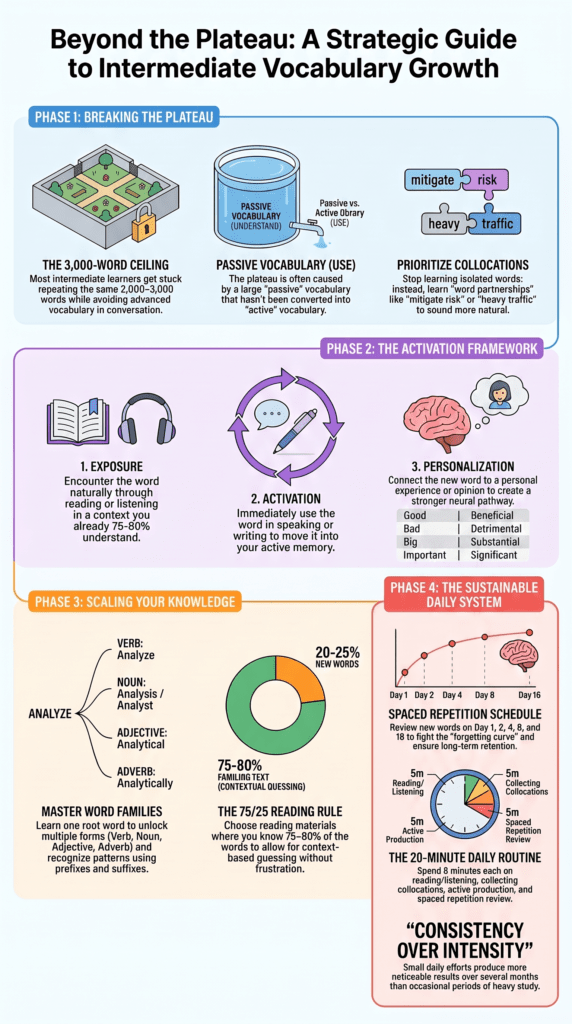
For many years, I believed that harder reading materials would automatically produce better results. I often selected books and articles that were well beyond my comfort level. In practice, I spent more time looking up words than actually reading.
Eventually, I found that moderate challenge produced better outcomes. Material that is too difficult often interrupts comprehension and reduces motivation. Material that is too easy provides little new vocabulary.
For intermediate learners, a useful target is content that contains roughly 75–80% familiar vocabulary. This level allows readers to understand the main message while still encountering enough unfamiliar language to support growth.
The 75/25 Learning Rule
- Comfortable comprehension
- Manageable challenge
- Context-based guessing
- Ongoing vocabulary growth
At this level, learners can often infer meaning from context before checking a dictionary. This process strengthens retention because the brain works actively with the language.
A context log can also support vocabulary development.
Keep a Context Log
Record:
- The complete sentence
- The source
- Your guessed meaning
- The confirmed meaning
Over time, these notes create personal connections to vocabulary. Those connections often make words easier to remember than definitions copied from a dictionary.
How Does Spaced Repetition Improve Long-Term Retention?
Forgetting vocabulary is one of the most common frustrations in language learning. I have learned words many times, only to discover weeks later that I could no longer recall them. Most learners have had the same experience.
The problem is not usually a lack of effort. Memory fades without review. Spaced repetition addresses this issue by reviewing vocabulary at carefully timed intervals before it is forgotten.
Systems such as the Leitner method and modern flashcard applications follow this principle. Instead of reviewing everything every day, learners review words at increasing intervals based on how well they remember them.
Sample Review Schedule
| Day | Action |
| 1 | Learn |
| 2 | Review |
| 4 | Review |
| 8 | Review |
| 16 | Review |
The quality of review also matters. Simple definition matching often produces weak retention.
As noted by Frontiers in Education
“Spaced repetition… is a well-researched method for improving long-term retention.” – Frontiers in Education
More effective review activities include:
- Fill-in-the-blank sentences
- Collocation practice
- Personal examples
- Context-based questions
For example, learners might complete a sentence such as “The company worked to ______ the impact of the problem.” This approach encourages active recall and strengthens long-term retention.
What Daily System Produces Consistent Vocabulary Growth?
Credits: Kara Ronin
After years of studying languages and working with students, I have become convinced that consistency matters more than intensity. Short study sessions repeated regularly often produce stronger results than occasional periods of heavy study.
Many learners search for a perfect technique. In practice, progress usually comes from combining several simple habits into one routine. The routine does not need to be complicated. These small habits often lead to the kinds of Intermediate English breakthroughs that learners struggle to achieve through intensive but inconsistent study.
A useful vocabulary system includes exposure, retrieval, recording, and review. Each part supports the others. Reading introduces new vocabulary. Active use strengthens recall. Review protects against forgetting.
Before starting a study session, it helps to prepare materials that support each step of the process.
20-Minute Daily Routine
- 5 minutes: Read or listen
- 5 minutes: Collect collocations
- 5 minutes: Practice active production
- 5 minutes: Complete spaced repetition review
This routine can fit into a busy schedule while still supporting meaningful vocabulary growth. Small daily efforts often produce noticeable results after several months. The key is continuing even when progress feels slow, because vocabulary growth is usually gradual rather than dramatic.
Building a Sustainable Vocabulary Expansion System

The most successful vocabulary learners I have worked with rarely rely on a single strategy. Instead, they build systems that combine several methods and repeat them consistently over time.
I learned this lesson through experience. Reading alone expanded my exposure but did not always improve recall. Flashcards helped retention but did not automatically improve speaking. Word-family study increased recognition but needed active practice before it became useful in conversation. Each method helped, but none worked well in isolation.
When these strategies are combined, they reinforce one another. Reading introduces vocabulary. Collocations show how words work together. Active retrieval strengthens memory. Word families expand understanding. Spaced repetition supports long-term retention.
Before ending a study session, it helps to review what was learned and think about when those words can be used again. Future exposure plays a major role in long-term retention.
- Prioritize phrases over isolated words.
- Convert passive knowledge into active usage.
- Learn vocabulary through families and patterns.
- Read slightly above your comfort level.
- Review strategically rather than randomly.
Steady vocabulary growth rarely comes from shortcuts. It comes from building habits that can be repeated consistently over time.
FAQ
How can vocabulary for intermediate students improve without memorizing long vocabulary lists?
Vocabulary for intermediate students often improves through repeated exposure and active use rather than memorizing words one by one. Learners can build vocabulary by studying collocations, useful phrases, and complete sentences.
Reading, listening, speaking, and writing activities help reinforce contextual meaning, improve vocabulary retention, and support steady vocabulary growth in everyday English.
Which vocabulary building activities help intermediate learners remember new words?
Intermediate learners often remember new words better when they use them in different ways. Flashcards, vocabulary exercises, vocabulary quizzes, and vocabulary games provide useful vocabulary practice. Combining English word learning with pronunciation practice, spelling practice, and word association strengthens vocabulary enrichment and supports long-term language development.
How do collocations and phrasal verbs improve speaking fluency?
Collocations and phrasal verbs help learners understand how English vocabulary is used naturally in conversation. Learning these common expressions improves speaking fluency because learners recall groups of words instead of single terms. This approach strengthens communication skills, expands lexical range, and supports clearer and more confident verbal expression.
Why should intermediate learners study word families and root words?
Studying word families helps learners recognize connections between root words, prefixes, suffixes, and related terms. This vocabulary strategy supports language acquisition and vocabulary expansion. It also improves reading comprehension and writing skills because learners can identify unfamiliar words and understand their likely meanings through context and structure.
What is the best vocabulary strategy for intermediate English learners?
The best vocabulary strategy combines daily vocabulary review with regular practice. Intermediate English learners can improve vocabulary through reading vocabulary, listening vocabulary, speaking vocabulary, and writing vocabulary activities.
Reviewing high-frequency words, academic vocabulary, synonyms, antonyms, and topic vocabulary consistently supports fluency development and stronger language skills over time.
Build Vocabulary With Confidence
Growing your vocabulary can feel slow at times, especially when new words don’t seem to stick right away. That’s normal. Real progress comes from using what you learn regularly and trusting that small efforts add up over time.
Every conversation and review session gives you another chance to strengthen your English. Start with one strategy today and stay consistent. Ready to grow with confidence? Learn with Ivy Languages International.
References
- https://learn.saylor.org/mod/page/view.php?id=92317
- https://www.frontiersin.org/journals/education/articles/10.3389/feduc.2024.1496578/full
Related Articles
- https://ivylanguagesinternational.com/how-to-overcome-english-learning-plateaus/
- https://ivylanguagesinternational.com/strategies-for-intermediate-english-learners/
- https://ivylanguagesinternational.com/intermediate-english-breakthroughs/