
You know all the grammar rules, you can pass the test. But real conversations? That’s where the wall hits. You feel stuck, using the same simple sentences even when you know better words.
This common plateau has a name: ‘fossilization.’
Moving forward isn’t about memorizing more rules. It’s a mental shift learning to use the grammar you already have with purpose and clarity.
Ready to break through? Let Ivy Language International show you how.
Grammar Shifts That Move You Toward C1
These are the main changes that helped me move beyond intermediate grammar and communicate with more precision and confidence.
- Advanced grammar focuses on communication quality rather than grammar memorization.
- Structures such as mixed conditionals, cleft sentences, inversion, and participle clauses improve clarity and precision.
- Consistent practice, sentence mining, and active production help transform grammar knowledge into natural communication.
The Intermediate Plateau: Why Does Progress Slow Down After B1/B2?
Advanced grammar is difficult because you must make the rules automatic. Knowing a rule differs from using it smoothly during a fast conversation.
This is what we call the intermediate plateau. You know the grammar. You can use past perfect, relative clauses, modals. You get by. Because you can communicate, the drive to use more complex structures fades.
This stage often prevents learners from achieving the intermediate English breakthroughs they expect after reaching B1 or B2. You might read and listen for years without your own sentences becoming more flexible.
Research from Serpil Tekir shows
“Many intermediate-level English learners face stagnation, known as the intermediate plateau, hindering their progress and affecting academic performance.” – Serpil Tekir (2024)
You might recognize some of these signs:
- You rely on the same handful of sentence patterns.
- You understand an advanced structure but never seem to use it yourself.
- Combining several ideas into one smooth sentence feels awkward.
- Your writing and speech stay in simple clauses.
This isn’t a failure. It’s a normal, frustrating stage. In my work at Ivy Languages International, I’ve seen the shift happen when a student stops just studying grammar and starts making deliberate communication choices. That’s where progress begins again.
What Are the Fastest Advanced Grammar Structures to Learn First?
I used to go back and review the easy grammar rules. It made me feel safe. But it wasn’t really helping me talk better. Now, I only work on the stuff that changes how I speak right away.
The best advanced grammar for me isn’t the weirdest stuff. It’s the kind I can actually use tomorrow to make my point clearer, or to just sound more like a normal person.
Effective advanced curricula prioritize real-time language production over passive drills. To move from understanding a rule to using it naturally, learners need opportunities to practice these patterns during live conversations.
These are the tools that give you the biggest return for your effort. They help you package information differently and express subtlety.
- Mixed conditionals (e.g., “If I had studied harder last year, I would be more confident now.”)
- Cleft sentences (e.g., “What I need is more time,” or “It was my teacher who helped me understand.”)
- Participle clauses (e.g., “Having finished the report, she sent it immediately.”)
- Selective inversion (e.g., “Not only did he pass, but he also scored the highest.”)
- The subjunctive mood (e.g., “I suggest that he be present.”)
- Advanced connectors (e.g., “whereas,” “insofar as,” “notwithstanding”)
- Information packaging (shifting the focus of a sentence for emphasis)
Books like Advanced Grammar in Use focus on these for a reason. They aren’t just more rules; they are communication strategies. Learning them felt less like studying and more like finally having the right tools for the job.
What Is the Difference Between Intermediate and Advanced Grammar?
Advanced grammar helps you connect complicated business or school ideas. It gives you control over your writing.
According to Cambridge English, learners moving from B2 to C1 must demonstrate increased flexibility, precision, and stylistic awareness.
| Intermediate Use | Advanced Use | Communication Benefit |
| Simple clauses | Compound-complex clauses | Greater precision |
| Basic conditionals | Mixed conditionals | More nuanced meaning |
| Standard emphasis | Cleft sentences | Stronger focus |
| Direct statements | Selective inversion | Formal emphasis |
| Basic connectors | Advanced discourse markers | Better cohesion |
| Simple paragraph flow | Information packaging | Improved clarity |
Intermediate grammar often focuses on correctness. Advanced grammar focuses on effectiveness. Learners begin making deliberate decisions about sentence structure, emphasis, and organization.
This shift affects spoken English grammar, written English grammar, and academic communication equally.
Need Precise Communication? Why Not Master Advanced Conditionals?

A lot of us think “if” sentences are the whole story with conditionals. But here’s the thing real conversation makes you link what happened before to what’s happening now. It’s not just about the word “if.”
A standard line like, “If we had more time, we would have succeeded,” is fine. It doesn’t really link a past choice to your current reality, though. Mixed conditionals fix that. They tie different times together in one clear idea.
As noted by Irena Polańska-Łuczyk
“Traditional textbooks describing English grammar concentrate generally on three main types of conditional sentences. Mixed conditionals represent an advanced structure necessary for more nuanced expression.” – Irena Polańska-Łuczyk (2009)
For example: “If she had practiced more last year, she would be confident in meetings now.” Or, “If she were less hesitant, she would have asked that question yesterday.”
This isn’t just grammar. It’s power. You can discuss regrets, risks, or professional scenarios with real accuracy. Your arguments get sharper.
How Do Cleft Sentences Improve Information Focus?
One of the clearest signs of an advanced speaker isn’t just vocabulary. It’s how they guide your attention. Early on, my sentences just presented facts. “The meeting is at three.” Later, I learned to point to what mattered most. “What’s important is the meeting at three.” That shift uses a cleft sentence.
These structures let you control emphasis. You take a standard sentence and rearrange it to spotlight one piece.
Take a simple statement: ‘John finished the report yesterday.’ Use an ‘it-cleft’ to clarify responsibility: ‘It was John who finished the report’ (not Sarah). Use a ‘wh-cleft’ to highlight the specific task completed: ‘What John finished yesterday was the report’ (not the presentation)
Compared with formal inversion, cleft sentences are often easier for learners to adopt because they sound more natural in spoken English. They provide a simple way to clarify, correct, or emphasize ideas.
Phrases such as “What I meant was…” and “It’s the deadline that’s the problem” help speakers communicate their intended meaning with greater precision and emphasis.
Resources like Cambridge Grammar note these structures help organize information more clearly. For me, they were a practical tool. They stopped my sentences from being just a list of facts and started making them a guided conversation.
Want to Sound More Formal? How Do You Use Inversion Naturally?
When I first learned about inversion, I thought it was the best thing ever. I started using it all the time in my sentences. But then my teacher told me my writing was starting to sound like an old book, not like something a normal person would say. I learned the hard way that inversion only works if you use it once in a while, not in every other sentence.
Inversion is for emphasis, not for daily conversation. You use it to make one point stand out sharply. Think of it like a spotlight in a dark room. If you turn on all the spotlights, the effect is gone.
It belongs in specific, formal contexts:
- In an academic conclusion: “Not only does the data support the theory, but it also suggests a new direction.”
- In an executive summary: “Under no circumstances should we proceed without client approval.”
- In a formal presentation: “Rarely have we encountered a challenge of this scale.”
It sounds unnatural in casual settings. You wouldn’t say “Little did I know the coffee was cold” to a friend at breakfast.
Effective examples are concise and punchy:
- “Never before had the team been so united.”
- “Only after the audit did the full picture emerge.”
- “Seldom do we get a second chance like this.”
Linguists classify inversion as a stylistic choice rather than a strict structural requirement. It functions exclusively to change sentence emphasis. Using it once in a report creates impact. Using it three times creates a distraction.
For most advanced learners, inversion works best as an occasional emphasis device. Used sparingly, it can add significant impact to a sentence without making the overall writing sound overly formal or unnatural.
The Subjunctive Mood: Is It Still Useful in Professional English?
For me, the subjunctive mood is really hard to notice. I don’t hear it much when people are just talking. So, when I was first learning, I just skipped right over it. I didn’t even know it was there.
The authors of The Cambridge Grammar of the English Language state that words of demand, suggestion, or necessity cause this mood. After these words, you must use the base form of the verb. This rule can sound strange at first.
You see it after words like:
- suggest that / recommend that
- insist that / demand that
- it is essential that / it is crucial that
So you write:
- “The manager suggested that he take a different approach.” (Not takes)
- “We demand that the process be transparent.” (Not is)
- “It is essential that every member attend.” (Not attends)
The subjunctive marks it as a formal requirement, not just a casual idea. It’s a small detail that signals you understand the conventions of professional and academic English. You use it not to sound fancy, but to be precisely correct in contexts where that correctness matters.
How Do Participle Clauses Improve Advanced Writing?

My early writing was full of short, repetitive sentences. “She felt tired. She went home early.” It was clear, but it sounded choppy. Learning to use participle clauses was like learning to combine thoughts smoothly. They help you pack more information into a sentence without adding more words.
Linguists Rodney Huddleston and Geoffrey Pullum highlight these clauses in their comprehensive research. They prove that participle clauses are a key feature of efficient, advanced writing.
They come in a few forms:
- Present participle (-ing): “Feeling tired, she went home early.”
- Past participle (-ed / irregular): “Published in 2020, the report remains influential.”
- Perfect participle (having + past participle): “Having completed the assignment, he submitted it immediately.”
But there’s one critical rule. The subject of the participle clause must be the same as the subject of the main clause. If you get this wrong, you create a “dangling modifier,” which can be confusing or even funny.
Once you manage that rule, these clauses become incredibly useful. They cut out repetition and make your writing flow. Instead of writing “He finished the report. He then emailed it to the team,” you can write “Having finished the report, he emailed it to the team.” It’s a small change that makes a big difference in how professional your writing feels.
Want More Control Over Your Sentences? What Is Information Packaging?
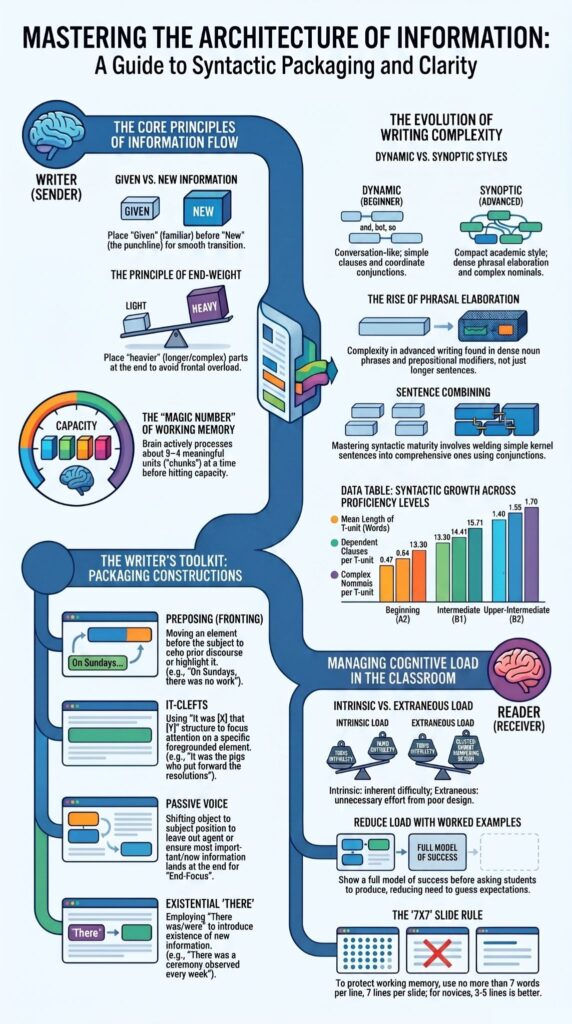
The goal is to present information in a way that is easy to understand, not more difficult to process. This reflects a key principle of advanced grammar: clarity is often more important than complexity.
A beginner might write a series of simple statements: “The student completed a project. The project lasted six months. The project involved extensive research.” It’s clear, but it’s inefficient.
An advanced writer packages those ideas together: “The student, having spent six months conducting research, completed the project successfully.” The same information is there, but it flows. It’s not about making a sentence longer; it’s about making the connection between ideas obvious.
This packaging uses the tools we’ve discussed:
- Relative clauses: “The report, which analyzed market trends, was well-received.”
- Adverb clauses: “After the data was verified, we published the findings.”
- Noun clauses: “What surprised the team was the rapid response.”
- Participle phrases: “Using the new software, she finished the task quickly.”
- Connectors: “The plan is sound; however, the timeline is ambitious.”
The goal is never to confuse. It’s to guide your reader through complex thoughts with as little friction as possible.
Why Advanced Grammar Often Fails During Real Communication
Credit: Teacher Luke
I can spot a tricky grammar rule in a workbook exercise. I know what it’s supposed to look like on paper. But the second I open my mouth to speak, it’s like my brain freezes. I just can’t pull that rule out when I need it. That gap between what I see and what I can say is something almost everyone who learns a language has to figure out how to cross.
This isn’t a personal failing. It’s how language learning works. Recognition develops faster. Production takes time and deliberate practice. Many learners only begin to overcome English learning plateaus once they shift their attention from grammar recognition to active production.
In my own experience, and in countless discussions with students, three main barriers get in the way:
- The Recognition-Production Gap. Knowing a rule and using it automatically are two different skills. The bridge between them is not more study, but more targeted use.
- Retention Burnout. Trying to master five new advanced structures in a week is a recipe for remembering none of them. It creates overload, not improvement.
- Over-Grammarization. I’ve seen learners, myself included, become so focused on applying a new rule that their communication freezes. The goal of speaking gets lost in the mechanics.
Progress at this stage isn’t about collecting more knowledge. It’s about making the knowledge you already have ready to use.
Tired of Forgetting Grammar Rules? What if You Could Automate Them Instead?Sentence Mining as a Path to Grammar Automation
The method that finally helped me bridge that gap between knowing a rule and using it wasn’t more theory. It was a practical technique called sentence mining, often discussed in language learning communities online. It’s simply collecting and internalizing real sentences.
The process is straightforward. You find a useful sentence from something you’re reading or listening to, a news article, a book, a podcast. You highlight the specific grammar structure you want to learn. Then you save it in a review system like Anki, a notebook, or a digital document.
But the key is what you do next. You don’t just memorize it. You work with it.
- Review it regularly, so the pattern becomes familiar.
- Create your own variations. Change the subject, the verb, the context.
- Try to use it in your next writing task or conversation.
This method moves grammar from passive recognition to active recall. You’re not just recognizing the structure; you’re practicing the act of producing it. Over weeks and months, these patterns start to feel natural. You stop searching for the rule and start using the tool. It turns abstract knowledge into a communication habit.
FAQs
How can I improve advanced English grammar without feeling overwhelmed?
You can improve advanced English grammar by following a structured study plan. I advise isolating exactly one target structure per week, such as mixed conditionals. Write five custom variations tied directly to your daily workload, and run them through a syntax checker. This keeps your cognitive load manageable while systematically breaking your old intermediate habits.
Which grammar topics improve English sentence structure the most?
The grammar topics that most improve English sentence structure are complex sentence formation, compound sentences, relative clauses, and sentence connectors. These structures help you combine ideas clearly and logically. For example, relative clauses add important details, while sentence connectors show relationships between ideas. Learning these topics makes your writing more organized and easier to understand.
Why do learners struggle with tense consistency in longer sentences?
Learners often struggle with tense consistency because they focus on individual clauses instead of the entire sentence. Speakers frequently lose tense consistency when they mix reported speech or complex perfect tenses inside a single narrative arc.
To avoid tense mistakes, draw a timeline of your story. Ensure your verbs match that timeline exactly, even when you write long sentences with multiple parts.
How do sentence connectors improve grammar for communication?
Sentence connectors improve grammar for communication by showing how ideas relate to one another. Words such as “however,” “therefore,” and “in addition” help readers follow your reasoning. These transition words, discourse markers, and conjunctions create logical connections between sentences. As a result, your written English grammar becomes clearer, more organized, and easier to understand.
What is the best way to practice advanced sentence patterns?
The best practice method is sentence rewriting. Take two simple sentences. Combine them using a single advanced tool, like a participle clause or a mixed conditional. Then, compare your new sentence to the old one to see the improvement. This method strengthens grammar practice, improves English fluency, and helps you use advanced structures accurately.
Building Advanced Grammar Takes Time
Advanced grammar can feel overwhelming at first because the challenge isn’t just understanding the rules, it’s learning when and how to use them naturally. If your English progress has stalled, the issue is often not a lack of knowledge but a lack of consistent real-world application.
In my experience, progress comes little by little through reading, listening, speaking, and paying attention to how language works in real situations. There is no single moment when intermediate grammar suddenly becomes advanced grammar.
Over time, If you’re working toward C1-level English, focus on using what you learn every day and be patient with the process.
For learners who want additional guidance, Ivy Languages International provides structured support and real-world practice to help make that journey a little clearer.
Ready to take the next step? Join us at Ivy Language International and turn advanced grammar into confident, natural communication.
Related articles:
- https://ivylanguagesinternational.com/intermediate-english-breakthroughs/
- https://ivylanguagesinternational.com/how-to-overcome-english-learning-plateaus/
- https://ivylanguagesinternational.com/why-your-english-progress-has-stalled/
Reference
- https://eric.ed.gov/?id=ED662809
- https://ejournals.eu/en/journal/zeszyty-glottodydaktyczne/article/how-not-to-get-all-mixed-up-about-mixed-conditionals