
Education
I first noticed how difficult advanced English listening can be when I knew every word in a conversation but still missed the meaning. The problem wasn’t vocabulary. People connected sounds, spoke quickly, changed their tone, and left some meaning unstated. At C1 and C2, listening asks us to handle these things at the same time.
I’ve learned that improving takes more than listening to difficult recordings. Some days, progress is hard to notice. Still, each repeated listen helps. Keep reading to build a practical routine we can use consistently.
Advanced Listening: The Quick Wins
Better listening comes from identifying where comprehension breaks, then training that specific skill with focused practice.
- We can combine top-down prediction with careful acoustic decoding instead of depending on only one approach.
- We can use micro-listening, shadowing, dictogloss, and two-pass listening to train specific weaknesses.
- We can build stronger listening confidence by gradually increasing speed, speaker variety, accents, and background difficulty.
What Makes Advanced Listening Harder Than Intermediate Listening?
I first noticed this problem when I could understand English in class but struggled with normal conversations. I knew the words, yet they didn’t always sound familiar when people spoke quickly. Sounds connected, some words became shorter, and speakers sometimes talked over each other. That’s when I realized that advanced listening isn’t only about vocabulary.
We also need to follow speed, pronunciation changes, context, and what the speaker means beyond the words. At C1 and C2, the CEFR expects us to handle complex spoken English, including unfamiliar terms and regional language at C2. It takes time, but regular exposure helps.
| Challenge | What we may experience | Training response |
| Processing speed | Speech moves ahead of analysis | Micro-listening |
| Connected speech | Familiar words become difficult to segment | Acoustic decoding |
| Cognitive load | One missed phrase affects later meaning | Strategic attention |
| Implicit meaning | Literal words do not show the whole message | Contextual inference |
| Speaker variation | Familiar words sound different | Accent diversity |
- We can focus on how comprehension breaks down.
- We can train one listening weakness instead of simply adding more hours.
- We can use CEFR descriptors to set realistic advanced listening goals.
Our experience is that listening practice becomes more useful when we can name the problem instead of simply saying that the audio feels difficult.
Why Does Clean Audio Keep Us at the Intermediate Plateau?

I noticed this gap when I could follow a clear podcast but struggled to keep up with real conversations. The recording was easy to hear, yet everyday speech felt different. People interrupted each other, shortened words, changed speed, and sometimes spoke with accents I wasn’t used to. Background noise didn’t help either.
Clean audio still has a place in my practice. It helps me get used to clear pronunciation and steady pacing. But once that feels comfortable, I need less controlled material too.
That’s also what the Council of Europe expects at advanced levels, where listeners may need to follow overlapping speech, colloquial language, and natural-speed conversations.
So I add harder material gradually. That feels more realistic.
Which Audio Environments Should We Add?
We can build difficulty gradually by changing one part of the listening environment at a time.
- We can begin with clear lectures and structured discussions.
- We can move toward interviews and conversational audio.
- We can add multiple speakers and less predictable turn-taking.
- We can include different accents and informal speech.
- We can return to difficult speakers instead of constantly changing sources.
We can increase one difficulty variable at a time so that our listening accuracy remains measurable as the material becomes harder.
How Can Top-Down and Bottom-Up Processing Work Together?
I learned that difficult listening gets easier when I use both my ears and the context around me. If I focus only on individual sounds, I can lose the main idea. But if I rely too much on what I expect to hear, I can misunderstand the speaker.
Bottom-up processing helps me build meaning from the sounds and words I hear. Top-down processing works from context, background knowledge, and what I expect the speaker might discuss. This same habit of using context to think in English can make it easier to process meaning without translating every sentence.
Before an academic talk on climate policy, for example, I might expect terms such as emissions or regulation. Then I listen and check those predictions against the actual discussion. If the speaker takes a different direction, I change my expectations.
That balance matters. I’ve found it helps me listen with more flexibility instead of trying to catch every word.
As highlighted by Furuya (2021)
“This study found that lower intermediate learners performed better when they had vocabulary knowledge but no background knowledge, whereas upper intermediate learners performed better with background knowledge but no vocabulary knowledge. Notably, no significant difference was observed between these two conditions for advanced learners, suggesting that advanced listeners must be able to flexibly deploy both processing modes .” – Furuya
| Processing route | What we focus on | Example |
| Bottom-up | Sounds and word boundaries | Decode reduced forms |
| Top-down | Context and expectations | Predict lecture content |
| Integrated | Evidence and prediction | Confirm or revise an inference |
- Before listening, we activate relevant background knowledge.
- During listening, we test our predictions.
- When predictions fail, we follow the acoustic evidence.
- We avoid automatically filling every gap with what we expected.
How Can Schema Pre-Activation Reduce Cognitive Load?
Before difficult listening, we can write 3–5 concepts or questions that may appear in the recording.
These anchors give our attention a structure. They do not need to predict exact sentences or vocabulary.
That small preparation can help us focus on the speaker’s main argument instead of treating every incoming word as equally important.
How Does a Two-Pass Listening Protocol Reduce Subtitle Dependence?
A two-pass method separates general comprehension from detailed decoding, giving us a clearer way to identify exactly where listening breaks down. During the first pass, we focus on the main idea, speaker purpose, structure, and important changes in the discussion.
We do not pause every time we hear an unfamiliar expression. Instead, we allow ourselves to continue and hold uncertain information temporarily. During the second pass, we return to the difficult sections and investigate what caused the problem. We can use a transcript at this stage as a diagnostic tool.
The approach fits the broader principle of metacognitive listening because we are not only listening. We are also checking how we listen and why comprehension succeeds or fails.
What Should We Do During the First Pass?
We can keep the first pass simple so that we train listening for gist rather than translation.
- Listen without subtitles.
- Identify the topic and main argument.
- Track the speakers and major transitions.
- Write only information that blocks understanding.
- Avoid stopping for individual words.
What Should We Do During the Second Pass?
We can use the transcript only after making our own interpretation of the audio.
- We locate the sections we missed.
- We mark connected-speech features.
- We check unfamiliar vocabulary.
- We identify predictions that were incorrect.
- We replay difficult sections without text.
Subtitles can therefore become a diagnostic tool rather than something we need throughout the entire listening session.
How Can We Decode Connected Speech More Accurately?

Natural English can make familiar words sound unfamiliar because speakers link, reduce, assimilate, or omit sounds during normal conversation.
I noticed this problem most clearly when written English felt easy but spoken English seemed much faster than expected.
A listener may know every word in a sentence and still fail to recognize the sentence because the acoustic form does not match the form stored in memory.
For example, connected speech can change how word boundaries sound. Function words can become less prominent, and neighboring sounds can influence one another.
The CEFR Companion Volume also recognizes the importance of prosodic features such as stress, rhythm, and intonation in advanced spoken communication.
How Does Metacognitive Monitoring Improve Listening Control?
Metacognitive monitoring helps us notice whether our interpretation still makes sense while speech continues.
We can think of this as listening while checking our own listening. Instead of stopping whenever something becomes unclear, we continue building meaning and revisit the uncertainty when more context becomes available.
This approach matters because real conversations do not pause for us to translate every sentence. We need to maintain enough understanding to follow the next idea.
A 2017 International Journal of Listening study examined task-based instruction for developing metacognitive awareness in English listening, while later research has continued examining the relationship between metacognition and comprehension.
Research from Aryadoust (2019) shows
“This theoretical framework emphasizes the role of both bottom-up and top-down processing in listening comprehension, highlighting the importance of perception, word recognition, situation models, mental imagery, and inferencing elements that align with the article’s discussion of cognitive load and contextual inference.” – Aryadoust
| Strategy | Real-time action |
| Selective attention | Prioritize stressed words and discourse markers |
| Monitoring | Check whether our interpretation still fits |
| Ambiguity tolerance | Delay low-value questions |
| Recovery | Reconstruct meaning from surrounding information |
What Should We Do When Comprehension Breaks?
We can use a simple recovery routine when a sentence becomes unclear.
- We do not stop after every unknown word.
- We hold uncertain information temporarily.
- We continue following the speaker’s argument.
- We use later context to reconsider the missing phrase.
- We return to the recording after the first listening attempt.
This habit takes time to develop because our first reaction may be to translate the missing phrase immediately.
That said, allowing a small amount of uncertainty can help us maintain the processing speed needed for real conversations.
Why Does Shadowing Help Advanced Listeners Process Natural Speech?
Shadowing connects listening with immediate speech production, giving us a practical way to notice rhythm, stress, timing, linking, and reduced forms.
We can begin by repeating short phrases after the speaker. Once that feels manageable, we can reduce the delay between hearing and speaking.
This practice makes us pay attention to features that are easy to ignore during passive listening, including pauses, sentence rhythm, stress, and changes in pitch.
The goal is not to copy an accent. The goal is to improve our ability to hear and reproduce the timing patterns that organize spoken English.
What Should We Listen For?
Our attention should stay on a few clear features during each practice session.
- Stressed syllables
- Reduced forms
- Pauses
- Linking
- Intonation
- Sentence rhythm
With regular practice, these features can become easier to recognize without conscious analysis.
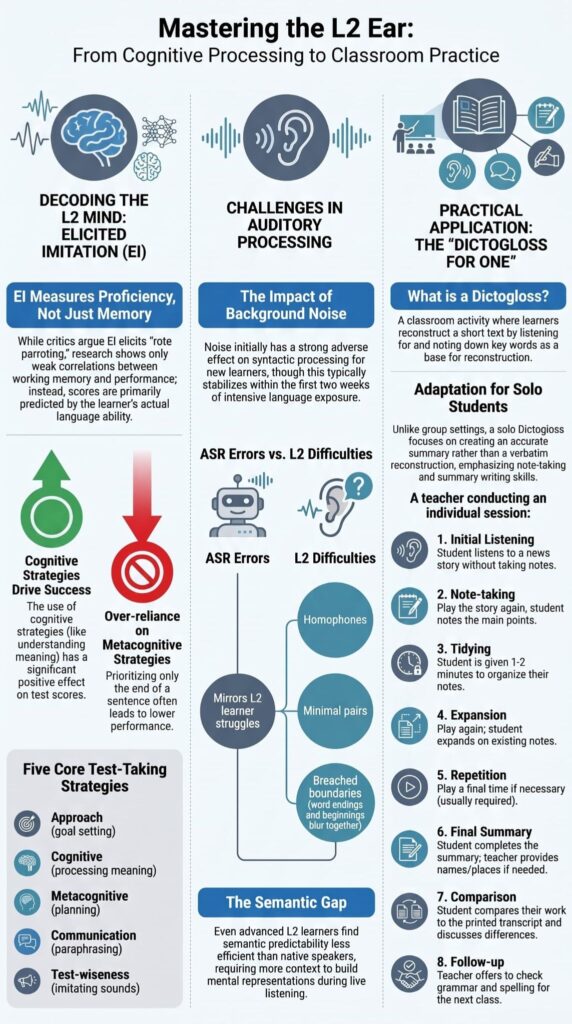
Can Dictogloss Reveal Listening Gaps That Passive Practice Misses?
Dictogloss can show us the difference between what we think we heard and what we can accurately reconstruct from memory.
We listen to a short passage, take limited notes, and then recreate the message. We are forced to decide which information we actually understood.
A 1–2 minute passage is enough for a useful exercise. The purpose is not to produce perfect grammar. The purpose is to identify where listening accuracy breaks down.
This exercise can reveal problems with vocabulary, segmentation, attention, inference, or working memory that may remain hidden during ordinary listening.
Which Audio Types Build Real-World Listening Flexibility?
We need different speakers, formats, speeds, and acoustic conditions because advanced listening rarely happens under one fixed set of conditions.
The CEFR describes advanced listening across demanding lectures, discussions, presentations, and situations involving complex meaning.
We can therefore build our listening library gradually rather than relying on one comfortable type of recording.
Which Audio Should We Practice?
A staged approach helps us increase difficulty without losing control of our progress. Reading advanced English literature can also expose us to complex vocabulary, varied sentence structures, and ideas that support broader language comprehension.
| Stage | Audio type | Primary skill |
| 1 | Clear lectures | Structural comprehension |
| 2 | Interviews | Speaker tracking |
| 3 | Conversational podcasts | Natural pacing |
| 4 | Panel discussions | Multiple-speaker tracking |
| 5 | Regional or informal speech | Accent adaptability |
How Can We Build Cognitive Stamina Without Burning Out?
Credits: Learn English Lab
Advanced listening requires sustained attention, but longer sessions are not automatically better because accuracy can fall when mental fatigue becomes too high.
We can use short intensive sessions for difficult decoding and longer sessions for extensive listening.
This gives us two different goals. Intensive practice improves precision, while extensive listening helps us stay engaged with meaning over a longer period.
A 20-minute focused session can be more useful than an hour spent listening while our attention has already disappeared.
Should We Use Faster Playback?
Limited speed manipulation can be useful as a demanding exercise, but natural-speed English should remain our main target.
We can briefly work with 1.25x playback when normal-speed material has become comfortable, then return to natural speed and check whether comprehension remains accurate.
The purpose is not to make normal English feel slow. The purpose is to make ordinary processing feel more manageable.
How Should We Measure Progress at C1–C2?
We can measure advanced listening by checking how well we maintain meaning under increasingly difficult conditions, not simply by counting listening hours.
The CEFR gives us useful reference points because C1 and C2 involve increasingly complex spoken material, including lectures, discussions, specialized language, and implied meaning.
We can track several skills separately because strong vocabulary does not guarantee strong acoustic processing.
Which Listening Skills Should We Track?
| Skill | Advanced target |
| Main idea | Follow a complex argument |
| Detail | Recover information at natural speed |
| Speech recognition | Decode reduced natural speech |
| Context | Infer unstated meaning |
| Speaker tracking | Follow multiple voices |
| Recovery | Continue after comprehension gaps |
How Can Ivy Languages International Turn These Strategies Into Practice?
At Ivy Languages International, we can organize advanced listening around specific processing problems rather than simply asking us to listen more.
We can begin by identifying whether the main difficulty involves connected speech, processing speed, speaker tracking, inference, or listening stamina.
From there, we can choose a focused exercise and measure the result before increasing the difficulty.
| Listening problem | Recommended strategy |
| Familiar words sound unfamiliar | Connected-speech micro-listening |
| We lose the argument after one missed phrase | Monitoring and recovery |
| We depend on subtitles | Two-pass listening |
| Native conversations feel too fast | Shadowing and narrow listening |
| We understand words but miss intent | Pragmatic inference |
| Long audio exhausts us | Structured stamina training |
Our practice can follow four steps: identify the bottleneck, choose a targeted drill, measure performance, and gradually increase difficulty.
This approach keeps advanced listening practice practical. We do not need to treat every listening problem as the same problem.
What Should an Advanced Listening Routine Look Like?
A strong routine combines intensive decoding with extensive comprehension so that we develop both listening accuracy and the ability to stay engaged with longer speech.
We can dedicate one day to connected speech and another to shadowing, while still making room for natural conversations and longer recordings.
The CEFR framework supports the idea of progressively demanding listening, including situations where we need to follow complex information and interpret meaning that is not stated directly.
How Can We Structure the Week?
- Day 1: Micro-listening and connected speech
- Day 2: Two-pass listening
- Day 3: Shadowing
- Day 4: Multi-speaker listening
- Day 5: Dictogloss
- Day 6: Extensive native-level audio
- Day 7: Progress review
We can track three basic measures:
- Accuracy
- Processing speed
- Recovery ability
This kind of structured practice can become part of broader advanced English mastery, especially when we increase difficulty based on the specific listening skill that needs more work.
The goal is not perfect decoding of every sound. The goal is maintaining meaning when speech becomes fast, reduced, ambiguous, or unpredictable.
FAQs
How can I improve listening comprehension when spoken English feels too fast?
Start with short sections of speech instead of trying to understand an entire recording at once. Listen once for the general meaning, then replay difficult parts and identify the words or sounds you missed. Pay attention to connected speech, reduced forms, stress, and intonation. This focused approach can improve listening accuracy, spoken English understanding, and confidence when processing fast speech.
What should I listen for when I cannot understand every word?
Listen for the main idea first, then identify the details that support it. Recognizing key words, repeated phrases, and discourse markers can help you follow the speaker without translating every sentence. You can also use the topic and surrounding information to predict meaning while listening. These habits make it easier to understand unfamiliar speech without losing track of the conversation.
How can I understand different accents in English?
Expose yourself to speakers from different English-speaking regions instead of listening to only one familiar accent. Notice differences in pronunciation, stress, intonation, and connected speech. Start with subtitles when necessary, then listen without subtitles to check your understanding. Regular exposure to different accents can improve auditory comprehension and help you follow conversations with unfamiliar speakers more comfortably.
How can I tell what a speaker really means?
Listen for more than the literal meaning of each sentence. A speaker’s tone of voice, word choice, pauses, and emphasis can reveal attitudes or intentions that are not stated directly. Pay attention to discourse markers and the relationship between ideas. These critical listening skills can help you identify speaker intention, understand implied meaning, and make better inferences during conversations.
What listening practice techniques work best for advanced English learners?
Combine different types of practice instead of relying on one exercise. Use intensive listening for difficult passages, extensive listening for regular exposure, and dictation or transcription practice to examine missed words. Shadowing can connect listening with speaking practice. Choose authentic listening materials that match your goals, such as conversations, academic discussions, or workplace communication, and practice consistently.
Breaking Through an Advanced Listening Plateau
When I reach a point where English feels familiar but spoken words still blur together, I know that simply listening to more audio isn’t enough. I’ve found that the better approach is to notice where I lose understanding, then practice that specific skill until it becomes easier. Sometimes the problem is connected speech. Sometimes it’s following one speaker in a busy conversation. The important part is being honest about where comprehension breaks down.
That kind of progress takes time. At Ivy Languages International, we can make the process more focused by choosing listening practice based on the skills that need work, then building difficulty gradually. There isn’t a quick fix, but steady practice can make real conversations feel easier over time. If you’re working through an advanced listening plateau, Ivy Languages International can be a practical place to keep moving forward.
References
- https://eric.ed.gov/?id=EJ1295625
- https://eric.ed.gov/?id=EJ1213278