
I remember the exhaustion of trying to follow a fast business meeting decades ago. Words blurred together, jokes were missed. I was working, studying, and building a life where English wasn’t academic, it was essential. That personal struggle is why we built Ivy Languages International and this program. We understand the gap between knowing English rules and using them confidently under pressure. Let’s walk through how to close that gap for good.
Quick English Wins
Before exploring the complete guide, here are the most important ideas to keep in mind. These points summarize the habits and mindset that lead to lasting English improvement.
- Mastery is defined by confident application, not perfection. Your goal is to use English accurately and flexibly in real professional, academic, and social settings.
- A structured routine beats random studying. Effective online learning combines daily input, deliberate output, and focused feedback on your specific weaknesses.
- Depth in vocabulary and grammar comes from context. Learning words and complex structures within real articles, conversations, and writing tasks makes them stick.
How to Master English Fluency Online with a Realistic Routine?
Online learning offers incredible freedom, but that freedom can lead to jumping between random lessons without progress. The key is building a simple, repeatable weekly routine. We found that a balanced schedule creates the consistent exposure your brain needs to internalize the language.
A strong weekly plan focuses on different skills each day. This prevents burnout and ensures all areas of language develop together. It turns chaotic studying into a clear path forward.
Research from Krashen (1989) shows
“Results showed that considerable vocabulary acquisition had taken place. Subjects had picked up at least forty-five words simply by reading a novel!” – The Modern Language Journal
| Activity | Purpose | Recommended Time |
| Read a long-form article or book chapter | Build vocabulary and reading comprehension | 20–30 minutes |
| Listen to a lecture or podcast | Improve listening accuracy and exposure to natural speech | 20–30 minutes |
| Write a professional email or essay paragraph | Strengthen writing and grammar application | 15–20 minutes |
| Speak aloud and record yourself | Develop fluency, pronunciation, and confidence | 15 minutes |
| Review mistakes and new vocabulary | Reinforce learning and improve retention | 10–15 minutes |
Your weekly routine should include these activities.
- Read one long-form article or book chapter.
- Listen to one lecture or in-depth podcast.
- Write one short professional email or essay paragraph.
- Speak aloud for 15 minutes, recording yourself.
- Review your errors and recycle new vocabulary.
This structure ensures you are not just passively consuming English, but actively working with it. The review stage is crucial. It’s where you correct mistakes and move new words from your short-term to your long-term memory. This method turns online resources from a scattered library into a cohesive training program.
Insights from Ericsson and Pool (2016) indicate
“We argue that the differences between expert performers and normal adults reflect a life-long period of deliberate effort to improve performance in a specific domain.” – American Psychological Association
How Can You Achieve Native-Level English Proficiency Through Practical Goals?

Students building English communication skills and spoken English confidence during language immersion tour at Rome’s Arch of Titus
I used to love the freedom of online learning. I could jump from a cooking video to a news clip to a random grammar quiz. But after months of this, my progress was zero. I was just collecting fragments.
The change happened when I built a simple, weekly routine. I stopped trying to do everything at once. Instead, I gave each day one core task. This is the schedule that worked for me.
- Read one long article or book chapter.
- Listen to one lecture or in-depth podcast.
- Write one short email or essay paragraph.
- Speak aloud for 15 minutes and record it.
- Review your errors and recycle new vocabulary.
This last step is the most important one. It’s where you actually learn from your mistakes and move words from your notes into your memory. This routine turned a chaotic digital library into a real training plan. The progress is slow, but for the first time, it’s consistent.
Building an Advanced English Vocabulary for Professionals
Early in my career, I used a fancy word incorrectly in a client meeting. The awkward pause that followed was my real lesson. I had the right word, but the wrong context.
At an advanced level, vocabulary isn’t about more words. It’s about the right words, used precisely. Stop studying random lists. Focus on the functional language from your actual work.
Advanced proficiency does not mean using complex, archaic words; it means using precise verbs that drive corporate clarity. For example, do not say, ‘We need to look at the plan to see what is important.’ An expert says, ‘We must assess the current project scope to prioritize our core deliverables.’ This shifts your tone from passive observer to the strategic owner of the room.
The method is straightforward. Read a professional article in your field. Underline the common phrases, not just single words. See how ideas are linked. Then, actively use those same constructions in your next email or report.
This is contextual learning. You see the language in action and give it a job in your own mind. It creates a stronger memory because it’s tied to a real purpose. Progress is slow and deliberate, but the result is a vocabulary that sounds natural, not forced or memorized.
What Does It Take to Master Complex English Grammar Nuances?

For years, my grammar was technically correct but still sounded off. The breakthrough came when a professor circled my sentence: “If I knew the answer, I would have told you.” He wrote, “This mixes time. Do you mean now, or yesterday?” I realized advanced grammar isn’t about right and wrong. It’s about choosing the best option among several correct ones.
These subtle choices matter. It’s the difference between “If I were” for a hypothetical and “If I was” for a past possibility. It’s using the passive voice to emphasize an action, or selecting the perfect article for precision. The goal isn’t to use every complex structure, but to master the few that make your meaning clear.
The path is observation and imitation. When you read a good report, notice the grammar. See how a relative clause adds information smoothly. Then, take one structure and practice using it in your next email. Imitate the pattern until it feels like your own.
This is how grammar becomes instinct, not a rule. It’s a slow process of noticing and practicing. We guide students to spot these patterns in real texts and give them space to practice, to build that quiet confidence for what simply sounds right.
Learning How to Think in English Naturally?
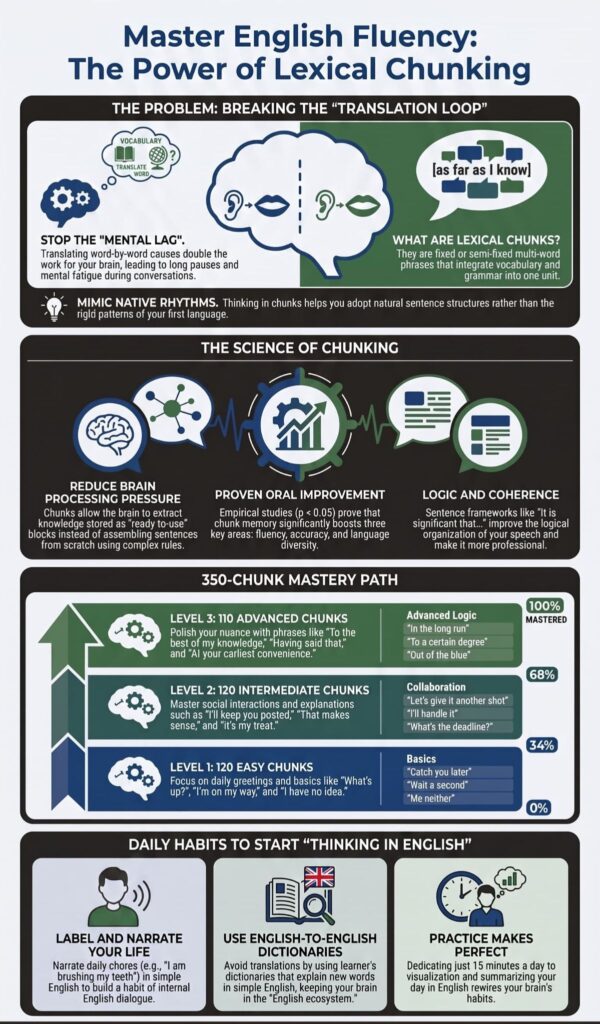
I used to feel stuck behind a mental delay. Someone would ask me a question, and my mind would scramble to translate it, formulate a reply, and translate back. The conversation always moved on without me.
To kill the internal translator, stop looking at individual objects and start narrating your immediate reality in complete, contextual sentences. Do not just think ‘busy street.’ Instead, challenge your mind with: ‘The morning traffic is bottlenecking at the intersection, which will likely delay my arrival.’ By upgrading your silent, internal dialogue from kindergarten observations to adult realities, you forge immediate pathways between your actual thoughts and your English output.
Another key is learning “chunks.” Memorize whole phrases like “on the other hand” or “the point is.” When you need the idea, the English phrase arrives automatically.
This process is gradual. It feels awkward at first. But the payoff is real: faster, more fluid speech because you’re not speaking a translation. You’re finally speaking a thought.
What Is the Value of Reading Advanced English Literature Online?
I used to feel a constant delay in conversation. Someone would ask me a question, and my mind would scramble to translate it, find an answer, and translate back. By the time I spoke, the moment was gone. I was always a step behind.
The change started in my mind, not my mouth. I began trying to think in simple English. It’s a slow rewiring. You link feelings directly to English words, skipping the translation step entirely.
You build this with small, daily habits.
- Narrate your surroundings silently. “Brown dog. Wet sidewalk.”
- Keep a tiny English journal. Two true sentences about your day.
- Make small internal decisions in English. “I’ll take the bus.”
Another helpful method is learning “chunks”, whole phrases like “on the other hand” or “it depends.” When the idea comes, the entire English phrase is already there.
This process is gradual. It feels awkward and slow. But one day, you’ll notice the mental translator is quiet. You’ll respond, and the words will just be there, connected directly to your thought. That’s when you’re no longer speaking a translation. You’re just speaking.
A Framework for Writing Sophisticated English Essays
I once spent days writing an essay packed with impressive vocabulary. My professor returned it with one note: “I cannot follow your argument.” The fancy words meant nothing because the structure was missing. Sophisticated writing starts with a clear roadmap, not a thesaurus.
A reliable structure is your foundation.
- Introduction: State your main point clearly.
- Body Paragraphs: Each paragraph presents one key reason or piece of evidence. Address a counterargument if needed.
- Conclusion: Restate your position, reflecting on the discussion.
This basic framework holds everything together. Once it’s solid, you can build on it. Use transitions like “therefore” or “in contrast” to connect ideas. Back general statements with specific examples. Vary your sentence length for rhythm.
The real work happens in the rewrite. Your first draft is for getting ideas out. Your second draft is for making them clear. Come back to it later. Cut what doesn’t fit. Rearrange sentences for better flow. This is where messy writing becomes precise, and precise writing starts to feel powerful.
How Can You Develop the Skill of Speaking English with Native Confidence?
Credits : AccurateEnglish
My early English conversations were full of long, awkward silences. I’d freeze, hunting for the perfect word, afraid of a small mistake. The conversation would die. I learned that confidence doesn’t come from perfection. It comes from fluency, keeping the talk going, expressing your idea even if the words aren’t perfect, and recovering smoothly from a stumble.
You build this through targeted practice.
- Shadowing: Listen to a native speaker and immediately repeat their words, matching their rhythm. It trains your mouth to move without overthinking.
- Record yourself: Answer a common question like “What do you do?” Listen back. Hear your filler words (“um,” “like”). Then do it again.
- Drill situational phrases: Practice the language for leading a meeting or giving an update until it feels ready on your tongue.
The goal is to build a toolkit of reliable phrases for common moments. When you don’t have to construct every sentence from scratch, you free up mental energy. You can focus on what you want to say, not how to say it. That shift, from building language to using it, is where real speaking confidence starts. It’s built in small, repeated moments of practice.
Why Should You Use Advanced Listening Comprehension Strategies?
When I first arrived, I could understand my English textbook perfectly. Then I tried to order a coffee. The cashier’s words blurred into a stream of sound I couldn’t decipher. I realized advanced listening isn’t about hearing distinct words. It’s about understanding a blur of connected speech, catching implied meanings, and following different accents. Your brain must learn to grab key information from the noise and infer the rest.
Effective practice requires active work, not just passive hearing.
- Listen twice. First, for the general idea. Then again, focusing on how the speaker builds their argument. What words do they stress?
- Try transcribing. Take a challenging 30-second clip from a podcast and write down every word you hear. It’s difficult, but it forces you to hear every sound.
- Expose yourself to different accents. Listen to a British news report, an Australian podcast, an American drama. Train your ear to be flexible.
Choose material that matches your goal. If you need business English, listen to earnings calls or industry panels. If it’s academic, find online lectures. Always try to understand as much as possible before you look at a transcript. That moment of struggle, of your brain straining to piece it together, is where the real skill is built. It’s the difference between hearing the noise and actually understanding the message.
Why Is Understanding English Cultural References Important?
I used to understand every word my colleagues said, but I kept missing the jokes. A reference to a TV show or a common saying would make the room laugh while I just smiled, confused. I learned that language is a container for culture. To master English, you need to learn what lives inside the words.
This cultural knowledge comes from immersion.
- Watch news panels and commentary. Listen to how analysts use cultural references.
- Listen to long-form interviews with authors or experts for stories and context.
- Watch popular TV shows and films. Pay attention to the humor and casual idioms. Watch with subtitles, then without.
- Read opinion columns. Notice the shared knowledge writers assume.
This understanding changes everything. It lets you grasp sarcasm and irony. It allows you to use an idiom like “beat around the bush” naturally, in the right moment. You stop being just a speaker of the language and start becoming a participant in its world. You move from understanding sentences to sharing meaning.
FAQs
How can I improve advanced English fluency without living abroad?
You can build advanced English fluency by creating daily language immersion at home. Read widely, listen to podcasts, practice thinking in English, and speak every day. Focus on English conversation skills, English pronunciation practice, and regular error correction. Consistent language feedback, shadowing technique, and self-study English help you develop more natural English speaking over time.
What is the fastest way to remember advanced vocabulary and use it naturally?
When you are sitting in an executive meeting, you do not have time to dig through a mental word bank. You need language that functions as a reflex. Instead of dry lists, pick up collocations words that naturally lock together like ‘mitigate risk’ or ‘leverage assets’. If you hear a phrase used twice in a professional podcast, write down the entire sentence, map its tone, and force yourself to deploy it in an email within 24 hours. That is how you turn passive vocabulary into active executive presence.
Which grammar topics matter most for English language mastery?
For strong English language mastery, prioritize advanced grammar structures that appear in real communication. Practice conditionals, relative clauses, reported speech, passive voice, modal verbs, tense mastery, article usage, prepositions, and English grammar nuances. Learning English syntax together with real examples helps you produce accurate, natural sentences in everyday and professional situations.
How do I improve English writing for work and academic tasks?
Improve English writing skills by writing regularly with a clear purpose. Practice professional writing, academic writing, essay writing, and email writing while paying attention to coherence, cohesion, paraphrasing, summarizing, tone and style, and choosing the right formal register or informal register. Reviewing your drafts helps strengthen accuracy and clarity.
How can I sound more confident during English conversations and presentations?
Build spoken English confidence through frequent English speaking practice in realistic situations. Develop presentation skills, interview English, and workplace communication by recording yourself and reviewing your performance. Better listening comprehension, advanced listening skills, accent reduction, understanding cultural references, and using appropriate business English expressions gradually lead to native-like proficiency and native confidence.
Final Thoughts on Your Advanced English Journey
When I think about learning English, I don’t remember a single breakthrough. I remember the small moments that slowly added up over time, practicing after long days, making mistakes in conversations, and realizing that progress came from showing up consistently, even when it felt difficult. Those experiences taught me that advanced English isn’t about sounding perfect. It’s about communicating with confidence in the moments that matter most.
That belief is the foundation of Ivy Languages International. Everything we’ve built comes from years of teaching, learning, and seeing what truly helps students move forward. Every learner follows a different path, but lasting progress always comes from steady practice and thoughtful guidance. If this article has encouraged you, start with one habit you can realistically keep this week. Small, consistent steps often lead further than we expect, and we’ll be here whenever you’re ready to continue your journey.
Ready to take the next step? Join us at Ivy Languages International, and let’s build your English confidence together.
References
- https://onlinelibrary.wiley.com/doi/abs/10.1111/j.1540-4781.1989.tb02525.x
- https://psycnet.apa.org/record/1993-97075-000