Education
Understanding English cultural references becomes easier when I stop treating every unfamiliar phrase as a vocabulary problem. I learned this while working with English learners who knew the words in a sentence but still missed the joke, comparison, or meaning behind them. The issue was often cultural context, not grammar.
Over time, I found that repeated exposure worked better than memorizing long lists of references. At Ivy Languages International, this same idea shapes how we approach practical English learning. We look at where expressions come from, how people use them, and why they fit certain situations. Keep reading to see how this approach works.
Quick Reads: Cultural Reference Essentials
Understanding English cultural references becomes easier when we focus on context, real usage, and repeated exposure rather than trying to memorize everything.
- Context matters: Cultural references can change the meaning of jokes, idioms, sarcasm, comparisons, and everyday expressions beyond the words themselves.
- Learn what you encounter: Focus on references that appear in your conversations, reading, media, studies, or work, then check their meaning, origin, and tone.
- Practice through repetition: Keep useful references in a small reference bank and revisit them in different situations until their meaning and use become familiar.
What Are English Cultural References?

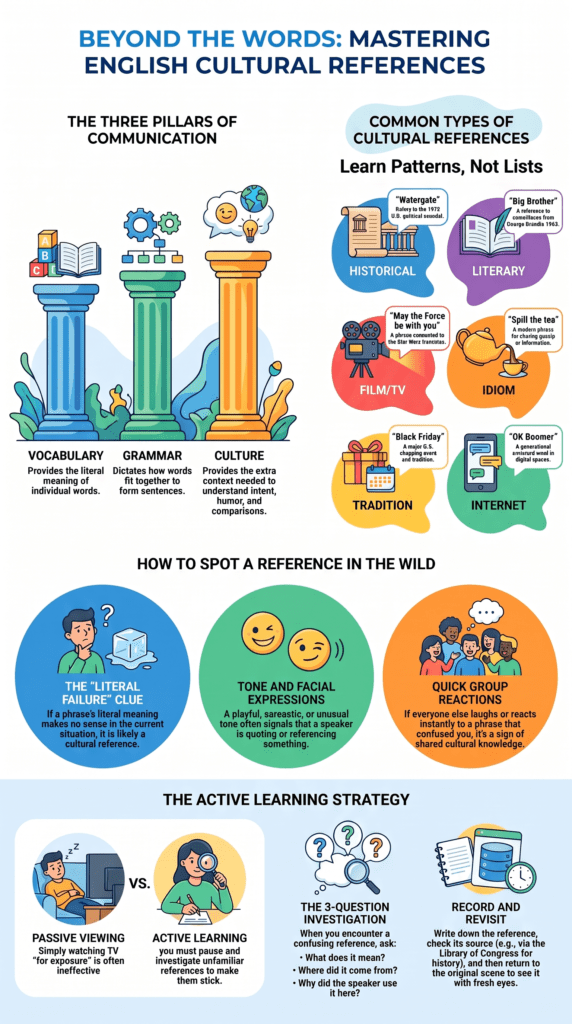
Cultural references are words, phrases, or comments that depend on shared knowledge. That knowledge can come from history, books, films, television, traditions, politics, or everyday life.
I’ve seen learners struggle with this because they often look at the literal meaning first. But sometimes the literal meaning isn’t the point.
Take the word “Watergate.” It can refer to a U.S. political scandal, not only the name of a building complex. The Library of Congress records the 1972 break-in and the investigation that followed.
The same thing happens with literature and entertainment. “Big Brother” can refer to surveillance because of George Orwell’s 1984. “May the Force be with you” has a different meaning because people connect it with Star Wars.
Idioms work in a similar way. The U.S. Department of State’s American English program explains that idioms can carry ideas linked to history, culture, values, and beliefs.
We can group many references into a few useful areas:
- History and politics
- Literature and books
- Film and television
- Idioms and sayings
- Internet culture
- Holidays and traditions
Once we see these patterns, an unfamiliar phrase becomes easier to investigate. We don’t have to memorize everything.
Why Do Cultural References Matter in English?
Cultural references help us understand what someone really means, especially when the words alone do not give us the full picture. They can add humor, explain a comparison, or show a shared experience.
This matters in everyday English. People may mention a film, historical event, television show, sport, or common social experience without stopping to explain it. We might understand every word and still miss the point.
Cultural knowledge can also make reading, listening, and speaking easier. A writer may refer to an event without explaining it. A speaker may use an indirect comment or familiar phrase because they expect others to understand the background.
It helps to separate three parts of communication:
- Vocabulary gives us word meanings.
- Grammar shows how words fit together.
- Culture gives us extra context.
That third part takes time to build. We develop it by reading, listening, asking questions, and seeing the same references in different situations. We do not need to know everything. We simply need to keep adding useful cultural knowledge as we encounter it.
How Can We Understand Cultural References, Humor, and Sarcasm?
Knowing the words in a sentence does not always mean we understand the joke. A speaker may refer to a film, song, television show, public event, or shared experience that we have never encountered.
Context can help. If someone says, “That went well,” after a meeting has gone badly, the literal meaning does not match the situation. Their tone may show that they are being sarcastic.
When a reference seems confusing, ask:
- What does the phrase mean?
- Where did it come from?
- Why did the speaker use it here?
Tone, facial expressions, and other people’s reactions can provide useful clues. Written English can be harder because many of these clues are missing.
There is also an important difference between understanding humor and enjoying it. Once we learn the reference, the joke may make sense, but we still may not find it funny. Humor depends on timing, personal taste, relationships, and shared experiences. That is normal. We do not need to laugh at every joke to understand the English behind it.
Which Types of English Cultural References Should We Learn First?
I’d start with references that appear often in the English we already use. History, literature, media, idioms, internet culture, and traditions are useful places to look.
| Type | Example | Context |
| Historical | “Watergate” | U.S. political scandal |
| Literary | “Big Brother is watching” | George Orwell’s 1984 |
| Film/TV | “May the Force be with you” | Star Wars |
| Idiom | “Spill the tea” | Gossip or sharing information |
| Tradition | “Black Friday” | U.S. shopping event |
| Internet | “OK Boomer” | Generational comment |
As highlighted by Alan Forrest TEFL
“Learn patterns, not references. Many references fall into types: films, sport, politics, internet culture. You don’t need all of them. Just notice which world your environment lives in.” – Alan Forrest TEFL
I don’t think we need to study these as a fixed list. It’s more useful to notice what keeps appearing in our daily English.
For example, if we hear “Watergate” several times, we can look up its history. The Library of Congress can help us check the background instead of relying on a quick online explanation.
The same idea applies to films, idioms, and internet phrases. Learn what you meet. That approach feels more useful because the reference has a reason to matter.
How Can We Recognize a Cultural Reference in Conversation?
We can often spot a cultural reference when the literal meaning does not seem to fit the situation. The wording may sound unusual, or the speaker may use a playful tone. Other people may also react quickly because they already understand the reference.
Research from Journal of Pragmatics
“This paper discusses whether and how cultural context can be used in studies using conversation analysis (CA) and ethnomethodology (EM).” – Journal of Pragmatics
A few clues can help:
- An odd or unexpected literal meaning
- A playful, sarcastic, or unusual tone
- A quick reaction from other people
- A phrase that seems familiar but does not make sense in context
We should also listen to what comes before and after the phrase. Sometimes the surrounding conversation gives us enough information to work out the meaning.
If we still do not understand it, we can write the phrase down and check it later. There is no need to stop every conversation to investigate every unfamiliar expression. The goal is to notice useful references without making communication stressful. With practice, these clues become easier to recognize.
Why Does “Just Watch More TV” Often Fail?
Watching English television can help, but watching more content doesn’t automatically mean we’ll understand every reference.
I’ve seen learners spend hours watching English shows without remembering much of the cultural material. They heard the language, but they didn’t stop to ask what unfamiliar phrases meant. That’s the difference between exposure and active learning.
When I hear an unfamiliar reference, I prefer to pause and investigate it. Then I go back to the original scene or sentence. This gives the phrase a place in my memory.
We can compare the two approaches:
| Passive viewing | Active learning |
| Watch and move on | Notice the reference |
| Guess and forget | Check its source |
| Remember the words | Record the context |
| Wait for exposure | Look for it again |
Suppose a character uses a phrase that makes no sense in the scene. Write it down. Then check where it came from.
Return to the scene after you understand it. The second viewing often feels different because the missing piece is now there. I prefer this method because it turns confusion into something useful.
How Does the Cultural-Reference Loop Work?
Credits: Ultimate Word Definitions
When I meet a cultural reference I don’t understand, I use a simple process. It keeps the research focused instead of turning every unfamiliar phrase into a long study session.
The loop has six steps:
- Encounter: Notice the unfamiliar phrase or reference.
- Search: Look up the exact phrase.
- Check: Compare information from reliable sources.
- Identify: Find the source and intended meaning.
- Record: Save the useful details.
- Revisit: Look for the reference again.
The recording step can be as simple as keeping a notebook, spreadsheet, or notes app.
A useful entry might include:
- The exact phrase
- Its meaning
- Where it came from
- The situation where we saw it
- Its social effect, such as humor or criticism
Writing the meaning in our own words can make it easier to remember. We can also add a short example.
The final step is important because repeated exposure helps the reference stick. We do not need to record everything. Focus on phrases that appear often or matter in our work, studies, media, or everyday conversations.
For internet references, check where the phrase started and how people use it now. Meanings can change over time.
For idioms, check examples and tone. Some are casual. Others may sound old-fashioned or unusual.
For pronunciation, listen to real examples. The way a phrase is said can change how it sounds.
The U.S. Department of State’s In the Loop guide is one useful resource for American English idioms. It groups expressions by meaning and topic, which can make them easier to study.
Still, we don’t need to investigate every unfamiliar phrase. Focus on references that appear often or matter in situations we care about.
When Should We Use Forums, Dictionaries, and Meme Databases?
Different sources answer different questions. A dictionary can confirm the meaning. A forum can help explain how people use a phrase. A reference site can help us trace where a cultural reference began.
I usually check a dictionary first when I need the basic meaning. Cambridge Dictionary is useful for definitions and examples.
Forums can help when the dictionary doesn’t explain the social side of an expression. WordReference has a large collection of language discussions where learners ask about wording and usage.
For internet references, we may need a different kind of source. A database or reference site can help explain where a meme started and how its meaning changed.
We can think about it like this:
| Resource | Best for | Example use |
| WordReference | Usage and nuance | Ask about unfamiliar wording |
| EnglishClub | Idioms and sayings | Study fixed expressions |
| Cambridge Dictionary | Definitions | Check meaning and examples |
| Reference sites | Cultural origins | Trace internet references |
Don’t expect one source to answer every question. A dictionary may explain what a phrase means but not why someone used it as a joke.
A forum may explain the social meaning, while a historical source gives us the background. Using the right source saves time.
How Do British, American, and Generational References Differ?
English is shared across many communities, but cultural knowledge isn’t shared equally. I noticed this most clearly when comparing conversations from different countries. The language can be familiar while the references are not.
British and American English have different cultural touchpoints. Television, food, sports, holidays, public institutions, and social habits can all shape the way people speak.
Australian English has its own regional expressions too.
So, I don’t think of “English culture” as one single thing.
People in London, New York, Sydney, and other places may use the same language while drawing on different experiences.
Why can regional references cause confusion?
Regional references assume background knowledge. A British speaker may mention a television show, sport, public institution, or social tradition that an American learner has never encountered.
The reverse can happen too. This is especially common with older references. Someone may quote a program they watched as a child. Everyone from the same age group understands it. Someone younger may have no idea what they mean.
A discussion in r/AskUK shows how strongly some British references are tied to television and shared memories.
The useful question is:
Where is this speaker from?
That can give us a clue about the source.
Why do age and media habits matter?
Age can affect cultural knowledge as much as location. Someone who grew up watching television in the 1980s may use a reference that younger speakers don’t know. The same thing happens with internet culture.
A phrase can become popular very quickly. Then people stop using it. A few years later, younger speakers may not recognize it. Native speakers miss references too.
That surprised me when I first paid closer attention to it. Cultural fluency doesn’t mean knowing everything. It means understanding that different people bring different backgrounds to the same conversation.
How Can We Practice Cultural References Without Feeling Fake?
Watching English shows, reading articles, and listening to conversations can expose us to cultural references, but exposure alone is not always enough. We learn more when we notice an unfamiliar reference and take a moment to understand it.
Building advanced English vocabulary for professionals can also help when the references appear in workplace conversations, reports, presentations, or professional media.
A simple routine can help:
- Watch or read authentic English.
- Write down useful unfamiliar references.
- Check their meaning, source, and tone.
- Look for the same reference again.
- Practice expressions that fit our real situations.
For example, we might notice a historical reference while reading the news. We can check it, write a short explanation, and then watch for it in another conversation or article.
We also need to be careful when copying expressions. Some phrases belong to certain age groups, regions, or online communities. Others may sound strange outside their original setting.
Instead of trying to sound like a native speaker, focus on understanding how people actually use the language. If something is unclear, asking, “I haven’t heard that before. What does it mean?” is perfectly normal.
How Can We Build a Practical Weekly Learning Routine?
We can build cultural knowledge through a short weekly routine. It doesn’t need to take hours. I’d rather spend a short amount of time with real English than study long lists of references that never appear in daily life.
A structured approach such as advanced English mastery training can also support this kind of regular practice by helping learners work on language skills in a more focused way.
It doesn’t need to take hours. I’d rather spend a short amount of time with real English than study long lists of references that never appear in daily life.
A week could look like this:
- Day 1: Watch or read English content.
- Day 2: Check unfamiliar references.
- Day 3: Add useful notes.
- Day 4: Review meaning and tone.
- Day 5: Look for the references again.
- Weekend: Practice a few useful expressions.
We can also change the routine based on our goals. Workplace learners might focus on office expressions and polite requests. Academic learners may need literary references, historical allusions, and formal language.
Learners working toward advanced English can also pay attention to pragmatic meaning, discourse markers, register, and indirect language. These details take time.
How Can Cultural Knowledge Improve Reading, Listening, and Speaking?

Cultural knowledge gives us information that vocabulary and grammar can’t always provide. When we read an article, the writer may refer to a historical event without explaining it. If we know the reference, the comparison is easier to understand.
Reading challenging texts through reading advanced English literature online can provide useful exposure to literary references, older expressions, and cultural ideas.
Listening can be harder because speakers often use jokes, shortened phrases, metaphors, and indirect comments. This is why learning vocabulary in context matters.
We need to know what a phrase means, but we also need to know when people use it. Speaking benefits too.
Cultural awareness can help us understand tone and politeness. For example, someone might say, “Could you take a look at this?” The sentence is shaped like a question, but in context it can be a polite request. These differences become clearer as our English improves.
At an advanced level, knowing the words is only part of communication. We also need to notice tone, intent, and social expectations. It takes practice. But once we start noticing these details, conversations become easier to read.
FAQ
How can I tell if a cultural reference is suitable for a professional conversation?
Consider the setting, relationship, and level of formality before using a cultural reference at work. A joke, slang term, or casual saying may sound friendly with colleagues but inappropriate with clients or managers. When unsure, choose clear and neutral language. Understanding English register and formality helps you communicate naturally while avoiding references that could confuse or offend others.
When should I avoid translating a cultural reference word for word?
Avoid word-for-word translation when an expression depends on a specific cultural meaning. Direct translation can make English idiomatic phrases sound confusing or unnatural. Instead, consider what the speaker means in the situation and find a natural way to express that idea. This approach is especially useful when dealing with English phrase origins, English metaphors, and common English sayings.
How can I remember cultural references without confusing similar expressions?
Group cultural references by meaning, situation, or topic instead of memorizing them as separate phrases. For example, keep expressions about work, humor, disagreement, or social situations together. Write one short example for each phrase and review it later. Using English vocabulary in context helps you remember differences between similar expressions and choose the right phrase during conversations.
How can I check whether an old cultural reference is still commonly used?
Look at recent conversations, articles, videos, or other current English-language content to see whether people still use the reference. Pay attention to who uses it and whether it sounds natural or dated. This matters because historical references in English can remain familiar without being common in daily speech. Current examples help you judge whether a phrase still fits.
How can cultural references affect the tone of my English writing?
Cultural references can make writing sound friendly, humorous, formal, or strongly connected to a particular audience. However, unfamiliar references can distract readers or change the intended message.
Before using one, consider who will read your writing and what they already know. English writing cultural tone becomes easier to manage when you choose references that support your message rather than obscure it.
What Should We Remember About Understanding English Cultural References?
Understanding English cultural references takes time, but context makes it easier. We don’t need to know every joke or quote to follow real conversations. Instead, we can notice unfamiliar references, check their meaning, and keep useful examples for later.
With regular reading, listening, and conversation, these pieces gradually connect and make English easier to understand. Ready to build your cultural-reference skills? Learn with Ivy Language International
References
- https://www.linkedin.com/posts/alan-forrest-tefl-aa15071aa_gostepsenglish-activity-7434925428294705152-KUxS
- https://doi.org/10.1016/j.pragma.2007.09.007
Related Articles
- https://ivylanguagesinternational.com/advanced-english-vocabulary-for-professionals/
- https://ivylanguagesinternational.com/advanced-english-mastery-training/
- https://ivylanguagesinternational.com/reading-advanced-english-literature-online/