
Improving my listening skills as an intermediate learner only began to work when I stopped trying to catch every single word and focused on overall meaning instead. I still remember sitting in a crowded café, ordering coffee, and hearing the barista speak too quickly for me to separate the words.
I had studied English for years, but at that moment everything felt distant and unclear. That experience pushed me to rebuild how I practiced listening, focusing on patterns, context, and repetition rather than translation. If you want to follow the same shift, keep reading and see what actually helped me with Ivy Language International.
Quick Listening Wins for Intermediate Learners
These lessons come from my own experience practicing listening daily, supported by research-based methods and gradual improvement over time together.
- Understand the general meaning first, not every single word.
- Use transcripts, replay difficult parts, and shadowing to build speed.
- Practice daily with material slightly challenging but not overwhelming.
What Should Intermediate Learners Focus on First?
The frustration that changed my entire teaching approach happened in a Barcelona café. I was surrounded by Spanish friends, laughing at jokes I couldn’t follow, catching maybe one word in three. I knew the grammar. I could read newspapers. But real speech felt like a different language entirely.
That moment taught me something I now share with every intermediate learner: your job isn’t to understand every word. It’s to follow the message.
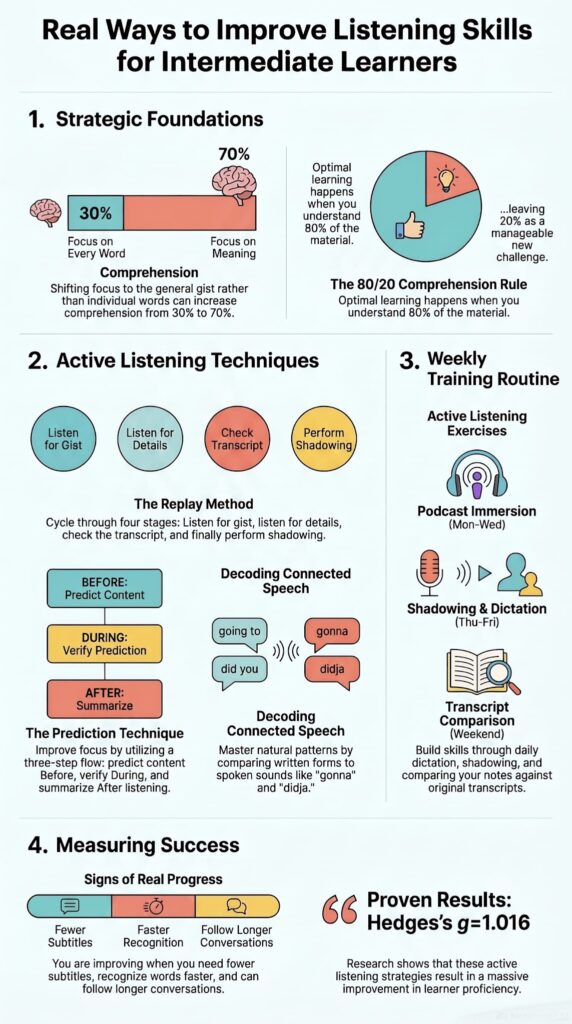
When I stopped trying to catch every syllable, and started listening for intent, tone, and key words, my comprehension jumped from 30% to 70% within weeks. Not because I learned new vocabulary, but because I stopped making listening a translation test.
I had been treating listening like a test of vocabulary, if I just knew more words, I’d understand more speech. But that wasn’t the problem. The problem was that I was trying to catch every syllable, and in doing so, I was missing everything that mattered.
The Real Goal
Here’s what I’ve learned from years of teaching intermediate learners: your first job is not to understand every word. Your first job is to follow the message.
This sounds simple, but it goes against everything most of us were taught in language classes. We were trained to decode. We were rewarded for precision. But real speech doesn’t wait for us to finish translating. By the time you’ve figured out that one unfamiliar word, the speaker has already moved on to the next three sentences.
Listening is a major part of everyday communication, and many teaching guides emphasize it as a core skill.”, provide or link a source if insisting on a percentage.
Think about that. A large share of everyday communication involves listening. If we’re spending that time trying to process every single word, we’re making conversation exhausting for ourselves.
Why Does Grammar Knowledge Doesn’t Translate to Listening?
Here’s something that took me years to accept: Knowing grammar rules does not guarantee instant recognition of them in fast speech.
Spoken English is not written English spoken aloud. It’s almost a different dialect. Words reduce. Sounds blend. Stress patterns shift. A sentence like “I am going to get a coffee” becomes “I’m gonna get a coffee” or even “Imma get coffee.” The grammar is still there. The meaning is the same. But if you’re listening for the textbook version, you’ll miss it entirely.
I’ve worked with learners who could write beautifully structured paragraphs but couldn’t follow a simple conversation about weekend plans. The gap wasn’t their knowledge. It was their ear.
What Actually Helps?
Over time, I started noticing patterns in what worked for intermediate learners. The ones who improved fastest weren’t the ones who studied the most vocabulary. They were the ones who shifted their attention toward:
- Main ideas first. What is this person trying to say? Not what specific words are they using, but what’s the point? Ironically, this approach often helps with expanding vocabulary because words become easier to remember when they appear inside meaningful contexts.
- Speaker attitude. Are they excited? Annoyed? Uncertain? This often carries more meaning than the actual words.
- Key details only. Not everything. Just the few things that anchor the message.
This shift changes everything. When you stop treating every word like it’s equally important, your brain has room to actually process meaning.
Small Signs of Progress
I’ve learned that improvement in listening doesn’t arrive like a sudden revelation. It creeps in through small moments. Many of the biggest intermediate English breakthroughs happen so gradually that learners barely notice them at first.
One morning, I realized I had watched an entire episode of a Spanish show without subtitles. I didn’t understand everything. But I understood enough. The story made sense. The characters felt real. I had followed the arc without needing every piece of dialogue.
That’s what progress looks like. Not perfection. Just less dependence on support.
For me, the real evidence came when I stopped panicking when I missed something. I used to freeze when I lost a phrase. I’d replay it in my head, trying to reconstruct it, and by the time I gave up, I’d missed the next four sentences. But with practice, I learned to let go. Missed something? Keep going. The context fills in many gaps.
Why Do Intermediate Learners Understand Text but Miss Audio?
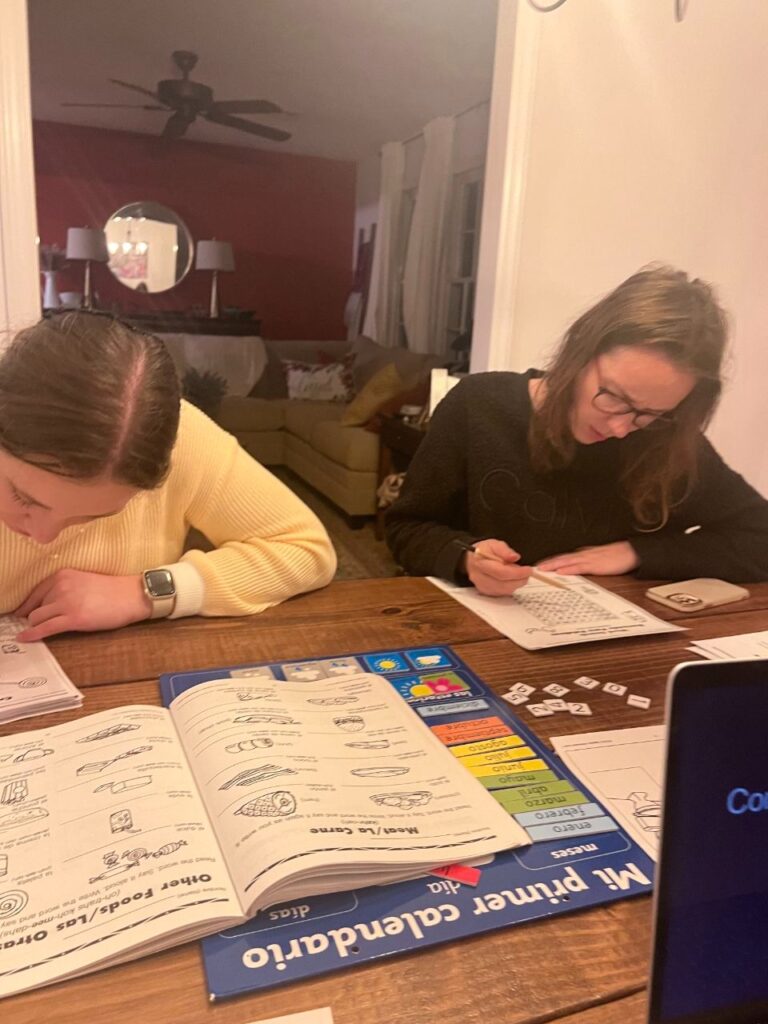
The reading-listening gap is real. I’ve met countless intermediate learners who can read a text with 90% comprehension but understand barely half of the same content spoken aloud.
Reading is forgiving. You control the pace. You can go back. Your eyes can rest on unfamiliar words while you puzzle them out. Listening has no such mercy. The speech moves forward whether you’re ready or not.
This doesn’t mean you’re bad at listening. It means you haven’t trained your ear for listening. These are different skills, and they need different practice.
What helps? Getting comfortable with ambiguity. Learning to hear where one word ends and the next begins. Recognizing the rhythm of natural speech before you try to parse its content.
Practical Shifts That Matter
I started seeing real change when I approached listening as its own skill rather than a test of my overall language ability. That meant:
- Listening to the same content multiple times. The first time, I just tried to catch the gist. The second time, I noticed more. By the third or fourth listen, details started emerging.
- Letting go of translation. This was hard. But I practiced staying in the target language, understanding through context rather than converting to English in my head.
- Noticing familiar words in unfamiliar forms. The first time I heard “gonna” and recognized it as “going to,” something clicked. I started paying attention to how words actually sound in speech, not how I thought they should sound.
Looking Forward
I still miss things when I listen in Spanish. I still tune out sometimes. I still have moments where I catch every tenth word and feel like I’ve regressed.
But I also notice things now that I never noticed before. I hear the subtle shifts in tone that signal sarcasm. I catch the quick phrases that native speakers use to fill space while they think. I understand more than I used to, and I panic less when I don’t.
That’s the goal, I think. Not perfect comprehension. Just better comprehension than yesterday. Just a little less fear when the speech starts flowing.
If you’re an intermediate learner feeling stuck, I’d invite you to try a different approach this week. Pick a short audio clip. Don’t try to understand everything. Just try to follow the thread. See what you catch when you stop trying to catch it all. I think you might surprise yourself.
Why Does Native Speech Sound So Fast?
Credits: Pronunciation with Emma
I remember sitting in a London pub years ago, surrounded by colleagues who were all native English speakers. They were laughing, joking, trading stories. I understood maybe a third of what they said. The words came at me like a fast-moving river, and I kept trying to catch individual drops.
At first, I blamed the speed. “They talk too fast,” I told myself. “If they just slowed down, I’d understand everything.”
But that wasn’t quite right. Because when someone did slow down for me, I still didn’t catch every word. The problem wasn’t just pace. The problem was that I wasn’t recognizing what I was hearing.
The Real Issue
Native speech isn’t fast, it’s different.
The actual speaking rate hasn’t changed much. What changes is how words connect in natural conversation.
Take the phrase “going to.”
- Textbook: two clear words.
- Conversation: “gonna.”
- Fast speech: even “gon.”
Same meaning. Completely different sound. If you’re listening for the textbook version, you’ll miss it entirely.
“Did you” becomes “didja.” “Want to” becomes “wanna.” “Could have” becomes “coulda.”
I used to hear these and think I was hearing new vocabulary I hadn’t learned. I’d freeze, trying to recall what “gonna” meant. By the time I remembered it was “going to,” the speaker was already three sentences ahead.
My brain was processing the wrong thing. I was treating connected speech like a translation puzzle rather than recognizing it as a normal feature of the language.
Why Textbook English Fails Us?
We learn from textbooks. Textbooks are careful. They pronounce each word clearly, as if it exists in isolation. But language doesn’t exist in isolation. It exists in streams, in rhythms, in the natural flow of conversation.
I had a student once who could read technical articles about engineering with perfect comprehension. But when I played a short podcast about cooking, he struggled. “They don’t speak clearly,” he said. But they did speak clearly. They spoke the way people actually speak. His expectation of clear, separated words was the problem, not their pronunciation.
When we expect to hear dictionary pronunciation, and we hear something else entirely, our brain doesn’t know how to match the sounds to the words we know. So we think we don’t know the word. The word is there. We just didn’t recognize its spoken form.
Why Does “Just Immerse Yourself” Often Fail?
“Just watch more TV,” people said. “Just listen to podcasts.” I tried that. For months. And while my comprehension did improve slightly, I hit a plateau that frustrated me.
The problem with passive immersion is that it’s passive. If you’re listening without structure, without review, without revisiting the parts you missed, you’re reinforcing what you already understand and skipping the hard parts.
I’d listen to a podcast and understand 60% of it. I’d feel good about that. But the 40% I missed? I never went back to find out what it was. I just moved on to the next episode, telling myself that more exposure would fix everything.
It didn’t. Not efficiently.
What Actually Helps?
The learners I’ve seen improve most consistently are the ones who do something uncomfortable: they go back.
They listen to a short segment. They catch what they can. Then they listen again. They check against a transcript if available. They notice the gap between what they heard and what was actually said. That gap is where the learning happens.
I started doing this myself. I’d pick a two-minute clip from a news broadcast. First listen: just the gist. Second listen: write down what I caught. Third listen: check the transcript.
Suddenly, I started noticing patterns. I heard “didja” and realized it was “did you.” I heard “shoulda” and recognized it as “should have.” These weren’t new words. They were familiar words wearing different clothes.
The Rhythm Piece
Speed isn’t the only factor. English has a rhythm that’s different from many other languages. We stress certain words and reduce others. Content words, nouns, verbs, adjectives, tend to be clearer. Function words, prepositions, articles, helping verbs, get reduced and rushed.
When I learned to listen for the stressed words, everything started making more sense. I didn’t need to catch every word. I just needed to catch the ones carrying the meaning. The rest? It filled in from context.
This changed my entire approach. Instead of trying to catch every sound, I started listening for the shape of the sentence, the rises and falls, the beats. The words I couldn’t catch became less important because I was following the rhythm.
Small Progress
I’m not saying I never struggle with native speech anymore. I still do. But I’ve stopped panicking when I miss things. I’ve stopped blaming speed. I’ve started recognizing the patterns that used to baffle me.
There was a moment a few years ago when I heard someone say “I dunno” and didn’t even pause. I understood it immediately. Not because I had studied it, but because I’d heard it enough times in context. My ear had finally caught up.
That’s the quiet victory. Not understanding everything. Just understanding more than you did before. Just recognizing patterns that used to sound like noise.
If you’re struggling with fast speech, I’d invite you to try something small this week. Pick a short audio clip, under three minutes. Listen once for the general idea. Listen again, and write down what you catch.
Then look at a transcript if you can find one. Notice what you missed. Notice what you heard but didn’t recognize. That noticing is where the real growth happens.
The pace will still feel fast sometimes. But you’ll start to notice that it’s not the speed that’s the problem. It’s the unfamiliarity. And unfamiliarity fades with repeated, intentional exposure.
What Is the Replay Method Learners Keep Recommending?
I still remember the first time I sat down with a Spanish news broadcast, convinced I was finally ready to understand it. I’d been studying for months, and I thought, this is it. I hit play, and for two minutes, I listened to a blur of sounds that I couldn’t separate into words. I caught “gobierno” and maybe “ayer,” and then it was over. I felt like I’d learned nothing at all.
That was the moment I started looking for a different way.
I didn’t want to just move on to the next video, pretending that one had counted as practice. I wanted to actually hear what people were saying. So I did something that felt counterintuitive: I played it again. And then again. And I kept doing it until the sounds began to feel familiar. Not easier, exactly, but more like I could finally see the shape of them.
That’s how I landed on what I now think of as the replay method. And it’s the approach I keep coming back to, and keep recommending to other learners.
What does the replay method actually look like?
It’s not complicated, but it does require patience. The idea is to take one short audio clip, maybe a minute or two, and listen to it multiple times, but with a different purpose each time.
Here’s what that sequence usually looks like for me:
| Step | What to Do | Main Purpose |
| First Listen | Listen without stopping and focus on the general message. | Build overall understanding. |
| Second Listen | Listen again and note important words, names, or phrases. | Identify key information. |
| Check the Transcript | Compare what you heard with the written text. | Find gaps in comprehension. |
| Replay Difficult Sections | Repeat short sections several times. | Improve sound recognition. |
| Shadowing Practice | Speak along with the audio. | Develop listening speed, pronunciation, and rhythm. |
The whole process might take twenty minutes, and I’m only covering a minute of audio, for some learners” or “in my experience. That used to feel too slow to be useful. But over time, I noticed something shifting.
Why it works?
I’m not a neuroscientist, but I’ve read enough to understand the basic principle: every time you hear a word, a neural pathway gets a little stronger. But it’s not just about repetition for its own sake. It’s about layering, each listen adds something new to the foundation.
The first time through, you’re just building familiarity. The second time, you’re attaching meaning to the sounds. By the time you check the transcript, you’re connecting spelling and pronunciation. And by the end, you’re internalizing the rhythm of the language in a way that no single listen could ever give you.
I’ve seen it in my own comprehension. Words that used to vanish into the noise now feel solid. I hear a phrase and I don’t have to translate it, I just know it. And that’s the goal, isn’t it? To stop processing and start understanding.
Should You Use Subtitles or Avoid Them?
I’ve gone back and forth on this more times than I can count. For a long time, I used subtitles as a crutch. I’d watch everything with English captions and tell myself I was learning. But I was mostly reading.
These days, I try to be more intentional. If I’m testing myself, I go without subtitles. If I’m focusing on vocabulary, I’ll turn on English captions so I can see how a phrase is written. And when I’m reviewing, I’ll use the transcript to check my understanding after the fact.
The danger is when subtitles become a permanent fixture. I’ve noticed that if I rely on them too much, my eyes do the work and my ears check out. The audio becomes background music, not language. And that’s when I stop improving.
So I follow a progression: audio only, then audio with subtitles, then audio only again. That last step is where the real growth happens. It’s where I prove to myself that I’ve actually learned something.
When progress feels invisible?
There are still days when I listen to that same news broadcast and feel like I’m back at square one. The words blur together, and I question whether any of this is working.
But then I’ll catch a phrase I would have missed a month ago. Or I’ll understand a joke without having to pause and think about it. And I remember that this kind of learning doesn’t announce itself. It accumulates quietly, underneath the surface.
The replay method is useful, but it is only one part of long-term listening improvement. But it will help you hear the language you’re trying to learn, not just see it on a page.
If you’re struggling with listening comprehension, I’d invite you to try it. Pick a short clip, give yourself permission to play it more than once, and see what happens. You might be surprised by what you start to hear.
How Can Prediction Improve Listening Accuracy?
Strong listeners rarely start with an empty head. They get ready before the audio begins. This simple habit of predicting helps you focus because your brain already expects certain words and ideas.
Before any listening activity, you can make guesses about what you’ll hear. Look at the title, the speaker, or any pictures you have. Think about:
- The topic
- Names of people
- Places
- Common words that might show up
Why does this work? Predicting helps your brain sort information ahead of time. It’s like putting folders on your desk before you start working. When you hear something new, you already have a place to put it. This makes it way easier to follow conversations and lectures.
Here’s the simple pattern I follow every time:
- Before listening → predict: I ask myself what I already know and what I expect.
- During listening → confirm: I check if my guesses were right.
- After listening → review: I think about what I got and what I missed.
Research from KCI – Korean Citation Index shows
“Results based on the random-effect model reveal that MSI [Metacognitive Strategy Instruction] has a large and statistically significant effect on learners’ English listening outcomes, with a combined effect size (Hedges’s g=1.016). MSI is more effective in the English Language Institute and intermediate learners benefit more than beginners and advanced learners” . – KCI – Korean Citation Index
What Listening Materials Are Best for Intermediates?

Here’s where most intermediate learners waste time: they pick materials that are either too easy (boring) or too hard (demoralizing).
I’ve seen students improve fastest when they follow the ‘80% rule’, you understand about 80% of what you hear without effort, and the remaining 20% pushes you. For my students, the sweet spot has been:
- News podcasts like ‘6 Minute English’ (clear, structured, transcript available)
- Interview clips from their industry (familiar vocabulary + natural speech)
- YouTube videos with auto-generated captions (pause, replay, check)
The common thread? They’re all interesting to the learner. If you’re forcing yourself to listen to something boring, your brain checks out, and that’s not practice, that’s background noise.
I’ve gotten better faster when I pick things I actually care about. If I’m interested in the topic, I want to understand it more. Over time, I’ve found these types of content work really well:
- Podcasts about things you like
- Short news clips
- Interviews with real people
- Educational videos
- Audiobooks
How difficult should content be?
The sweet spot is when you get most of the message but still run into some new words and phrases. You know you’re in the right place when you:
- Understand most of it
- Miss some small details
- Don’t feel confused all the time
Checklist for Choosing Listening Material
Before I start, I run through this quick list to make sure I’m not wasting my time. It helps me stay consistent and pick things that actually help me grow.
- Interesting topic: If I’m bored, I won’t stick with it.
- Transcript available: It’s great for checking what I missed.
- Short enough to replay: Under ten minutes works best so I can listen again.
- Slightly above comfort level: It challenges me without breaking me.
Which Listening Exercises Deliver the Fastest Progress?
Active exercises often produce faster gains than passive exposure alone. The best improvement comes from tasks that make you do something, not just sit there and let the audio play.
These activities work on a bunch of skills at once, understanding words, hearing sounds clearly, keeping up with speed, and even getting better at speaking. Here are the exercises that made the biggest difference for me and for other intermediate learners I’ve talked to:
| Exercise | How It Works | Main Benefit |
| Dictation Practice | Write down exactly what you hear and compare it with a transcript. | Improves word recognition and attention to detail. |
| Shadowing | Repeat speech immediately after the speaker. | Builds pronunciation, rhythm, and listening fluency. |
| Transcript Comparison | Listen first, then check the transcript. | Identifies comprehension gaps. |
| Read-and-Listen Sessions | Read while listening, then listen again without reading. | Strengthens vocabulary recognition and listening confidence. |
| Focused Replay | Repeat challenging audio segments multiple times. | Improves understanding of connected speech and fast pronunciation. |
Why does shadowing help?
Shadowing means repeating what you hear as fast as you can, right after the speaker. It’s awkward and you’ll stumble, but it helps you get used to the natural rhythm of the language. It’s good for:
- Pronunciation
- Hearing the rhythm of sentences
- Recognizing sounds better
In a recent analysis by RELC Journal
“Shadowing is the act of vocalizing the speech one is listening to as simultaneously as possible. The primary function of shadowing is learners’ listening skill and pronunciation skill development. shadowing [is] an important pedagogical tool of teaching bottom-up listening skills” . – RELC Journal
What Does a Realistic Weekly Listening Plan Look Like?
A good mix helps you build both careful listening skills and bigger-picture understanding. Changing things up also keeps you from getting bored.
Here’s a weekly plan I’ve used that works. Some days are short and intense. Other days are more relaxed. Both matter.
| Day | Activity | Primary Focus |
| Monday | 5-minute clip + transcript | Understanding main ideas and checking comprehension |
| Tuesday | Replay + shadowing | Improving pronunciation and speech recognition |
| Wednesday | Longer podcast (just listen) | Building listening stamina and overall comprehension |
| Thursday | Dictation practice | Strengthening word recognition and accuracy |
| Friday | Interview or news clip | Exposure to natural speech and different speaking styles |
| Saturday | Listening without subtitles | Developing independent listening skills |
| Sunday | Review notes from the week | Reinforcing learning and identifying weak areas |
Why is variety important?
Different exercises work on different parts of listening. When I only did one kind, I got stuck. Mixing it up helped me grow more evenly. It also:
- Keeps you from getting bored
- Builds your stamina
- Works on multiple skills at once
That frustrating week taught me something I still think about. Progress isn’t about how many hours you log. It’s about how you spend those minutes. Some days I still miss a lot. Some exercises still feel clumsy. But I’ve stopped expecting magic.
Instead, I just try to show up and do the work, even when it’s uncomfortable. If you’re stuck like I was, try swapping one passive session for something active this week. It might not feel great at first, but it’s what actually moves the needle.
How Do You Know Your Listening Is Improving?
A few months ago, I was sitting in a coffee shop in Jakarta, trying to follow a podcast about urban farming. I had chosen it because the host spoke clearly and the topic interested me. Halfway through, I realized I had understood almost everything, not perfectly, but enough to follow the argument, catch the jokes, and feel like I was part of the conversation.
This surprised me. Just a few weeks earlier, the same podcast had felt like noise. I would catch a word here and there, but the meaning slipped away before I could hold onto it.
That moment in the coffee shop taught me something important: progress in listening rarely announces itself. It arrives quietly, often when you are not paying attention to how far you have come.
The Small Signs That Matter
Over the years, I have learned to watch for specific indicators that tell me my listening is improving. These are subtle, but they are reliable.
You understand more without subtitles.
This is the most obvious sign, but it takes time. When I first started learning English seriously, I relied heavily on subtitles. Then one day, I turned them off by accident and realized I could follow the dialogue anyway. It was not perfect, I missed some nuances, but I got the gist. That is when I knew something had shifted.
You catch connected speech.
English speakers do not pause between words. They run them together in ways that can feel impossible to decode. “What are you going to do” becomes “Whatcha gonna do.” “Did you eat yet” becomes “Jeet yet.” For a long time, these phrases sounded like a different language.
Then, slowly, I started to hear them. Not every time, but often enough that I could follow casual conversations without asking people to repeat themselves. When I caught my first “gonna” in real time, I felt like I had cracked a code.
You recognize familiar words faster.
This might sound small, but it is a major milestone. When you are learning a new language, even words you know require a moment of mental translation. You hear “cat,” your brain translates it to your native language, and then you understand it.
Over time, that translation step fades. The word becomes the meaning. When I started recognizing words instantly, without that split-second delay, I knew my brain was rewiring itself. Conversations felt less exhausting because I was not processing every single word manually.
You follow longer conversations.
In the beginning, even a two-minute dialogue would exhaust me. My concentration would waver, and I would lose the thread.
Now, I can listen to a thirty-minute lecture without my mind wandering. This did not happen suddenly. It happened because I kept practicing, kept pushing myself to stay engaged, and kept letting go of the need to understand every word.
What to Stop Measuring?
Here is the tricky part: some measurements will make you feel like you are failing, even when you are improving.
Perfect comprehension is not the goal.
I still do not understand everything. There are accents I struggle with, topics I find difficult, and moments when I completely lose track of what someone is saying. That is okay. Listening to fluency is not about perfection. It is about being able to function, communicate, and connect despite the gaps.
Every missed word is not a failure.
When I miss a word, I used to panic. I would stop listening altogether, trying to replay what I had missed in my head. This made everything worse.
Now, I let it go. I keep listening. Often, the meaning becomes clear from context. Sometimes it does not, and that is fine too. The conversation moves forward, and so do I.
Daily fluctuations do not mean you are stuck.
Some days, I listen to a podcast and understand ninety percent. Other days, I struggle to understand fifty percent. It depends on how tired I am, how familiar I am with the topic, and even my mood.
At first, this inconsistency frustrated me. I thought I was regressing. Sometimes it feels like your progress has stalled, even when your listening ability is quietly improving underneath the surface. But I have learned that progress is not linear. It goes up and down, and that is normal.
FAQ
How can I stay focused during longer listening activities?
Many intermediate learners lose focus because they try to understand every word they hear. Instead, focus on the speaker’s main idea and write down key points using note taking while listening. This approach reduces mental overload and improves listening retention. Practicing concentration in listening for 10 to 15 minutes each day gradually strengthens active comprehension and listening confidence.
Should I use subtitles when doing English listening practice?
Subtitles are useful when they support learning instead of replacing listening. Listen to the audio once with subtitles to identify unfamiliar vocabulary and phrase recognition patterns. Then listen again without subtitles and answer comprehension questions about the content. This method improves listening comprehension, spoken English understanding, and listening accuracy while reducing dependence on written text.
How can I improve my understanding of different English accents?
You can improve accent recognition by listening to speakers from different regions on a regular basis. Pay attention to connected speech, stress and intonation, and rhythm in speech because these features often change across accents. Listening to authentic listening materials such as interviews, discussions, and presentations increases pronunciation awareness and strengthens spoken English understanding in real-life situations.
What is the best way to practice listening by myself?
A balanced self-study listening routine includes several activities. You can combine podcast listening, video listening, dialogue practice, and monologue practice throughout the week. Add repetition practice, dictation practice, and transcript-based listening to check your understanding. This combination develops listening fluency, expands vocabulary building, and provides consistent English audio practice at an intermediate level.
Why do I understand individual words but miss the overall meaning?
This problem occurs when you focus only on detailed listening and ignore the larger message. Start by identifying the topic and main idea listening points before searching for specific details. Use keyword identification and context clues in listening to connect unfamiliar words to the surrounding information. This strategy improves audio comprehension and makes listening for specific information more accurate and efficient.
Keep Listening, Even When It Feels Slow
Missing words in real conversations can feel frustrating, especially when you know you’ve studied hard. That’s normal. The real progress happens when you stop chasing perfect understanding and start training your ears through repeated listening. That’s the difference.
At Ivy Language International, we believe steady practice beats guessing every time. Replay, verify, and listen again until familiar speech starts to feel natural. The shift may be small at first, but it builds confidence that lasts. Ready to hear more of what you’ve been missing? Start with one short clip today.
References
- https://www.kci.go.kr/kciportal/ci/sereArticleSearch/ciSereArtiView.kci?sereArticleSearchBean.artiId=ART002934580
- https://eric.ed.gov/?ff1=subListening+Skills&q=descriptor%3a%22Listening+Skills%22&id=EJ1420199