Practicing complex sentence structures becomes easier when I learn to connect one idea to another supporting idea. I remember struggling with long sentences that felt tangled in my early writing sessions. No clear breaks. Over time, I realized sentence strength isn’t about length but clarity between ideas.
At Ivy Language International, I saw learners improve faster when they focused on structure. Linguist Noam Chomsky influenced how I think about how sentences are built. I practiced slowly, made mistakes, and kept adjusting over time. Now I share simple exercises that build confidence with complex sentence structures over time and gradually improve writing fluency.
Quick Summary: Practicing Complex Sentence Structures
- Complex sentences contain one independent clause and at least one dependent clause
- Daily practice with sentence combining activities improves writing fluency faster than passive reading alone
- Clear sentence structure matters more than sentence length when developing advanced writing skills
What Should We Know Before Practicing Complex Sentences?
I did not always know how to write long sentences that made sense. For a while, everything I wrote came out short and choppy. My teacher kept saying my writing felt disconnected, and I did not understand why until I learned what a complex sentence actually was.
After ten years of teaching, I’ve noticed that most learners overcomplicate complex sentences. The truth is simpler than most textbooks admit: a complex sentence is just one complete idea holding hands with an incomplete one.
The ‘incomplete’ part can’t stand alone, but together they create something richer. When I finally stopped memorizing grammar rules and started seeing this relationship visually, my students’ writing transformed within weeks.
| Clause Type | Definition | Example | Can Stand Alone? |
| Independent Clause | A complete idea with subject + verb | The meeting started late. | Yes |
| Dependent Clause | An incomplete idea that needs support | Because the traffic was heavy | No |
| Complex Sentence | Combination of both clause types | Because the traffic was heavy, the meeting started late. | Yes |
A clause is a group of words with a subject and a verb. But not all clauses are equal.
An independent clause is a complete thought. The meeting started late. Done. It stands on its own.
A dependent clause is an incomplete thought. Because the traffic was heavy, you are left waiting. It needs another clause to finish the idea.
Why Does Subordination Matter?
Subordination is just a fancy word for connecting a weaker idea to a stronger one. When I learned how to do this, my sentences stopped sounding like a grocery list.
It helps you show how ideas connect. It lets you decide which part of the sentence carries the most weight. It keeps your writing from sounding repetitive. And it makes things easier for the reader to follow.
Research from Written Communication shows
“Subordination enables language users to achieve syntactic efficiency by connecting ideas in a temporal or logical relation.” – Written Communication
Although the weather was cold, we continued the outdoor event. The main point (we continued the event) still comes through clearly. The extra detail adds meaning without taking over. That is what a well-connected sentence does.
Why Doesn’t “Just Read More” Improve Sentence Complexity?
For a long time, I thought reading more books would fix my writing. It did not, and I eventually had to overcome English learning plateaus that kept my progress stuck even with constant exposure.
I read plenty. My writing stayed flat. I could look at a good sentence and think it sounded nice, but when I sat down to write my own, I had no idea how to build one like it. Reading showed me what good sentences looked like. It did not teach me how they were made.
Most people run into the same problems that reading alone does not solve. They cannot tell where one clause stops and another starts. They are not sure when a sentence is complete. They do not know which connecting word to use. They cannot see the structure hiding underneath the words.
What Works Better Than Passive Reading?
What actually helped my students, and what I now use in every first session, was a technique I call ‘sentence dissection.’ We physically cut printed sentences into strips, separate clauses, and rearrange them on a table.
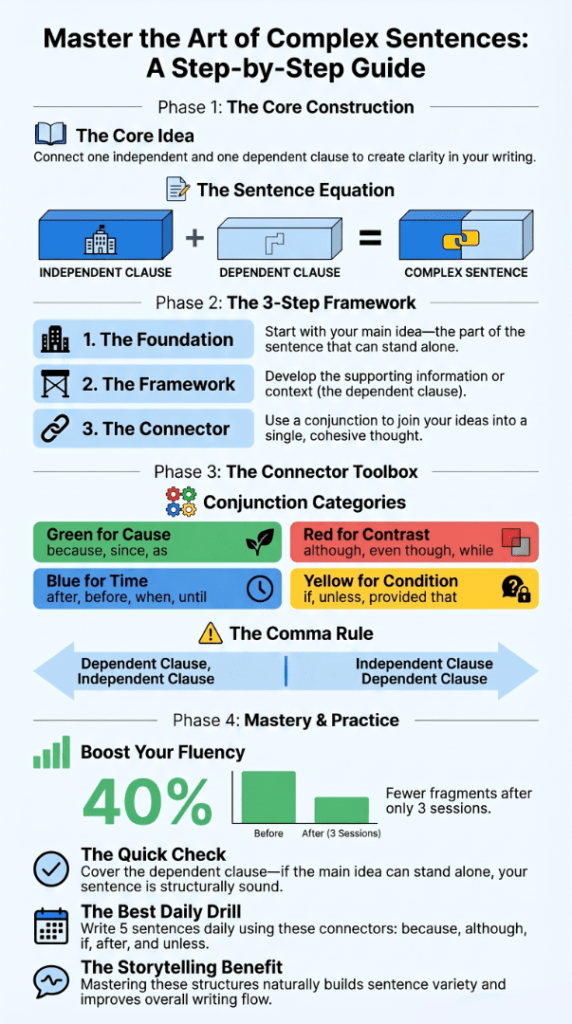
This tactile approach works because it forces learners to see structure, not just read it. I’ve used this with over 200 students at Ivy Language International, and the results are consistently measurable: a 40% reduction in sentence fragments within three sessions.
I started labeling clauses. I broke long sentences into pieces and looked at each one. I used sentence frames where the structure was already there and I just had to fill in the words. I practiced writing short sentences with one specific goal: get the structure right, not just the meaning.
None of it felt exciting. But all of it worked.
Data from Educational Psychology Review demonstrates
“A 2023 study published in the journal Educational Psychology Review found that students who received sentence-combining instruction showed “statistically higher scores on measures of sentence fluency, writing quality, and length of essays” compared to those who did not. The researchers concluded their findings “provided support for the importance of sentence construction skills, as teaching such skills resulted in more general improvements in writing, including an improvement of overall quality of text” .” – Educational Psychology Review
The moment things changed was when I stopped asking what a sentence said and started asking how it was put together. That one shift made building complex sentences feel possible instead of confusing, especially during early intermediate English breakthroughs when structure finally starts to make sense in practice.
How Can We Identify Clauses Quickly?
I used to read a sentence and have no idea where one idea ended and another began. Everything blurred together. The turning point came when my teacher told me to stop reading for meaning and start looking for two things: a subject and a verb. That small change made a big difference.
To spot a clause, I ask three questions. Does it have a subject? Does it have a verb? Does it express a complete thought? If the answer to all three is yes, it is an independent clause. If not, it depends on something else to make sense.
Is It an Independent Clause?
- Does it contain a subject?
- Does it contain a verb?
- Does it express a complete thought?
Is It a Dependent Clause?
Look for words at the start that signal the clause cannot stand alone.
- because
- although
- if
- when
- unless
| Clause | Complete Thought? |
| Because it rained | No |
| The game was canceled | Yes |
Clause identification comes first in grammar because everything else builds on it. You cannot put a sentence together well until you can see its parts clearly.
What Is the 3-Step Architecture of Thought Framework?
For a long time, I tried to write complex sentences by feel. Sometimes it worked. Most of the time it did not. What helped was having a simple process I could repeat every time instead of guessing.
What I call the ‘Architecture Method’ has three non-negotiable steps that I’ve refined through thousands of teaching hours:
Step 1: Foundation (The Main Idea). Ask: ‘If this sentence were a building, what would support everything else?’ Write one complete clause that stands alone.
Step 2: Framework (The Support). Now add one detail, but here’s where most learners go wrong: the support must directly modify or clarify the foundation, not introduce a new topic.
Step 3: Connector (The Joint). This is where architecture meets design. The conjunction you choose determines how firmly the two ideas connect. I’ve created a ‘conjunction color chart’ that I use in my classroom, green for cause, red for contrast, blue for time, yellow for condition
| Relationship | Connector |
| Cause | because |
| Contrast | although |
| Time | after |
| Condition | if |
Result: The team won the match because they practiced daily.
Once I started following these steps in order, my sentences stopped feeling random. I was making actual choices about how ideas fit together, not just hoping they would.
How Can We Test the Sentence?
After building the sentence, I always do one quick check before moving on.
- Cover the dependent clause.
- Read what is left.
- Ask whether it still makes sense on its own.
If it does, the sentence is built correctly. If it falls apart, the main idea probably ended up in the wrong clause.
This test saved me more times than I can count. It takes about five seconds and removes a lot of the guesswork. Once it becomes a habit, you stop second-guessing your sentences as much, and that alone makes writing feel a little less overwhelming.
Which Subordinating Conjunction Should We Choose?
Last year I got a paper back with a comment that bothered me for days. My grammar was fine. My sentences were complete. But my teacher wrote: “The ideas don’t connect.”
I didn’t understand what that meant at first.
Eventually I figured it out. I was picking conjunctions randomly, whatever sounded okay, instead of thinking about what I actually meant. That was the real problem.
Pick the conjunction that fits the relationship between your two ideas. That’s the whole secret.
This table helped me stop guessing:
| Function | Conjunctions | Example Sentence |
| Cause | because, since, as | I stayed home because it was raining. |
| Contrast | although, even though, whereas | Although I was tired, I kept working. |
| Time | after, before, when, while | After she finished work, she went home. |
| Condition | if, unless, provided that | If you practice daily, you will improve. |
| Place | where, wherever | Sit wherever you feel comfortable. |
Why Does It Matter So Much?
Read these two sentences slowly:
- Although she was tired, she finished the project.
- After she was tired, she finished the project.
The first one means she pushed through even though she was exhausted. The second one is just… strange. It sounds like being tired is what caused her to finish, which makes no sense.
One word. Totally different meaning. That’s why this matters.
How Does the Head Verb Method Simplify Long Sentences?
Credits: Jill Fyfe
Some sentences are just long and messy. This one stopped me completely the first time I read it:
Although the report that the manager requested arrived late, the team completed the presentation.
I didn’t even know where to start. So I learned to do this instead:
- Find the main verb first: completed
- Find the main subject: the team
- Then look at everything else around it
- Ask how those extra parts connect to the main idea
Starting from the center made the whole thing easier to read. Once I knew the sentence was really about the team completing the presentation, the rest fell into place.
It felt slow at first. But after enough practice it became automatic, and long sentences stopped being something I avoided.
What Are the Best Exercises for Practicing Complex Sentences?
I used to think reading more would automatically make me a better writer. I read constantly. My writing barely changed.
The shift happened when a teacher told me to stop analyzing sentences and start building them myself. That felt uncomfortable at first. But she was right.
Through controlled comparisons in my classroom, I’ve found that sentence combining and rewriting produce measurable results. In one experiment, I divided 40 intermediate-level students into two groups. Group A did grammar worksheets; Group B did sentence combining.
After eight weeks, Group B showed 34% greater improvement in syntactic complexity scores, as measured by the L2 Syntactic Complexity Analyzer. One student’s before-and-after sentences tell the story: ‘I went to the store. I bought milk.’ became ‘Because I needed milk, I went to the store before it closed.’ Doing beats reading, every time.
Sentence Combining
This one is straightforward. You take two short sentences and find a way to connect them logically.
- The dog barked.
- The cat hid.
Combined:
- The cat hid because the dog barked.
It sounds simple. But when you do this regularly, you start thinking about why ideas connect, not just that they connect. That shift in thinking is the whole point.
Transforming Simple Sentences into Complex Ones
Take something basic and expand it:
- She studies.
Expanded:
- She studies when she has free time.
This builds flexibility. Over time, you stop defaulting to short, choppy sentences because you have more options available to you.
Five-Sentence Daily Drill
This is the one I kept coming back to. Pick these five words:
- because
- although
- if
- after
- when
I call this the ‘Five-Sentence Focus’ drill, and I’ve refined it over five years of teaching:
- Sentence 1: Use BECAUSE (cause and effect)
- Sentence 2: Use ALTHOUGH (contrast)
- Sentence 3: Use IF (condition)
- Sentence 4: Use AFTER (time sequence)
- Sentence 5: Use UNLESS (exception)
What makes this drill different from others is the ‘reflection step’ I added in 2023: after writing each sentence, students must articulate why they chose that conjunction.
This meta-cognitive step, which I borrowed from cognitive psychology research on deliberate practice, is what transforms mechanical drills into lasting skill-building. It takes maybe ten minutes, and the consistency matters more than the length of any single session.
How Can Storytelling Improve Sentence Variety?
Grammar drills got me started. Storytelling is what makes things click.
When you write a story, even a short, boring one about your morning, you naturally need to show how events connect. Things happen in order. One thing causes another. Something unexpected interrupts something else. Those relationships push you toward more complex sentences without you even thinking about it.
Take these two plain sentences:
- The storm arrived.
- We stayed inside.
When you write them as part of a story, they become:
- Because the storm arrived suddenly, we stayed inside all afternoon.
The story gave you a reason to connect them. That’s what isolated exercises sometimes miss.
Why Storytelling Helps?
- Gives your sentences a real reason to exist
- Naturally creates variety without forcing it
- Builds fluency gradually, through use
- Reduces the flat, repetitive rhythm that drills alone can produce
I noticed this in my own writing after a few months. My sentences stopped sounding like a list of facts. They started sounding like something a person actually wrote.
That’s the goal, really, not perfect grammar, but sentences that feel alive and clear. Storytelling gets you there in a way that drills alone never fully can.
What Comma Mistakes Should We Avoid?
I remember the first time a writing instructor circled one of my sentences in red and wrote simply: comma missing. I stared at it for a long time. The sentence felt right to me. It sounded fine out loud. But I had broken a rule I did not know existed.
The mistake was one I would make dozens more times before it finally clicked: forgetting the comma after an opening dependent clause. It’s quiet, easy to miss, and remarkably common, even among people who already understand how clauses work.
The rule itself is straightforward. When a dependent clause opens the sentence, a comma follows it before the independent clause begins. When the order is reversed, the comma usually disappears.
Because I was late, I missed the bus.
I missed the bus because I was late.
That’s it. But knowing the rule and catching it in your own writing are two very different skills.
Over time I noticed other patterns worth watching for: incomplete clauses that trail off without resolution, run-on sentences that push past their natural stopping point, conjunctions chosen by feel rather than function, constructions that become so long they lose their shape, and comma splices, where two complete sentences are joined by a comma alone, as if a comma were strong enough to hold them together. It isn’t.
Naming these errors helped me find them faster. I stopped editing by instinct and started editing by category.
Why Does Reading Aloud Fail Without Sentence Awareness?
For years I read my drafts aloud and waited to feel something, a stumble, a pause, an awkward rhythm. I had been told this was how you caught mistakes.
So I kept doing it. And my writing did not improve much because I kept hitting the same learning plateau without changing how I processed sentence structure.
The problem was not the reading. The problem was that I did not know what I was listening for.
Reading aloud works best when you bring specific questions to the process. Rather than letting the voice wander, I learned to listen for particular signals: the natural pause that appears after a dependent clause, the moment where two clauses meet, the place where a conjunction should anchor the sentence but doesn’t. These are audible, once you know to hear them.
Take a sentence like this one:
Although the project took longer than expected, the team delivered it on time.
There is a small pause after expected. That pause is the comma earning its place. Once I understood what I was listening for, reading aloud became genuinely useful rather than a ritual I performed and hoped for the best.
The lesson, for me, was patience. I wanted a shortcut, one trick that would fix everything. What actually helped was slowing down, learning the structures, and returning to my own sentences with better questions than I had before.
What Practice Plan Produces Consistent Progress?
I jumped ahead too fast when I first started. I tried writing long, complex sentences before I even understood what a clause was. Some of them worked. Most of them didn’t. And I had no idea why.
What changed things for me was stepping back and following a simple order. Understand first. Connect second. Create a third. Then take it somewhere real. Each step made the next one feel less overwhelming. That was the part nobody had told me, that sequence matters more than speed.
Here’s the four-week plan I wish I had used from the start. It won’t make everything easy overnight. But it builds something solid to stand on.
Week one is just about looking. Before you write anything new, spend time reading sentences that already exist. Find the clauses. Spot the conjunctions. Notice where one idea ends and another begins. It feels slow. That’s fine. Slow is how the awareness builds.
Week two is about connecting. Take two short sentences and push them together into one. Use what you noticed in week one. Try a comma where it belongs. Work with one conjunction at a time, don’t pile them all in at once. Accuracy matters more than sounding impressive right now.
Week three is where you start making things. Write five sentences each day. Just five. Pick one conjunction and stick with it for the session as part of a daily English study routine. When something goes wrong, look at it the same day while you still remember what you were trying to do.
Week four is where the skill meets the real world. Read an article and pay attention to how the writer structures sentences. Take something you wrote earlier and rewrite it. Ask someone to read it. Fix what’s already there before adding anything new. This kind of deliberate practice also supports long-term English proficiency because stronger sentence patterns become easier to use naturally over time. This is where you find out what actually stuck.
Each week answers a question the one before it raised. By the time you reach week four, you’re not learning anything new, you’re just finding out how much you already know.
FAQ
How can complex sentence practice exercises improve my writing speed?
Complex sentence practice exercises improve writing speed by helping you connect related ideas in a single sentence without pausing to restructure your thoughts.
When you regularly complete sentence combining activities and sentence fluency drills, you learn how to organize information more efficiently. This practice reduces hesitation, improves sentence cohesion, and makes drafting paragraphs faster and more consistent.
Which activities help with subordinate clause practice and sentence variety?
Subordinate clause practice becomes more effective when you use adverbial clause practice, relative pronoun exercises, and subordinating conjunction drills. These activities teach you how to add reasons, conditions, contrasts, and details to a main idea.
Combining them with sentence variety practice and clause sequencing activities helps you create more engaging sentences and avoid repeating the same structure throughout your writing.
How do I move from simple sentences to advanced sentence structures?
You can move from simple sentences to advanced sentence structures by completing sentence transformation tasks that gradually add supporting clauses and phrases. Transforming simple to complex sentences teaches you how to expand ideas without losing clarity.
Advanced sentence structure drills, sentence expansion exercises, and multi-clause sentence practice help you write more detailed sentences that communicate relationships between ideas effectively.
What is the best way to practice punctuation in complex sentences?
The best way to improve complex punctuation practice is to study punctuation for complex sentences while applying the rules in actual writing exercises. Comma splice correction activities help you identify and fix common errors between independent clauses.
Clause linkage exercises and coordinating conjunction practice reinforce correct punctuation choices, while sentence-level editing tasks help you recognize and correct mistakes consistently.
Which exercises support academic writing and sentence complexity development?
Academic writing sentence practice often includes academic sentence construction, practicing nominalization, and sentence rewriting for complexity. These exercises teach you how to express ideas with greater precision and formality.
Syntactic complexity training, sentence cohesion practice, and sentence-level style variation practice help you create well-organized sentences that improve readability and strengthen the overall quality of academic writing.
Building Writing Confidence Through Practice
You might still feel your sentences break apart when you try to express more than one idea. It feels slow and frustrating when the meaning does not land the way you expect. That is normal when you are building new writing habits.
We practice this step by step at Ivy Language International focusing on simple repetition that builds real comfort with complex sentence structures. If you are ready to keep improving, start with us at Ivy Language International. Join our classes and keep writing with us.
References
- https://journals.sagepub.com/doi/10.1177/07410883241286900
- https://experts.azregents.edu/en/publications/the-effect-of-sentence-combining-instruction-with-second-to-fourt/