
Can adults reach highly fluent, native-like English? In many practical ways, yes. But sounding exactly like someone who grew up with the language is uncommon. I know this from my own life, teaching for years while living between languages.
At Ivy League International, we saw the same pattern. The students who progressed furthest didn’t just memorize grammar. They built small, daily habits that made communication feel automatic. It’s a longer road, but it leads to a place where the language works for you, not against you.
Let’s look at what really makes the difference.
Key Insights for Achieving Native Level English Proficiency
- C2 English level and native performance are not identical goals.
- English pronunciation practice, automatic processing, and collocations create the largest barriers for advanced learners.
- Deliberate English fluency training produces stronger results than additional grammar study alone.
Why C2 Does Not Equal Native-Level English?

A C2 certificate means you can write a complex essay or understand a technical report. It does not guarantee effortless performance in fast, informal, culturally loaded conversation.
I had a student, a published academic, who aced her Cambridge C2 exam. She came to my office the next week, completely deflated. She’d been to a dinner party. The jokes, the rapid-fire small talk, the cultural references, it all left her behind. She had the top formal credential, but in that living room, she felt like a beginner again.
That’s the common divide. The official frameworks test formal, structured skills. They’re important for work and study. But they don’t measure the spontaneous, social layer of language.
Real fluency happens in the unplanned moments. It’s hearing the subtle shift in someone’s tone that signals sarcasm. It’s catching a pop culture reference that makes a whole room laugh. It’s knowing how to gently correct a misunderstanding without derailing the conversation.
No test can easily grade:
- Whether you get the joke as soon as it’s told.
- If you recognize a reference to a famous movie or song.
- How smoothly you recover from a conversational stumble.
- Reacting with feeling, not just with grammatically perfect words.
Estimates vary, but educated native speakers may know substantially more words than even highly advanced learners. A native speaker often knows more. But the bigger gap isn’t just the number of words you know; it’s the instinct for which one to use, and when. It’s the difference between having a well-stocked toolbox and knowing exactly which tool to grab without looking.
What Native-Level English Means for Adults?
For years, I believed sounding exactly like a native speaker was the only goal. I’d focus on every accent slip, every tiny mistake.
Then I met professionals who had learned English as adults. A lawyer from Tokyo presenting a case, a scientist from Mexico City explaining her research. They spoke with total command. Their occasional non-native phrasing didn’t hinder their authority at all.
I realized the difference. Language skill is separate from native identity. You can’t recreate a childhood of cultural memories. But you can master communication within a language.
In professional life, this is not only possible, it happens every day. Adults reach near-native proficiency in offices, labs, and universities globally. The real goal isn’t hiding your background. It’s communicating so clearly and naturally that people hear your ideas, not your accent.
It’s a more honest, and more achievable, standard for success.
| Goal | Realistic for Adults? |
| Native speaker identity | No |
| Native-like communication | Yes |
| Professional indistinguishability | Often |
| Complete elimination of all non-native markers | Rare |
Why Your Accent Survives Years of Practice?
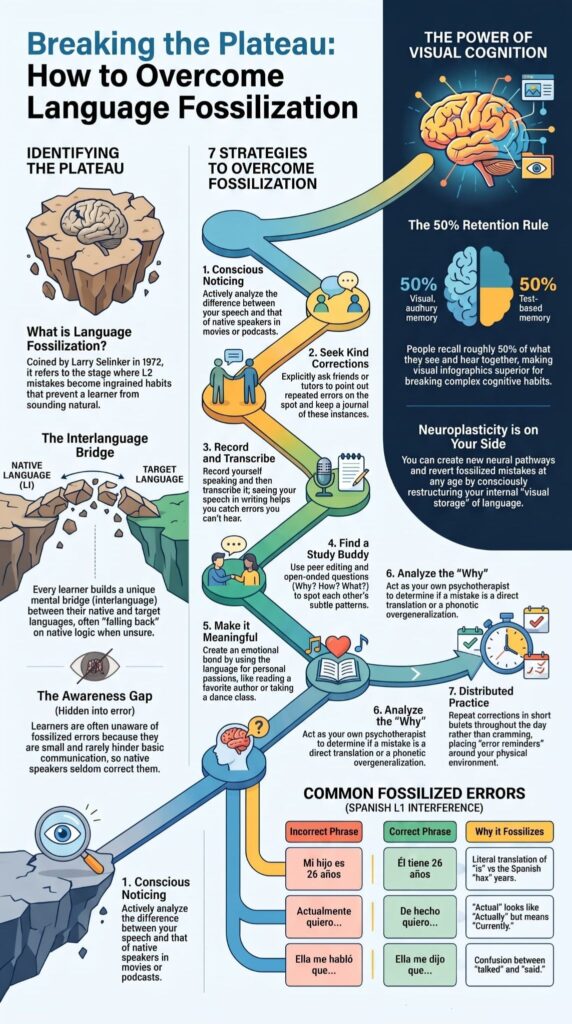
I used to give my students simple advice: “Listen more, and you’ll sound better.” I was wrong.
A student from Poland, a brilliant software developer, told me he’d watched American TV shows for ten years. He knew the grammar, his vocabulary was excellent. But when he spoke, his Polish accent was unmistakable. He was frustrated, and I realized my old advice was useless.
The issue isn’t hearing. It’s in the mouth. Your tongue, your jaw, your lips, they have decades of memory. They’ve spent a lifetime forming the sounds of your first language. When you attempt a new sound, they instinctively revert to the old, comfortable path. Linguists call this fossilization. It’s not a knowledge gap. It’s muscle memory.
As noted by Donna Lardiere
“Donna Lardiere presents the narrative of Patty, an adult Chinese immigrant learner of English, who achieves native-like proficiency in some areas of her English idiolect, although reaches a plateau in her language acquisition, known as the concept of fossilization.” – Donna Lardiere
Your brain compounds the problem. It interprets new sounds through the filter of your native language. You may not truly hear the difference between the “th” in think and the “s” in sink because your language doesn’t require you to. Remove this sentence, or replace with: “Listeners often notice accent cues very quickly.
This persistence comes from a few things:
- Your mouth muscles default to familiar positions.
- Your brain categorizes new sounds as versions of old ones.
- The rhythm and melody of your first language bleed through.
- Some new sound contrasts are physically difficult to perceive.
Realizing this changes the entire task. Improving your accent isn’t an academic study. It’s physical training. It’s the slow, deliberate work of building new muscular habits, like an athlete learning a new motion. It demands a specific kind of patience, the patience required to rebuild instinct.
How We Retrain the Muscles Behind English Sounds?

I once spent an entire afternoon in my office, just practicing “ship” versus “sheep.” My jaw ached. My tongue felt thick and clumsy. I was drained in a way that grammar study never left me. That’s when I understood: pronunciation isn’t about knowing the rules. It’s a physical skill.
Think of it like learning a proper tennis swing. You can read every instruction manual, but until you retrain your muscles, nothing changes. Your mouth, your jaw, your tongue, they need the same kind of training.
A few key sounds act as gatekeepers. Master them, and your speech locks into place. The short “i” in “ship” against the long “ee” in “sheep” is one. Another is the little puff of air on “p,” “t,” and “k” in words like pen, time, and cat. English uses that burst for emphasis.
The work that helps is physical, even repetitive:
- Shadowing: Speaking in sync with a native recording.
- Recording yourself: It’s cringe-worthy, but it shows you the gap.
- Mirror work: Watching your mouth make the shapes.
- Short loops: Repeating one phrase dozens of times until it flows.
The fatigue can be real because you are practicing unfamiliar speech movements repeatedly . You’re asking parts of your mouth to move in ways they never have. That fatigue means it’s working.
So treat it like athletic training. Brief, focused sessions. Relentless consistency. Patience for the slow process of creating a new habit. For many adult learners, this stage becomes the foundation of advanced English mastery, where communication starts feeling automatic rather than constructed. The goal isn’t to mimic a specific accent.
It’s to make your speech clear and effortless, so nothing stands between your thoughts and the person listening.
Why the Dark L Matters?
Now, about the ‘dark L.’ It is a subtle sound that can noticeably improve naturalness.
Try “light.” Your tongue taps behind your teeth. That’s the clear L.
Now try “full.” That final L is different. For the dark L, the back of your tongue lifts toward your soft palate. The tip stays low. You’ll find it in words like pool, school, milk, and help.
I practiced this for months. “Light” was fine, but “bell” came out as “beh.” A teacher gave me the key: stretch the vowel in “full,” and let the back of your tongue lift to finish the sound.
It feels odd. Uncomfortable. But getting this one sound right makes your sentences link together. Listeners may not pinpoint why, but your speech will sound more fluid, more connected. It’s a small adjustment that helps you sound at home in the language.
Why Schwa Controls Natural Rhythm?
If I had to choose one feature that strongly shapes natural English rhythm, it would be the schwa: that quick “uh” sound, like the ‘a’ in “about.”
For years, I pronounced every vowel fully. “Ba-NAH-na.” It was clear, but stiff. Then I heard a native say it: “buh-NA-nuh.” The first and last vowels softened into that short “uh.” The word got smoother, faster.
That’s the secret. Native speakers constantly reduce unstressed vowels to the schwa. It’s the rhythm of the language. Pronouncing every syllable fully makes you sound careful, but slow.
Using the schwa isn’t being lazy. It’s learning the music. It turns “photograph” into “PHO-tuh-graf” and “I’m going to” into “I’m gonna.” It feels wrong at first, but it’s what makes speech flow and keeps you in the conversation.
Why Native Speakers Sound So Effortless?
Credits:Adam’s English Lessons · engVid
I used to watch brilliant students struggle in conversation. Their grammar was perfect, their vocabulary large. But there was always a slight delay, a small pause before they spoke. They were translating in their heads, building sentences piece by piece.
Native speakers don’t do that. They speak in chunks. They’ve stored thousands of pre-built phrases and word combinations they can pull out whole. Research on formulaic language suggests advanced learners still use collocations less often than native speakers.
Research from Laura Vilkaitė and Norbert Schmitt shows
“The results suggest that [advanced non-native speakers] read adjacent collocations faster than non-formulaic controls, but this facilitation almost disappears for non-adjacent collocations.” – Laura Vilkaitė and Norbert Schmitt
You can see the difference clearly:
A learner might think: I have a high desire for coffee.
A native speaker says: “I’m craving a coffee.”
A learner might say: I am very tired.
A native speaker says: “I’m completely spent.”
A learner might state: I disagree.
A native speaker might say: “I see your point, but…”
Using these chunks changes everything. Your word retrieval is faster. Your speech rhythm sounds more natural. You use less mental energy, so you can focus on the conversation itself, not the construction of each sentence. For many learners trying to master English fluency, this shift from assembling language to retrieving language automatically becomes the turning point.
This is why memorizing vocabulary lists has limited returns. Learning words in their natural pairs and groups, strong coffee, heavy rain, make a decision, is far more powerful. It moves you from assembling language to simply using it.
Why Accent Mimicry Can Backfire?
I once had a student who became fascinated with a Cockney accent after watching a British TV show. He practiced diligently, mastering the dropped ‘h’ sounds and the distinctive slang. When he tried it in conversation with a colleague from London, the colleague was visibly uncomfortable. He later told me it felt like a caricature, not communication.
It was a hard lesson. Pronunciation is tied to identity. Trying to adopt a highly specific regional accent, like a deep Southern American drawl, a thick Scottish brogue, or Cockney, without the lived experience that shapes it often comes across as artificial, even offensive. For the learner, maintaining that facade in a long conversation is exhausting and feels inauthentic.
Most learners find a better path by focusing on the underlying music of the language, not a specific local flavor. What makes a bigger difference is mastering the general rhythm, the stress patterns, how words connect in flowing speech, and how to group your thoughts naturally.
The goal isn’t to imitate a specific person’s accent. It’s to speak with a clarity and flow that makes you easy to understand and allows your own personality to come through. Natural, comfortable communication will always matter more than a perfect impersonation.
FAQs
Is achieving native level English proficiency realistic for adults?
Achieving native level English proficiency is possible for adults, but the outcome depends on factors such as age of exposure, learning environment, and practice intensity. Most learners can reach near-native English proficiency with consistent English fluency training and English language immersion. Regular exposure to real-world English conversations also improves natural English communication and supports long-term progress.
How can I speak English like a native in conversations?
Learners who speak English like a native usually focus on communication patterns rather than grammar rules alone. English pronunciation practice helps improve clarity, while English intonation patterns make speech sound more natural. Learning idiomatic English expressions, phrasal verbs in conversation, and natural sentence patterns also helps learners develop native-like English fluency in everyday discussions.
Why do I still translate in my head while speaking English?
Many learners translate mentally because they first learned English by matching words from their native language. Reducing translation dependency requires building direct connections between ideas and English words. Thinking in English becomes easier through English speaking practice daily, English output practice, and contextual vocabulary learning used in realistic situations.
Which activities improve English listening comprehension the fastest?
Extensive listening in English improves English listening comprehension by exposing learners to natural speech speed and pronunciation patterns. Authentic English materials introduce learners to English rhythm and stress, English discourse markers, and connected speech in English. The shadowing technique for English and regular English pronunciation drills also improve advanced listening skills and fast English comprehension.
What separates C2 English level learners from fluent speakers?
The C2 English level measures advanced English language competence, but fluent speakers often show stronger control over context and communication style.
They adjust vocabulary, tone, and sentence structure for professional, academic, and casual situations. This flexibility often depends less on grammar knowledge and more on having enough advanced English vocabulary to respond naturally across different contexts.
Cultural understanding in English, register awareness, understanding English humor, and mastering English nuances all contribute to conversational English mastery.
Language That Feels Like Your Own
Over time, we’ve learned that reaching a high level of English isn’t about leaving behind your history, your identity, or the way you sound. For most adults, the real work is building communication that feels natural and steady in everyday life. It takes time. We know because we’ve lived through the long hours of listening, speaking, and feeling uncomfortable before things finally began to feel familiar.
At Ivy League International, that experience continues to shape how we teach and learn. We don’t see language as a test of perfection. We see it as a way to connect with people while still sounding like yourself. That’s the kind of progress we’re still building together.
Related Articles
- https://ivylanguagesinternational.com/advanced-english-mastery-training/
- https://ivylanguagesinternational.com/how-to-master-english-fluency-online/
- https://ivylanguagesinternational.com/advanced-english-vocabulary-for-professionals/
References
- https://koha.baobab-ebooks.com/cgi-bin/koha/opac-detail.pl?biblionumber=446948
- https://academic.oup.com/applij/article-abstract/40/2/329/4345772


Comment(01)