
Education
Common mistakes English beginners make often come from thinking in our first language and carrying that pattern into English without noticing. I learned this slowly. I still remember sitting in a quiet classroom, trying to answer a simple question, and saying, “Yesterday I go to school.” No one corrected me, so I repeated it for weeks.
Over time, I saw the same pattern in others. It was not about ability. It was about habits forming without feedback. These habits can change, but only with steady practice and clear correction. Keep reading, and I will walk you through how we fix them step by step.
Quick Fix Focus: What Actually Improves Your English
These points reflect what consistently helped me reduce common mistakes and build clearer, more stable English over time.
- We improve faster when we focus on a few common mistakes instead of everything at once
- We learn better through patterns, not isolated rules
- We stop repeating errors when we get regular feedback and correct them daily
Quick fix snapshot: what to focus on first
In my early years of learning and later teaching, I noticed a pattern. Learners who tried to fix everything at once often slowed down. They studied many rules but still made the same mistakes when speaking. I went through that phase too. I had notebooks full of grammar notes, but when I spoke, the same errors came back.
Instead of trying to cover all topics, I started working on a few high-frequency mistakes each week. That shift made a clear difference. Progress became easier to track because we knew exactly what we were fixing. This approach also aligns with practical English for beginner’s starter strategies, where focusing on manageable patterns leads to faster improvement.
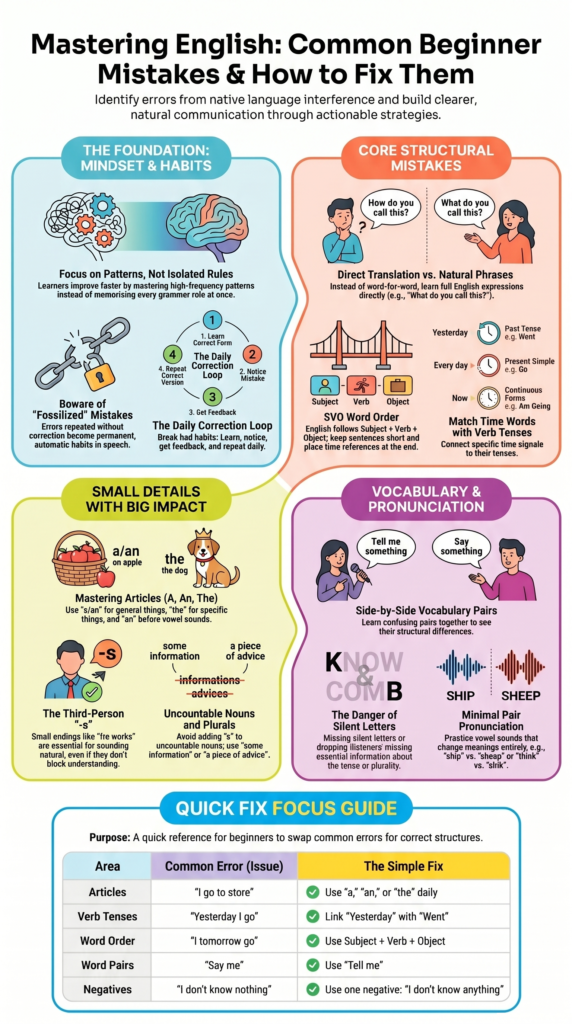
Here is a simple focus guide:
| Area | Example issue | Simple fix approach |
| Articles | “I go to store” | Practice “a,” “an,” “the” daily |
| Verb tenses | “Yesterday I go” | Match time words with verb forms |
| Word order | “I tomorrow go” | Use Subject + Verb + Object |
| Vocabulary pair | “Say me” instead of “tell me” | Learn pairs side by side |
I always suggest working on two or three areas at a time. Stay with them for a week, use them in real sentences, and repeat them out loud.
Why direct translation causes problems

When I first started learning English, I translated everything in my head. It felt natural because I was thinking in my own language first. The problem was, English does not follow the same structure. So even when my sentence had the right words, it still sounded off.
I remember saying, “How do you call this?” many times. People understood me, but something felt wrong. Later, I learned the correct phrase: “What do you call this?” That small change came from learning the full expression, not translating word by word.
This habit is hard to break because it feels efficient. But over time, it creates patterns that are difficult to fix. I saw this in many learners. They knew vocabulary, but their sentences still followed their first language structure.
Here is what worked:
- Learn full phrases instead of isolated words
- Repeat sentences out loud, not just in your head
- Practice common expressions daily
This method takes time, but it builds natural patterns. After a while, you stop translating and start thinking directly in English, even if only in short sentences at first.
How incorrect word order affects clarity
Word order was one of the first things I struggled with. I used to say, “I tomorrow will go to Jakarta.” People understood me, but it sounded unusual. At the time, I did not know why. I only knew something felt off.
English follows a fairly fixed structure. Once I understood that, things became clearer. Before that, I was placing words based on how I would say them in my first language. That habit made my sentences harder to follow.
I started simplifying everything. Instead of long sentences, I used short ones and followed the same pattern again and again. That repetition helped more than memorizing rules.
Here is the basic structure I practiced:
| Pattern | Example |
| Subject + Verb + Object | I eat breakfast |
| Add time at the end | I will go to Jakarta tomorrow |
I kept my sentences short at first. That helped me focus on structure without getting lost. Over time, I added more details, but the base stayed the same.
If you feel your sentences sound unclear, go back to simple structure. Build slowly. Clarity improves step by step, not all at once.
Why articles are difficult to master
Credits: English Easy Practice
Articles confused me for a long time. My first language did not use them, so I often skipped them without noticing. I would say, “I go to store” or “She is teacher,” and it felt normal.
The challenge with articles is that they seem small, but they carry meaning. At first, I tried to memorize rules, but that did not help much in real conversation. What helped was using simple, repeated patterns.
I began with everyday sentences. I focused on one idea at a time. For example, I practiced “a” for general things and “the” for specific ones. I did not rush to cover everything.
Here is how I kept it simple:
- “a” for something general: “I saw a dog”
- “the” for something specific: “The dog is barking”
- “an” before vowel sounds: “an apple”
I repeated these patterns daily, often out loud. Over time, they became more natural. I still made mistakes, but they became less frequent.
Articles take patience. They improve through use, not just study. If you keep your practice simple and consistent, they start to feel less confusing.
Why verb tenses cause confusion
Verb tenses were another area where I knew the rules but still made mistakes. I remember clearly saying, “Yesterday I go,” even after learning past tense. The issue was not knowledge. It was a habit.
When speaking quickly, I often forgot to match time words with the correct verb form. I saw the same thing in others. We understood the concept, but we did not apply it consistently.
What helped me was linking time expressions with verb forms. I stopped treating them as separate pieces. Instead, I practiced them together.
For example:
- “Yesterday” always goes with past tense
- “Every day” connects with present simple
- “Now” signals continuous form
I built short sentences and repeated them:
- “Yesterday I went to the store”
- “I go to work every day”
- “I am working now”
I practiced slowly at first. Speed came later. This step mattered more than I expected. Once the connection between time and verb became clear, my sentences improved.
Consistency matters here. You will still make mistakes, but with repetition, the correct forms begin to feel automatic.
Why small grammar details are often ignored
Some mistakes stay because they seem small. The third-person “-s” is a good example. I used to say, “He work” or “She like coffee.” The meaning was clear, so I did not pay attention to the missing “-s.”
This kind of error is easy to ignore. It does not block understanding, so it often goes uncorrected. Over time, it becomes a habit. I saw this in many learners who had studied English for years but still missed this detail.
Fixing it required slowing down. I had to notice the pattern and repeat it often. I practiced simple sentences again and again:
- He works
- She likes
- It runs
I also made a habit of listening more carefully. When I heard native speakers, I paid attention to these small endings. That helped reinforce the pattern.
Another common issue is double negatives. I used to say, “I don’t know nothing.” It felt natural, but it was incorrect in standard English. The fix was simple:
- Use one negative: “I don’t know anything”
Small details like these may seem minor, but they shape how natural your English sounds. Paying attention to them takes time, but it is worth the effort.
Why vocabulary and plural forms create confusion
Vocabulary mistakes often come from words that look similar but follow different patterns. I used to mix up “say” and “tell” all the time. In conversation, I would say “say me,” which is not correct.
The problem was not the meaning. It was the structure. Some words require an object, and some do not. I learned this by comparing them side by side, not separately.
For example:
- “Tell me something”
- “Say something”
Seeing both forms together helped me understand the difference. I applied the same method to other pairs like “borrow” and “lend.”
Plural forms also caused confusion. I often said “informations” or “homeworks.” It sounded logical, but it was incorrect. English has uncountable nouns, and that concept took time to accept.
I started using correct forms in simple sentences:
- “A piece of advice”
- “Some information”
I also learned irregular plurals like “children” and “people.” These required repetition, not memorization alone.
Vocabulary and plural forms improve with use. The more you see and hear them in context, the clearer they become. Progress here is gradual, but steady.
Why pronunciation and limited structures hold learners back
Pronunciation was something I ignored at first. I focused more on grammar, thinking that was enough. But I remember a moment when someone misunderstood me because of a vowel sound. That stayed with me.
Sounds like “ship” and “sheep” or “think” and “sink” can change meaning completely. I realized that pronunciation affects understanding more than I thought. Building this skill becomes easier when you follow structured methods like how to practice english pronunciation alone. Especially when you do not always have a speaking partner.
What helped was listening and repeating full phrases. I stopped practicing single words and started copying short sentences. This made my speech more natural over time.
At the same time, I noticed I was using very basic sentence patterns. I often said, “I want” or “I am” for everything. It was safe, but limiting.
To grow, I began replacing these with slightly richer structures:
- “I would like to…”
- “Could you help me…”
- “I am planning to…”
I did not rush this process. I added one new structure at a time and practiced it in real situations.
Pronunciation and structure improve slowly. They require attention and patience. But once they improve, communication becomes clearer and more flexible.
Insights from Cambridge English Blog indicate
“The second reason is that English pronunciation is unpredictable and really difficult even for English speakers. There are some pronunciation rules, but there are so many exceptions to these rules that they are not worth learning.” – Cambridge University Press & Assessment
Why mistakes become permanent and how we fix them

Some mistakes stay for years because no one corrects them early. I experienced this myself. Certain errors became automatic because I repeated them without feedback.
This process is often called fossilization. It happens when a mistake becomes part of your habit. I started noticing patterns in my own speech. If I repeated the same mistake often, I wrote it down and focused on it. Awareness was the first step.
One challenge many learners face during this stage is hesitation when speaking. That is where overcoming fear of speaking english becomes closely connected to fixing mistakes, because fear often prevents us from practicing enough to correct those patterns.
Then I followed a simple loop:
- Learn the correct form
- Notice the mistake
- Get feedback
- Repeat the correct version
I practiced this daily, even in small amounts. Over time, the correct form replaced the old habit.
This process is not fast, but it works. It requires patience and consistency. The key is not avoiding mistakes, but correcting them regularly.
Data from ERIC
“When learning a language the apprentices almost always make some mistakes that in the long run could be fossilizable or quickly become fossilized. The fossilization in the lexical plane occurs when we change the words that are similar to the native language (L1) because the teachers think that these words mean and pronounce themselves in the same way in (L2)… Phonology is another aspect that we must take into account listening comprehension as a way to focus on the pronunciation of reading, analyze the structure of writing and the fluency of speech.” – ERIC
FAQ
What are the most common English beginner mistakes when speaking?
Many English beginner mistakes happen in speaking because learners translate directly from their first language. This habit often causes English speaking errors, word order mistakes, and common beginner conversation errors. I experienced this myself when I relied on familiar patterns. Speaking improves when we slow down, use simple sentences, and correct mistakes daily through repeated practice.
Why do learners keep making common grammar errors in English?
Common grammar errors often continue because they feel normal after repeated use. I used to repeat verb tense mistakes and subject verb agreement errors without noticing them. These common ESL grammar mistakes become habits when no one corrects them. Improvement begins when we focus on one pattern, practice it often, and apply it clearly in daily sentences.
How can I fix common vocabulary mistakes and confusion in English?
Common vocabulary mistakes usually come from learning words without context. I often confuse pairs like say and tell, or lend and borrow. These typical English learner errors improved when I studied words in pairs and used them in short, clear sentences. Practicing collocations and everyday phrases helped me understand how words naturally work together.
Why are pronunciation mistakes in English hard to correct?
Pronunciation mistakes in English are difficult because learners often do not hear their own errors clearly. I struggled with long and short vowel sounds and the pronunciation of the “th” sound. Dropping word endings also changed meaning. Progress came when I listened carefully, repeated full sentences, and focused on stress and intonation in daily speech.
How do I stop making common English mistakes in daily use?
Stopping common English mistakes requires consistent correction, not more rules. I often repeated direct translation errors and simple sentence structure problems. What helped was noticing each mistake, correcting it immediately, and repeating the correct form. Small, daily practice builds better habits, and over time, these mistakes appear less often in real communication.
Moving Forward One Step at a Time
Learning English can feel exhausting when the same mistakes keep showing up no matter how much you study. It gets discouraging fast. But real improvement usually comes from slowing down, practicing the basics often, and giving yourself enough time to grow without expecting perfect results overnight.
What matters most is staying consistent, even when progress feels small. We believe steady practice builds real confidence and clearer English over time. If you want support that feels simple and encouraging, start learning with us at Ivy Language International
References
- https://www.cambridge.org/elt/blog/2018/07/19/odd-one-out/
- https://eric.ed.gov/?id=ED595198
Related Articles
- https://ivylanguagesinternational.com/english-for-beginners-starter-strategies/
- https://ivylanguagesinternational.com/how-to-practice-english-pronunciation-alone/
- https://ivylanguagesinternational.com/overcoming-fear-of-speaking-english/