
Education
Writing sophisticated English essays means expressing ideas with clarity, precision, and logical organization rather than using difficult vocabulary. We learned this through years of studying, teaching, and helping students improve their academic writing. Early in our own journey, we believed advanced words alone would make our essays stronger.
Experience taught us otherwise. Careful planning, thoughtful analysis, and consistent revision produced far better results. At Ivy Languages International, we continue applying these lessons every day to help students become stronger writers. Keep reading to learn the techniques that consistently improve essay quality.
Quick Reads: Sophisticated Essay Wins
Writing sophisticated English essays becomes easier when you focus on clear reasoning, careful planning, and thoughtful revision rather than complicated vocabulary.
- Clear reasoning matters most: Strong essays use organized ideas, precise language, and well-supported arguments instead of difficult words.
- Plan before you write: A clear plan helps create stronger thesis statements, better paragraph flow, and a more focused argument.
- Revise for stronger writing: Careful revision improves clarity, strengthens analysis, and helps develop a more confident academic voice.
What Separates Sophisticated Essays From Average Ones?

When I first started writing essays, I thought long sentences and advanced vocabulary would make my work stand out. They didn’t. My teachers kept pointing out that my ideas were hard to follow, even though I had spent hours choosing “academic” words.
Over time, I learned that strong essays are built on clear thinking, not complicated language. A reader should never have to guess what the writer means. Every paragraph should support one clear idea, and every piece of evidence should move the argument forward.
The words don’t need to be difficult. I also stopped trying to impress readers and focused on helping them understand my point. That shift improved my writing far more than any long vocabulary list ever did.
Common mistakes I learned to avoid:
- Using difficult words without purpose
- Writing long sentences that lose focus
- Adding quotes without explanation
- Repeating ideas instead of analyzing them
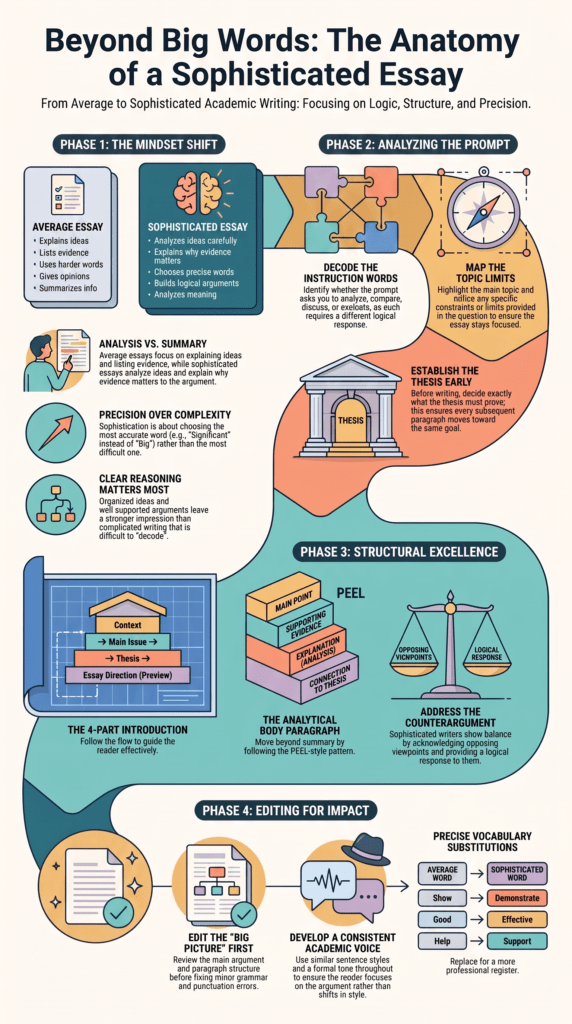
| Average Essay | Sophisticated Essay |
| Explains ideas | Analyzes ideas carefully |
| Lists evidence | Explains why evidence matters |
| Uses harder words | Chooses precise words |
| Gives opinions | Builds logical arguments |
Clear writing often leaves a stronger impression than complicated writing because readers can focus on the ideas instead of trying to decode every sentence.
Research from Education Resources Information Center (ERIC) shows
“Writing by this group of students was generally characterised by low lexical variation, a preponderance of high-frequency words and under-use of academic vocabulary in comparison with the target style.” – Breeze, R. (2008), International Journal of English Studies
Why Should You Analyze the Essay Question First?
One habit changed my writing more than almost anything else, slowing down before I wrote the first sentence. I used to read the question once and begin drafting right away. Fixing those mistakes later took far more time than planning would have.
Now I spend several minutes studying the question before I begin. It may seem like a small step, but it keeps every paragraph moving toward the same goal. After years of writing and teaching, I have found that careful preparation often separates an average essay from a strong one.
Essay questions contain clues that tell us exactly what the examiner expects. Words such as analyze, compare, discuss, or evaluate each ask for a different kind of response. Missing those differences can weaken an essay, even if the writing itself is clear. Before I start drafting, I use a short planning routine that keeps me focused.
- Highlight the instruction words.
- Circle the main topic.
- Notice any limits.
- Rewrite the question.
- Decide what the thesis must prove.
Taking a few extra minutes at the beginning often saves much more time during revision. It also helps every paragraph support the same central idea instead of drifting into unrelated points.
How Do You Build an Outline That Prevents Weak Arguments?
I used to think outlines slowed me down. I wanted to start writing while my ideas were still fresh, so I skipped the planning stage. I repeated points, forgot important evidence, and spent hours moving paragraphs around later. After enough frustrating editing sessions, I decided to try outlining first.
Instead of guessing where the essay was going, I already had a clear direction before I wrote a single paragraph. My ideas connected more naturally, and revision became much easier. Looking back, I wish I had learned this lesson earlier because it would have saved me a great deal of time and unnecessary stress.
A good outline does not need to be detailed or complicated. Its purpose is to organize your thinking before the drafting begins. When I prepare an outline, I always include the same basic parts.
- Thesis statement
- Main arguments
- Supporting evidence
- Counterargument, if needed
- Conclusion
This simple structure helps me notice weak ideas before they become full paragraphs. In my experience, spending fifteen or twenty minutes planning usually saves much more time during editing. More importantly, it produces essays that feel organized from beginning to end instead of being stitched together after the writing is finished.
What Makes an Introduction Immediately Strong?
I remember spending a lot of time trying to write impressive opening sentences. I thought a powerful introduction needed a dramatic statement or an unusual idea. After receiving feedback on my early essays, I learned something different.
A strong introduction does not need to sound complicated. Over time, I learned that a good introduction works like a guide. It gives the reader enough background, explains the direction of the essay, and prepares them for the discussion ahead.
A strong introduction usually has three main parts:
- Brief background information
- Clear thesis statement
- Main points preview
These parts help readers understand what they are about to read. I also learned that the thesis statement should not be hidden at the end of the introduction. It should appear clearly so the reader knows the purpose of the essay from the beginning.
Avoid openings that delay the main idea. Dictionary definitions, overly broad statements, or general comments about society often take attention away from the actual argument.
A simple structure has helped me many times:
Context → Main issue → Thesis → Essay direction
It keeps the introduction focused and gives the essay a stronger starting point. Small changes can improve the whole paper.
How Can Every Body Paragraph Become More Analytical?
One of the biggest lessons I learned about essay writing came from looking at my own mistakes. In the past, I thought collecting more evidence would automatically make my essays stronger.
Evidence alone does not create analysis. Writers need to explain why the evidence matters and how it supports the main argument. That was a difficult lesson because finding information felt like progress. Yet, the real work started after collecting that information.
A strong body paragraph usually follows a clear pattern.
- Main point
- Supporting evidence
- Explanation
- Connection to thesis
The explanation part is where many students struggle. They include a quotation but do not tell the reader what it means. A good paragraph answers questions like:
- Why does this evidence matter?
- What does it prove?
- How does it connect to the argument?
I now spend more time explaining fewer examples instead of adding many examples with little discussion. That approach creates writing that feels more thoughtful and controlled.
| Weak Approach | Strong Approach |
| Adds many quotes | Explains key evidence |
| Summarizes information | Analyzes meaning |
| Repeats the topic | Develops an argument |
The difference is not the amount of information. It is the quality of the thinking behind it.
Why Isn’t Sophistication About Using Bigger Words?
For a long time, I believed sophisticated writing meant replacing simple words with advanced ones. I carried a dictionary everywhere and searched for alternatives whenever I wrote. Sometimes the result looked more academic, but the meaning became less clear. Readers had to work harder to understand what I wanted to say.
That experience taught me that word choice is about accuracy. A precise word can make an idea clearer, while an unusual word can create confusion if it does not fit the context.
Good writers choose language that supports their message. Building a stronger vocabulary also becomes more useful when the words are learned in context, especially through advanced English vocabulary for professionals.
I still see students make the same mistake. They worry that simple words will make their essays seem weak. In reality, clear writing often shows stronger control because the writer understands the idea well enough to explain it simply.
Avoid these habits:
- Using words without knowing the meaning
- Replacing every repeated word
- Choosing complicated synonyms
- Writing long sentences without purpose
Instead, focus on choosing the right word.
| Less Precise | More Precise |
| Big | Significant |
| Show | Demonstrate |
| Good | Effective |
| Bad | Ineffective |
| Help | Support |
That surprised me when I first learned it. Strong academic writing is not about making readers notice the vocabulary. It is about making them understand the argument.
As noted by UC Davis University Writing Program
“The 5 paper is an interesting and sophisticated response to the topic. The central idea or thesis is clearly stated, worthy of development, and suitably specific; usually the thesis constitutes a thoughtful answer to a question worth asking. The paper recognizes the complexity of the topic or question, acknowledging contradictions, qualifications or limits of the thesis while sustaining logical development.” – UC Davis Grading Criteria
How Can You Develop a Consistent Academic Voice?
When I reviewed some of my earlier essays, I noticed a problem I had not expected. The ideas were acceptable, but the tone changed from paragraph to paragraph. One section sounded formal, while another sounded like a casual conversation. The writing felt uneven.
Developing an academic voice takes time because it involves more than choosing formal words. It requires consistency in sentence structure, tone, and the way ideas are presented.
I learned this slowly through practice and revision. Structured advanced English mastery training can also help learners develop greater control over these areas through focused practice.
A consistent voice helps readers focus on the argument instead of noticing changes in style. It means the writing should feel controlled from the introduction to the conclusion.
Before submitting an essay, I check a few areas:
- Formal tone throughout
- Consistent point of view
- Clear transitions
- Similar sentence style
- Appropriate vocabulary
I also read my essays aloud. It sounds like a small habit, but it helps me notice sentences that feel unnatural or unclear.
Writing improves through repeated review. There is no shortcut. Each revision teaches me something new about how to communicate ideas more effectively.
How Do Strong Writers Build Better Arguments?
Credits: English with Valentine
I used to think a strong argument meant proving my opinion and ignoring other viewpoints. Later, I learned that good academic writing requires more balance. A convincing essay shows that the writer understands different perspectives before explaining why one position is stronger.
This was not always easy for me. I worried that mentioning another viewpoint would weaken my argument. Over time, I realized the opposite was true. Addressing another perspective shows careful thinking and gives the reader more confidence in the conclusion.
A balanced argument usually includes:
- A clear claim
- Supporting evidence
- Explanation
- Opposing viewpoint
- Response to that viewpoint
This structure helps the essay feel fair and thoughtful. It also prevents the writing from becoming a simple list of opinions.
When I include a counterargument, I do not add it only because I think I should. I include it when it helps explain the topic better. Some essays need more discussion of different views, while others can remain focused on one main idea.
Good arguments are not created by speaking the loudest. They are created by understanding the topic carefully and explaining ideas with patience.
Which Tools Actually Help Students Write Better Essays?
During my own writing journey, I tried many different tools because I wanted to improve faster. Some helped, while others only distracted me. Eventually, I learned that tools are useful when they support my thinking, not when they replace it.
Research tools can help students find reliable information, organize sources, and manage references. Editing tools can also help identify grammar problems or unclear sentences. Still, the writer must make the final decisions because an essay should represent the writer’s own understanding.
Some useful resources include:
| Purpose | Resource |
| Research | Google Scholar |
| Sources | JSTOR |
| References | Zotero |
| Editing | Grammarly |
These tools can save time, but they cannot create a strong argument by themselves. A student still needs to understand the question, develop ideas, and explain evidence.
Technology has become part of modern writing, but I believe the best use of it is as support. Get curious. Ask questions. Review your work carefully.
The thinking behind the essay remains the most important part. Good tools can help the process, but they cannot replace effort, learning, and practice.
How Should You Edit Like an Advanced Writer?
I used to treat editing as the final step where I only corrected spelling and grammar mistakes. Later, I realized that strong editing begins much earlier. The first question should not be “Is my grammar correct?” It should be “Does my essay clearly prove my argument?”
That change completely improved the way I revised my work. Instead of fixing small details first, I began looking at the bigger picture. I checked my thesis, paragraph order, evidence, and explanations before focusing on individual sentences.
My editing process now follows this order:
- Review the main argument.
- Check paragraph structure.
- Improve explanations.
- Remove repeated ideas.
- Fix grammar and punctuation.
- Proofread carefully.
This approach prevents wasted effort. There is no reason to perfect a paragraph that may need to be rewritten because the main idea is unclear.
Before submitting an essay, I ask:
- Does every paragraph support the thesis?
- Is the evidence explained?
- Are transitions clear?
- Is the conclusion connected?
Revision requires patience. Good writing rarely appears in the first draft. It develops through careful review and honest improvement.
How Can You Practice Sophisticated Writing Faster?

When I wanted to improve my writing, I believed the answer was simple: write more essays. I thought producing more pages would naturally make me better. After some time, I noticed that my mistakes were repeating.
The biggest improvement came when I started studying my own work. I looked at comments from teachers, compared my essays with stronger examples, and rewrote sections that were unclear.
Building a regular routine around how to master English fluency online can reinforce this process by giving learners more opportunities to practice language in meaningful contexts.
Writing skill grows through focused practice. It is about paying attention to weaknesses and making small improvements each time.
Some exercises that helped me include:
- Rewrite unclear paragraphs.
- Study strong examples.
- Practice different sentence structures.
- Summarize articles.
- Review old essays.
These activities helped me improve my organization, vocabulary, and ability to explain ideas.
I also learned that rewriting is one of the most useful parts of learning. A first draft shows my thoughts, but revision helps shape those thoughts into a stronger message.
Real improvement takes time. Each revision teaches something new, and those lessons build better writing habits over the years.
FAQ
How can rhetorical devices make an essay more persuasive?
Rhetorical devices can make your ideas stronger and easier to remember. Techniques such as antithesis, parallelism, and juxtaposition can highlight important differences or connections.
Use them only when they support your point. Too many devices can distract readers and make your writing feel forced. Choose techniques that fit your argument, audience, and purpose.
How can I use critical analysis in literary interpretation?
Begin by looking beyond the basic meaning of the text. Ask why the writer uses certain words, images, symbols, or points of view. Pay attention to diction, connotation, tone, and imagery. Then connect these details to a larger idea. This method helps you explain meaning instead of simply retelling what happens.
How can I make my essay sound more academic?
Use clear academic vocabulary and maintain a formal register throughout your essay. Avoid words that sound overly casual or emotional. You can also improve your writing through syntactic variety. Mix shorter sentences with complex sentences when appropriate. This creates a natural rhythm while helping you explain detailed ideas clearly and accurately.
How can cohesive devices improve my essay structure?
Cohesive devices help readers understand how your ideas connect. Use transitional phrases to show relationships such as contrast, cause, comparison, or result. Discourse markers can also guide readers from one point to another. However, do not add transitions to every sentence. Each one should have a clear purpose and make your argument easier to follow.
How can I add more nuance to my academic arguments?
Nuance comes from showing that an issue may have more than one reasonable interpretation. Consider different viewpoints, limitations, and exceptions before making your final claim.
Hedging language can help you avoid statements that sound too absolute. Choose precise words and explain your reasoning carefully. This approach makes your argument balanced without making it unclear.
Build Confidence Through Better English Writing
Writing sophisticated English essays doesn’t require perfect words from the start. We improve by planning our ideas, explaining them clearly, and revising when something doesn’t work. Each essay gives us another chance to write with greater confidence.
Progress takes time, but we can keep moving forward with steady practice. Ready to strengthen your writing? Ivy Languages International is here to support your next step. Write with confidence. Keep improving with us.
References
- https://eric.ed.gov/ff1=locSpain&q=Spelling+of+a+word&ff2=subVocabulary&ff3=subSecond+Language+Instruction&id=EJ1072209
- https://stenzel.ucdavis.edu/180/exercises/standards.html
Related Articles
- https://ivylanguagesinternational.com/advanced-english-vocabulary-for-professionals/
- https://ivylanguagesinternational.com/advanced-english-mastery-training/
- https://ivylanguagesinternational.com/how-to-master-english-fluency-online/