Tips
Moving from intermediate to advanced English means shifting from basic communication to greater precision, flexibility, and active language use. I remember reaching B2 and wondering why all my effort no longer produced obvious results. I could follow conversations and read comfortably, yet I still struggled to express complex ideas with confidence.
At Ivy Languages International, we often see learners move forward when they replace passive exposure with deliberate practice and consistent feedback. The plateau is real, but it is not permanent. Keep reading to explore practical ways to continue growing from B2 toward C1 and beyond.
B2-to-C1 Quick Wins
Moving from intermediate to advanced English is less about doing more and more about practicing with intention. These are the habits that make the biggest difference over time:
- Focus on precision, nuance, and context rather than basic communication.
- Prioritize active output through speaking, writing, and self-correction instead of relying on passive immersion.
- Use domain-specific learning and consistent feedback to move through the intermediate plateau more effectively.
Why Does Progress Slow Down After B2?

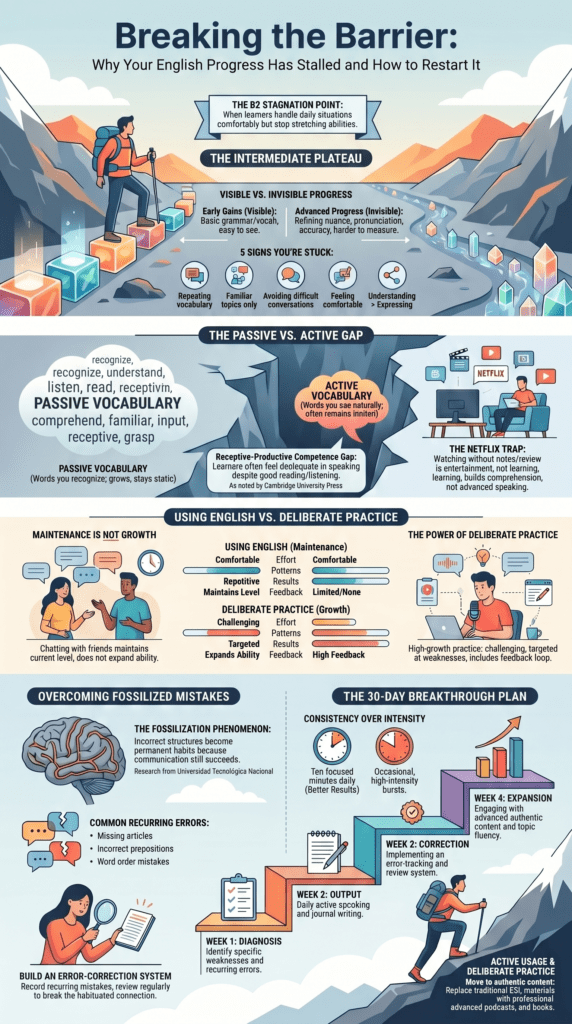
I remember reaching B2 and feeling proud of how much English I could understand. Daily conversations became easier, and I could follow most movies, articles, and podcasts. But after that, progress felt much slower.
At first, every new word seemed to make a big difference. Later, the improvements became harder to notice.
Many learners experience this stage for a few reasons. In fact, understanding how to overcome English learning plateaus often begins with recognizing progress has stopped. It usually means the work has shifted toward deeper skills.
- Most common vocabulary is already familiar.
- Advanced words appear less often in everyday situations.
- Grammar becomes more subtle and harder to master.
- Understanding tone, humor, and context takes time.
- Passive learning stops producing the same results.
I often think of it like adding water to a lake. In the beginning, each gallon changes the level noticeably. Later, the same amount of water is still there, but the change is harder to see.
Another challenge is following long discussions or complex arguments. I could understand individual sentences, yet still lose track of the bigger message. Looking back, I realize growth never stopped. It simply became deeper, slower, and more connected to real-world use.
Why passive immersion stops working
I remember a period when I spent several hours each week watching English shows, listening to podcasts, and reading online articles. At first, my English improved quickly. I understood more, learned new expressions, and felt more comfortable using the language. Then something changed. The improvement became harder to notice.
The problem was not a lack of exposure. I was spending plenty of time with English. The problem was that I had stopped paying close attention. I understood enough to follow the content, so my brain rarely needed to work through unfamiliar language.
Looking back, a few habits slowed my progress:
- Watching shows without noticing new vocabulary or sentence patterns.
- Listening to podcasts without reviewing unfamiliar expressions.
- Reading for information instead of studying how ideas were presented.
- Choosing familiar topics instead of more demanding material.
- Treating English as entertainment rather than practice.
Things improved when I became more active. After listening or reading, I would summarize the main ideas, write down useful phrases, and pay attention to how speakers organized their thoughts. These habits led to some of my biggest Intermediate English breakthroughs because they forced me to engage with the language.
How can you build advanced vocabulary faster?
I remember feeling stuck with my vocabulary even though I was learning new words every week. I could understand most conversations, but my own speaking sounded repetitive.
A few habits helped me make better progress:
- Learn vocabulary through complete sentences.
- Pay attention to common collocations.
- Study phrasal verbs in real contexts.
- Notice idioms while reading and listening.
- Replace vague words with more precise alternatives.
Developing these habits also reminded me how different advanced learning is from the common mistakes English beginners make. Where the focus is often on memorization and basic comprehension rather than precision and nuance.
| Intermediate Phrase | Advanced Alternative |
| Very angry | Livid / Indignant |
| Big rain | Torrential rain |
| Make an agreement | Strike an agreement |
| Fix a problem | Iron out an issue |
Once I crossed the 2,000–3,000-word high-frequency vocabulary range, I noticed that growth became more dependent on reading widely. Books, essays, and longer articles exposed me to language that rarely appeared in everyday conversations.
I also spent time with resources such as Project Gutenberg, where I could read authentic texts at my own pace. New vocabulary became part of my active language because I encountered it repeatedly in meaningful contexts.
Which advanced grammar structures matter most?
I spent years studying grammar rules before I realized that advanced grammar is not about sounding complicated. It is about choosing the right structure for the situation. Some patterns help create emphasis. Others help connect ideas more clearly or express subtle differences in meaning.
As I listened to skilled speakers and writers, I began noticing certain structures appear again and again. They were not used to impress anyone. They were used because they communicated ideas more effectively.
As highlighted by British Council
“Often, intermediate learners rely on short, simple sentences… advanced English requires elements such as: Linking words, Relative clauses, Conditionals, [and] Diverse vocabulary.” – British Council
The structures that helped me most included:
- Inversion for emphasis and formal communication.
- Cleft sentences to highlight important information.
- Mixed conditionals to connect past events with present outcomes.
- Relative clauses for adding detail.
- Participle clauses for smoother written English.
- Advanced reported speech.
- More flexible use of modal verbs and conditionals.
For example:
- Standard: I have never seen such a challenge.
- Inversion: Never have I seen such a challenge.
At the CEFR C1 level, these structures become useful because they offer more choices. The goal is greater control over meaning, tone, and emphasis.
How do you improve speaking without sounding scripted?
I remember reaching a point where I could understand most conversations, podcasts, and videos without much difficulty. I realized that understanding English and using it spontaneously were two different skills.
A few activities made a noticeable difference:
- Practice shadowing every day.
- Complete a 3-minute monologue challenge.
- Record speaking sessions regularly.
- Review recurring mistakes.
- Pay attention to pronunciation, rhythm, and stress patterns.
Shadowing became one of the most useful exercises in my routine. I listened to short clips from interviews, podcasts, and conversations, then repeated them immediately. The goal was to develop a better sense of pacing and natural speech.
The 3-minute monologue challenge was equally valuable. I would choose a topic, set a timer, and speak without stopping. This revealed gaps in vocabulary, organization, and fluency that passive learning never exposed.
When I got stuck, a few repair phrases helped keep the conversation moving:
- Let me rephrase that.
- Let me think about that for a moment.
- What I mean is this.
- I would like to clarify my point.
Many learners also find useful speaking partners through communities such as Discord. Real conversations create situations that practice exercises cannot fully replicate.
What is the physical side of fluency?
Credits: Speak English Class
One lesson surprised me as my English improved. Many speaking problems had very little to do with vocabulary. I knew the words I wanted to use, but producing them quickly and naturally was another challenge.
Several physical factors often affect advanced learners:
- Pronunciation fatigue during long conversations.
- Difficulty linking sounds smoothly.
- Limited automation of advanced language patterns.
- Weak control of difficult sound contrasts.
- Inconsistent pacing and voice control.
I began noticing these challenges after recording longer conversations. Certain sounds required more effort than others. Some sentence structures felt natural in writing but awkward when spoken aloud.
Discussions across Reddit language-learning communities often reflect the same experience. Many learners discover that fluency is partly a motor skill. The brain may know what to say, but the mouth still needs practice producing it efficiently.
Regular speaking, shadowing, pronunciation drills, and repeated exposure gradually improve this connection. Over time, common language patterns require less conscious effort.
This is one reason fluent reading does not automatically lead to fluent speaking. The two skills overlap, but they develop in different ways. Consistent speaking practice remains essential if the goal is effortless communication.
Why should you stop studying “English” and start studying a subject?
One of the biggest changes in my own learning happened when I stopped treating English as the main subject. Instead, I started using English to learn about topics that genuinely interested me.
At first, I read a little of everything. My progress felt scattered. Later, I narrowed my focus and spent more time exploring a single area. The language became easier to remember because it was connected to ideas that mattered to me.
Popular domains include:
- Politics
- Psychology
- Philosophy
- Business
- Technology
Focusing on one area creates several advantages:
- Vocabulary appears repeatedly.
- Reading becomes easier over time.
- Listening comprehension improves faster.
- Speaking becomes more confident.
- Writing gains more depth and precision.
Many learners use resources such as Project Gutenberg, industry publications, academic articles, and long-form interviews to build knowledge within a chosen field.
I often recommend choosing one specialized domain and staying with it for several months. The goal is not to become an expert overnight. The goal is to create repeated contact with the same ideas, vocabulary, and patterns of communication.
In my experience, a focused approach produces stronger long-term results than constantly jumping between unrelated topics. Language grows naturally when it supports a genuine interest.
How can you develop native like nuance and professional communication?
As my English improved, I realized that advanced communication was not mainly about vocabulary or grammar. It was about knowing how to say the same thing in different ways depending on the situation.
A direct statement that works with a close friend may sound inappropriate in a professional meeting. Learning that distinction took time and observation.
| Direct Statement | Advanced Alternative |
| That’s wrong. | I wonder if we might reconsider this approach. |
| Fix it. | It may be worth revisiting this section. |
These differences may seem small, but they often affect how a message is received.
Several skills became increasingly important:
- Using hedging language appropriately.
- Recognizing formal and informal registers.
- Understanding discourse markers.
- Adjusting tone for different audiences.
- Recognizing cultural expectations in communication.
Advanced speakers shift naturally between styles. They can participate in small talk, write formal reports, discuss technical subjects, and handle difficult conversations while adjusting their language to fit the context.
At the CEFR C2 level, this flexibility becomes one of the clearest signs of proficiency. The focus is no longer on what a person can say. The focus is on how effectively they can adapt their message to the people around them.
What does an effective B2-to-C1 study plan look like?

When I was working toward advanced English, I learned that consistency mattered far more than motivation. What made the difference was showing up regularly and following a routine that gave me opportunities to read, listen, speak, and write every week.
A simple daily structure can look like this:
| Activity | Daily Time |
| Active Reading | 30 minutes |
| Listening + Shadowing | 30 minutes |
| Speaking Practice | 20 minutes |
| Writing & Editing | 20 minutes |
What helped me most was creating regular feedback loops. Progress became more noticeable once I started reviewing my work and asking for feedback.
A practical weekly routine should include:
- Following a weekly feedback cycle.
- Recording speaking sessions.
- Reviewing recurring mistakes.
- Editing written work carefully.
- Seeking feedback from teachers or conversation partners.
Research from Cambridge University Press & Assessment shows
“Learners will now need to… Expand their grammatical competence, including acquiring new ways of using known forms, as well as adding more complex language resources… Become more fluent and accurate… Continue to develop their vocabulary, particularly at the 5,000 to 6,000 word range.” – Cambridge University Press & Assessment
One listening method I found especially useful was the multi-pass subtitle workflow:
- Watch with subtitles.
- Study the transcript closely.
- Watch again without subtitles.
At Ivy Languages International, we encourage learners to combine independent practice with meaningful human interaction. Technology can be useful, but real conversations often reveal communication habits that software misses. Consistent practice, regular feedback, and steady exposure to challenging material tend to produce the strongest long-term results.
FAQ
How can I improve natural English pronunciation without losing my accent?
Natural English pronunciation is not about sounding native. It is about being understood clearly. Focus on English stress timing, English connected speech, and regular English pronunciation drills. Practicing English minimal pairs and noticing English intonation patterns can improve clarity and build English speaking confidence without changing who you are.
What helps with the B2 to C1 transition in professional settings?
The B2 to C1 transition often requires stronger professional English communication skills. Learners benefit from practicing English email writing, English report writing, and English presentation skills. Paying attention to English register switching between formal English register and informal English usage also helps people communicate more effectively at work.
How can I remember advanced vocabulary more easily?
Advanced vocabulary acquisition becomes easier when words are connected to real situations. Focus on English collocations mastery, phrasal verbs advanced learners encounter often, and English synonyms nuances. Seeing vocabulary repeatedly through English reading comprehension and active use supports long-term retention better than memorizing isolated lists.
Why do I struggle to sound confident during conversations?
Many learners understand English well but hesitate when speaking. Building native-like English speaking skills takes practice with English conversation flow, English small talk skills, and English active listening. English clarification requests and English self-correction strategies can reduce pressure and make conversations feel more natural over time.
Which skills support advancing English proficiency beyond grammar?
Advancing English proficiency involves more than complex grammar mastery. English pragmatics skills, cultural English nuances, and English discourse markers help shape clearer communication. Developing English critical thinking, English argumentation skills, and English cohesion devices also strengthens academic, professional, and everyday interactions.
Keep Advancing with Purpose
Reaching an advanced level can feel frustrating because the improvements are smaller and harder to notice. That’s normal. Growth at this stage comes from refining how you communicate, applying feedback, and staying consistent even when progress feels slow.
We know the B2 plateau isn’t the end of the road. Keep showing up, keep practicing with intention, and let each real conversation move you forward. Ready to level up? Join Ivy League International.
References
- https://takeielts.britishcouncil.org/blog/use-advanced-language-skills-to-pass-ielts
- https://www.cambridge.org/elt/blog/2015/11/03/moving-beyond-plateau-conclusions/
Related Articles
- https://ivylanguagesinternational.com/how-to-overcome-english-learning-plateaus/
- https://ivylanguagesinternational.com/intermediate-english-breakthroughs/
- https://ivylanguagesinternational.com/common-mistakes-english-beginners-make/