Advanced English vocabulary for professionals is about choosing precise words that fit the situation, audience, and purpose.
In my ten years coaching cross-border teams at Ivy Language International, I’ve seen managers create confusion by using “fancy” vocabulary when simple language would have been clearer. I faced the same challenge when my words did not match the listener or situation, leading to misunderstandings and extra questions.
The New York State Department of Labor reports that 61% of regional employers value clear communication above role-specific technical skills. Keep reading to learn practical ways to communicate with greater precision and confidence.
Professional English: The Quick Wins
Strong professional English comes from using the right words in the right context, practicing them regularly, and focusing on clearer communication rather than impressive-sounding vocabulary.
- Choose precision over complexity. Use advanced vocabulary when it makes your meaning clearer or more accurate, not simply to sound impressive.
- Learn through real work situations. Practice professional English in meetings, emails, presentations, reports, and negotiations where vocabulary has a clear purpose.
- Track practical progress. Look for clearer communication, faster word retrieval, and better control of your professional tone as signs of improvement.
What Makes Professional Vocabulary Truly Advanced?

I remember early on how using the right word wasn’t about sounding fancy but about being clear. The word mitigate is a good example. It means to lessen harm or risk, not just “fix” something. Using it in the wrong place can confuse people instead of helping them understand.
Over time, I learned vocabulary isn’t just about definitions. It’s about four key things:
- Precision, does the word match the meaning?
- Register, is it right for the setting, like an email or meeting?
- Collocation, does it fit naturally with other words?
- Context, will it sound natural to the listener or reader?
These parts matter because communication in real workplaces isn’t perfect or textbook-like. The New York State Department of Labor found 61% of employers value communication skills beyond technical knowledge. That lines up with what I see: clear, practical language makes the biggest difference.
When selecting vocabulary for high-stakes settings, default to words that eliminate ambiguity. If a simpler word communicates the exact scope without losing technical precision, use the simpler word
Why Can Advanced Vocabulary Backfire at Work?
Early in my career, I noticed something that changed how I think about language at work. Sometimes, using complex words doesn’t help, it just makes things harder to understand. Words like optimize or mitigate have clear meanings, but they don’t always fit every situation. Saying “make better” might actually be clearer, especially in simple conversations.
Insights from Professor Sir Cary Cooper
“Rather than conveying professionalism they frequently indicate that the message is covering up some more negative intention or information.” –Professor Sir Cary Cooper
That lesson came from real struggles, trying to communicate clearly across cultures and industries. I’ve seen firsthand how language that’s too fancy or mismatched can cause confusion and even tension between colleagues.
Research from Singapore Management University backs this up, showing that misunderstandings tied to language choices impact workplace harmony and results.
For me, this means professional language should cut through uncertainty, not add to it. It’s about choosing words that fit the moment and audience, not just sounding advanced. This approach requires patience and attention to detail, worked out over years of experience, not shortcuts.
At Ivy Language International, we teach vocabulary grounded in practical use, helping learners communicate clearly and confidently, no matter the setting. That’s the kind of progress worth making.
Here are some useful replacements when the meaning is genuinely more precise:
| General phrase | More precise alternative | When it fits |
| Make better | Optimize | Improve performance or conditions |
| Make worse | Exacerbate | Increase the severity of a problem |
| Reduce risk | Mitigate | Lessen a negative impact or threat |
| Combine operations | Consolidate | Bring separate parts together |
| Prove the claim | Substantiate | Support with evidence |
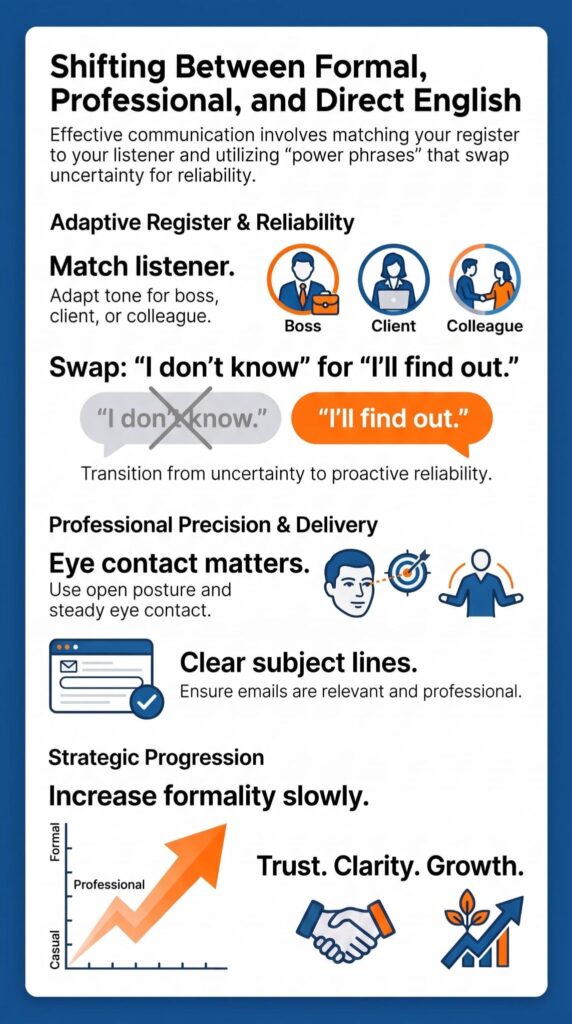
How Should We Shift Between Formal, Professional, and Direct English?
Early in my time working with professionals, I realized how much language changes depending on who’s listening. Asking a favor from a close colleague might be straightforward, but that same directness can feel harsh with a client or boss. Learning to adjust, what we call register, has been a slow but necessary lesson.
For example, instead of “I need this ASAP,” saying, “Could you prioritize this by Friday?” respects the relationship and sounds more professional. It isn’t about sounding stiff or vague, but about matching the right tone without losing clarity. I’ve seen how missteps here can cause confusion or tension, especially in emails where words can come across differently than spoken.
At Ivy Language International, we focus on this balance. We don’t aim to make every sentence formal but to help learners choose language that fits the moment, whether it’s a quick check-in or a polite disagreement. Years of trial and error taught me that mastering this subtlety takes patience and attention to real conversations, not shortcuts.
This skill helps professionals communicate clearly and respectfully, building stronger workplace connections. That’s the kind of progress I want to support, and I invite you to take this journey with us.
Which Advanced Words Improve Executive Strategy and Decision-Making?
When I first began working with business professionals, I quickly saw how vital precise vocabulary is for clear communication. Words like bifurcate, efficacy, incumbent, and amortize aren’t just fancy terms, they carry specific meanings that shape decisions and discussions. Understanding these words well makes it easier to explain complex ideas without confusion.
Here are a few key terms I’ve found especially useful:
- Bifurcate: To divide something into two paths. Example: “We need to bifurcate the strategy between enterprise and consumer markets.”
- Efficacy: The ability to produce the intended result. Example: “The pilot will help us evaluate the efficacy of the new process.”
- Incumbent: The current holder of a position. Example: “The incumbent has a strong distribution network.”
- Amortize: To spread a cost over time. Example: “We will amortize the software investment over five years.”
The distinction between efficacy and efficiency matters most. One asks if something works, the other asks how well resources are used.
At Ivy Language International, we focus on learning vocabulary through real business situations, not just lists of words. It takes time and patience, but that’s how precise, practical communication grows. I hope you’ll join us on this journey.
How Can We Use Vocabulary for Negotiation and Diplomacy?

Early in my career, I found negotiations could become tense quickly, often because of the words we chose, not just the issues themselves. Learning to use diplomatic language helped me keep conversations open, even when disagreement or uncertainty was on the table. That skill matters. It keeps relationships intact and solutions possible.
Four words stood out as particularly helpful:
- Equivocal: When something is unclear or open to interpretation, like saying, “The client’s response was equivocal,” which avoids blaming but signals a need to clarify.
- Unilateral: Actions taken by one party alone, without agreement.
- Palpable: So strong it feels almost tangible, often used for tension or emotion in the room.
- Capitulate: To stop resisting and accept unfavorable terms.
Mixing up equivocal with equivalent is a common mistake I’ve encountered, one means uncertain, the other equal.
At Ivy Language International, we don’t just teach these words. We practice using them in real scenarios like price negotiations or contract clarifications. That takes patience and experience, but it’s the way to speak calmly and clearly when it matters most. I hope you’ll join us in mastering this skill.
What Is the Difference Between Systemic and Systematic?
Systemic describes something that affects an entire system, while systematic describes an organized and methodical process.
These two words appear often in reports, business communication vocabulary, risk analysis, and management discussions. Their similar spelling makes them easy to confuse.
| Word | Meaning | Example |
| Systemic | Embedded throughout or affecting a whole system | “The delays reflect a systemic problem in the database architecture.” |
| Systematic | Organized according to a planned method | “We conducted a systematic review of every vendor contract.” |
We can remember the difference by asking what we are describing. If we are describing the condition of the system, systemic may be correct. If we are describing the way we complete a task, systematic may be correct.
For example, a company may have a systemic problem with its reporting structure. We might then conduct a systematic review to understand the problem.
This distinction is useful because precise professional language often depends on small differences. At Ivy Language International, we can reinforce these distinctions through workplace case studies and corrective exercises.
Of course, we do not need to use either word if a simpler phrase communicates the idea better. “The problem affects the whole system” may be clearer for a general audience.
Which Precision Verbs Make Executive Reports Stronger?
Early in my career, I struggled with writing clear reports that didn’t feel wordy or vague. I found I often leaned on general verbs like “make,” “do,” or “fix,” which left readers guessing about the real impact of our work. Over time, I realized that targeted verbs, words that speak directly to an action or outcome, can clarify meaning and simplify writing.
For example:
- Instead of “eliminate the need for,” using obviate sharpens the message, “Automation will obviate manual reconciliation.”
- Rather than “make worse,” exacerbate shows the risk clearly, “The delay could exacerbate customer complaints.”
- Where “combine” feels broad, consolidate points to a precise business action, “We plan to consolidate the regional teams.”
But these words aren’t meant for mechanical swaps. If “reduce” works, that’s enough. It’s about knowing when a stronger verb helps and when it doesn’t.
At Ivy Language International, we practice this through real-world reporting scenarios. The goal isn’t complicated language, it’s controlled, precise writing that guides the reader, showing exactly what happened and what comes next. That’s the kind of clarity I’ve worked hard to build, and want to share.
How Can C1 and C2 Professionals Break Through Vocabulary Fossilization?
Early in my teaching career, I noticed something curious: some students knew thousands of words but still recycled the same simple phrases during fast-paced meetings. Recognizing a word doesn’t always mean you can use it quickly when it matters. That gap between knowledge and action stuck with me.
A global study by Pearson revealed that 56% of professionals felt their formal education failed them because it focused heavily on grammar rather than practical workplace scenarios. This echoed what I saw repeatedly, familiar vocabulary doesn’t always translate into smooth communication.
So I developed a simple, practical method to close that gap:
- Capture phrases needed frequently in meetings or presentations.
- Find sharper or more precise ways to say the same thing.
- Check real examples and natural word pairings.
- Write original sentences using the new language.
- Use it actively in conversations or emails.
At Ivy Language International, we focus on these real moments, not just flashcards. Flashcards help memory, but real progress happens when learners practice speaking and writing under pressure. This steady, hands-on approach builds confidence and moves language from theory to everyday use. For professionals who want to develop advanced English mastery, consistent practice in realistic situations is especially important. It takes time, but it works, and that’s what I’m committed to supporting.
How Should We Replace Test-Prep Vocabulary With Business Collocations?
Early in my teaching journey, I saw that many learners excelled at recognizing advanced words on tests but faltered in meetings where quick, natural use mattered most. The difference is clear: professional fluency isn’t just about knowing words; it’s about retrieving them fast, using the right tone, and pairing words naturally.
For example, learning mitigate alone isn’t as helpful as learning phrases like mitigate risk, mitigate exposure, or mitigate the impact. These collocations ease word recall and fit real conversations.
I found that test prep and workplace learning often pull us in different directions: memorizing isolated definitions versus practicing language used day-to-day. At Ivy Language International, we prioritize vocabulary tied to actual professional tasks, business emails, presentations, negotiations, and meetings, because that’s the language people really need.
This approach isn’t a quick fix. It demands time, patience, and practice. But it’s the only way I’ve found to bridge the gap between knowing words and using them confidently. And that’s the journey I’m eager to share with you.
Which Professional Vocabulary Framework Helps Us Choose Better Words?
Early in my language teaching career, I struggled with how to help busy professionals learn words that truly mattered. Alphabetical word lists felt endless and disconnected from the real decisions people face at work. Over time, I developed a more practical way, organizing vocabulary by professional functions.
For instance, words like bifurcate, incumbent, and efficacy fit strategy discussions. Amortize and parsimonious belong in finance conversations. Negotiations often call for equivocal, unilateral, or capitulate. Words like mitigate, systemic, and exacerbate speak to risk. Finally, reporting uses terms like substantiate, consolidate, and obviate.
Before reaching for a sophisticated word, I learned to ask: Does this add precision? Will my audience understand it? Does it suit the formality of the situation? And does it sound natural alongside other words?
At Ivy Language International, we use this framework to personalize vocabulary, focusing on what each learner really needs in their role. The goal isn’t knowing every advanced word. It’s knowing the right words, and using them naturally when it counts.
I invite you to discover this approach with us, built on patience, practice, and real experience.
How Can We Practice Advanced Vocabulary in Real Workplace Situations?
When I first started working in professional settings, I quickly realized that knowing vocabulary wasn’t enough. The challenge lay in using the right words at the right time, especially in meetings, emails, or presentations where tone and clarity make all the difference.
It was frustrating to want to say something diplomatic but end up sounding abrupt, or to ask for action without slipping into passive aggression. My early struggles taught me that mastering professional language comes only from deliberate practice in real situations.
Research from Eduardo Salas shows
“Effective teams are quiet. Effective teams share unique information. Effective teams engage in a pattern of information exchange that is accurate, precise, timely.” –Eduardo Salas
That’s why I developed a simple routine: pick one workplace scenario each week, focus on key expressions, write my own examples, then practice speaking aloud. I learned to spot awkward phrases in my emails and swap them for clearer, more natural ones. It wasn’t fast or effortless, but steady repetition built both my skills and confidence.
At Ivy Language International, we guide learners through this exact process, step by step, using real-world language, with patience and realistic goals. For professionals balancing work and language development, English fluency online can also make it easier to practice consistently around a busy schedule. Growth takes time, but sustained effort gradually turns communication from a source of stress into a professional strength. We invite you to take that path with us.
How Do We Know When Our Professional Vocabulary Is Improving?
Credits: Business English Benjamin · engVid
Early in my career, I learned that miscommunication rarely comes from having a small vocabulary. It happens when professionals use imprecise words at critical moments.
- Precision: I often struggled to find the right words and relied on vague language.
- Natural flow: I learned that strong vocabulary is about using words naturally, not collecting difficult terms.
- Adaptability: I became better at adjusting my language for executives, peers, and clients.
- Clarity: Over time, my emails became clearer, presentations easier to follow, and meetings more efficient.
That experience taught me that professional vocabulary is about communicating with precision, clarity, and flexibility.
At Ivy Language International, we focus on real outcomes like these, not just quizzes or lists of words. Progress means speaking with confidence, clarity, and ease. For professionals aiming for native-level English proficiency, these improvements in precision, adaptability, and natural communication are meaningful signs of long-term progress.
This kind of growth demands patience and steady practice, but in the end, it transforms how professionals connect and succeed. We welcome you to join us in this ongoing journey.
FAQs
How can I improve my advanced English vocabulary for professionals?
Start with words and phrases that you regularly need in your job. Build your professional English vocabulary around meetings, emails, presentations, negotiations, and workplace conversations. Learn each term in context, then use it in your own sentences. Reading professional articles and keeping a personal vocabulary list can also help you develop stronger professional language skills and remember new words more effectively.
What is the best way to learn English vocabulary for work?
Focus on vocabulary that matches your job, industry, and daily responsibilities. Learn workplace terminology, business terminology, and industry-specific vocabulary from real emails, reports, meetings, and presentations. Instead of memorizing long word lists, practice using new terms in realistic situations. This approach helps you build practical English vocabulary for work and communicate more clearly and confidently with colleagues and clients.
How can I sound more confident in professional communication in English?
Use clear, precise language and organize your ideas before you speak or write. You do not need complicated words to sound professional. Learn useful professional English phrases for expressing opinions, disagreeing politely, asking for clarification, and making suggestions. Regular practice with workplace conversations can strengthen your professional speaking skills and help you communicate with greater confidence.
Which vocabulary should I learn for business meetings and presentations?
For meetings, learn English vocabulary for meetings that helps you give opinions, interrupt politely, clarify information, summarize key points, and reach decisions. For presentations, study professional presentation vocabulary for introducing topics, explaining data, highlighting important findings, and concluding your talk. Learning these expressions will improve your English for business meetings and English for presentations while helping you communicate your ideas more clearly.
How can I build professional vocabulary for career growth?
Choose vocabulary that supports the professional situations you want to handle more effectively. For example, learn professional networking vocabulary for building connections, leadership vocabulary for managing teams, and business negotiation vocabulary for discussing agreements. Read industry-related materials and practice using new terms in conversations and writing. This approach can strengthen your vocabulary for career advancement and improve your professional communication in English.
Building Professional English Takes Time
I learned that professional English isn’t built by memorizing difficult words. It grows when we meet a word at work, struggle to use it, then hear it again in a meeting or see it in an email. That’s how vocabulary starts to feel natural. It takes time.
At Ivy Language International, we understand that process because language learning is rarely easy or quick. We help professionals practice English in situations that feel relevant to their daily work, with guidance and feedback along the way. If you’re working to express yourself more clearly, we’re here to support you as you keep learning and improving.
Related articles:
- https://ivylanguagesinternational.com/advanced-english-mastery-training/
- https://ivylanguagesinternational.com/how-to-master-english-fluency-online/
- https://ivylanguagesinternational.com/achieving-native-level-english-proficiency/
References
- https://www.psychologicalscience.org/news/minds-business/quality-beats-quantity-in-team-communications.html
- https://financialaccountant.co.uk/features/jargon-buzzword-communications/


Comments(02)