
Mastering complex English grammar means using grammar to communicate clearly, naturally, and precisely rather than trying to sound more advanced.
After many years of teaching students from different backgrounds, we have learned that real progress comes from seeing how grammar shapes meaning in everyday conversations and writing, not from memorizing isolated rules.
At Ivy Languages International, we have watched learners become more confident once they stopped chasing perfect grammar and focused instead on expressing their ideas with accuracy and purpose. Keep reading to discover practical ways we can build advanced grammar with confidence.
Grammar Essentials at a Glance
These three ideas guide everything we teach because they help us build lasting grammar confidence instead of depending on memorized rules alone.
- Grammar exists to improve meaning, not to impress readers.
- Advanced grammar works best when it matches the audience and situation.
- Regular practice with authentic English creates stronger grammar confidence than memorizing isolated rules.
Why Does Advanced Grammar Matter Beyond Correctness?

Before we spent years teaching English, we thought grammar was mainly about avoiding mistakes and following rules. Over time, that view changed. Through our own learning and many conversations with students, we saw that grammar does much more than keep sentences correct.
It helps people understand our ideas, our intentions, and the tone we want to create. The same message can sound formal, friendly, confident, or academic simply because of the grammar we choose.
Teaching learners with different backgrounds reinforced this lesson. We found that students made the most progress when they learned from real examples instead of memorizing rules alone.
Research supports this approach. A 2025 PLOS ONE study found that learners who used corpus consultation achieved a 93.6% success rate in correcting word-form errors. The findings suggest that studying authentic English examples can help learners build stronger grammar skills than relying only on traditional correction methods.
The ideas below explain why advanced grammar matters beyond correctness.
- Grammar changes emphasis.
- Grammar shapes tone.
- Grammar improves precision.
- Grammar helps readers understand our meaning more quickly.
- Grammar supports stronger academic and professional writing.
These principles provide a practical foundation for approaching advanced English grammar with greater confidence and purpose.
What Changes After We Reach Advanced English?
Reaching an advanced level changes the questions we ask ourselves while writing.
Instead of asking whether a sentence is correct, we begin asking whether it sounds natural. That small change makes a big difference. Advanced writers think about audience, purpose, and clarity before choosing complex grammar structures.
For example, a business email usually benefits from direct language. An academic paper may require more formal sentence structures. Understanding this difference is part of mastering complex English grammar and advanced English mastery rather than simply memorizing advanced grammar rules.
Why Can Perfect Grammar Make Us Sound Like AI?
Perfect grammar alone does not create natural communication. In our own experience, this became clear after reading and reviewing hundreds of essays from learners at different stages of their English journey.
Many were technically accurate, yet something still felt missing. Every sentence followed the rules, but together they sounded overly formal and distant instead of clear and engaging. That experience reminded us that grammar is a tool for communication, not a performance.
As we continued teaching, we noticed that confident English speakers rarely tried to display every advanced grammar structure they knew. They combined short and long sentences naturally and adjusted their language to fit the situation rather than impress the reader.
We have found that this balance also helps advanced English vocabulary sound natural for professionals, producing writing that feels more authentic and easier to understand.
The following habits consistently help writing sound more natural.
- Use inversion only when emphasis genuinely matters.
- Mix short and longer sentences to improve rhythm.
- Choose simple wording when it expresses the same idea clearly.
- Reserve highly formal structures for academic or professional contexts.
Natural writing develops through thoughtful choices made consistently over time, not through using the most complicated grammar possible.
How Does the Mandative Subjunctive Work?

The mandative subjunctive uses the base form of the verb after words that give a recommendation, requirement, or demand. When we first learned this grammar pattern, it seemed strange because it did not follow the subject-verb agreement rules we already knew.
Later, after teaching many students, we found that they often had the same question. The pattern is not hard to learn. It is simply less common in everyday conversation than in formal writing.
As highlighted by Ruohonen (2025)
“The most productive syntactic context for what remains of the English subjunctive, the mandative alternation is characterized by a matrix clause that expresses deontic or dynamic or directive modality and governs a declarative complement clause, whose modalized/irrealis status is marked either A) morphologically through an uninflected ‘subjunctive’ verb, [or] B) periphrastically through the use of should as a desemanticized ‘mood marker’.” – Ruohonen
We understood it much better after seeing it again and again in academic papers, business documents, and official reports. Real examples made the pattern easier to remember and easier to use with confidence.
The examples below illustrate how the mandative subjunctive works in practice.
- The committee recommended that he be reinstated.
- We insist that every student arrive on time.
- They requested that the report include additional evidence.
In many varieties of British English, writers may also use should after these expressions.
- The committee recommended that he should be reinstated.
Understanding both forms helps us read formal English more confidently and choose the structure that best matches the audience, context, and style of writing.
When Should We Use “Be” Instead of “Is”?
We should use the base form after recommendations, demands, suggestions, or requirements.
Incorrect:
The committee recommended that he is reinstated.
Correct:
The committee recommended that he be reinstated.
Correct (British English):
The committee recommended that he should be reinstated.
Once this structure becomes familiar, it feels much more natural than trying to memorize isolated grammar rules.
When Should We Use Mixed Conditionals?
Mixed conditionals connect different time periods to show how one situation influences another. We found this concept much easier to understand once we stopped treating conditionals as isolated grammar formulas and started seeing them as ways to describe real-life experiences.
In many conversations with learners, we noticed that people could explain first, second, and third conditionals individually but hesitated when a situation involved both the past and the present.
The examples below show how mixed conditionals create more accurate timelines.
- If I had accepted that position, I would work in London now.
- If we had studied harder, we would feel much more confident today.
- If she were more patient, she would have accepted the offer.
These structures are especially useful when one time period naturally affects another. We often use them to describe situations such as:
- A past decision affecting the present.
- A present characteristic influencing a past outcome.
- Long-term circumstances with present consequences.
- Academic or professional writing that requires precise timelines.
Learning mixed conditionals takes practice, but the effort is worthwhile. They allow us to explain relationships between events more accurately, making both our grammar and our overall communication clearer and more natural.
How Can Inversion Add Emphasis Without Sounding Pretentious?
Inversion adds emphasis in formal English, but we learned through experience that using it too often can make writing feel unnatural. When we first encountered inversion, we tried to include it whenever possible because it sounded more sophisticated.
After reviewing our own writing and working with learners over the years, we realized that the strongest writing does not depend on complex grammar. It depends on choosing the right structure for the right moment.
Consider these examples:
Standard sentence:
I realized the mistake only after the meeting ended.
Inverted sentence:
Only after the meeting ended did I realize the mistake.
Both sentences are correct. The inverted version simply places greater emphasis on the timing of the realization.
The following expressions commonly introduce inversion in formal English.
- Only after…
- Rarely…
- Hardly…
- Under no circumstances…
- No sooner…than…
We most often see these structures in academic writing, formal reports, speeches, and presentations, where emphasis serves a clear purpose. In everyday conversation, simpler sentence patterns usually sound more natural. Using inversion thoughtfully adds variety and precision without making our writing feel overly formal or difficult to read.
Which Inversion Triggers Should We Remember?
The most useful inversion patterns are the ones we actually encounter in professional writing.
Rather than memorizing dozens of rare structures, we recommend practicing a few common patterns until they feel comfortable. Consistent practice creates lasting grammar confidence far more effectively than trying to use every advanced grammar rule at once.
Why Do Cleft Sentences Improve Focus?
Credits: Adam’s English Lessons
Cleft sentences help us highlight the most important information without changing the main meaning of a sentence.
As we became more comfortable with advanced English, we noticed that grammar could change emphasis without changing facts. Cleft sentences are one of the simplest ways to direct a reader’s attention toward the information that matters most.
Instead of rewriting an entire sentence, we can move the focus to one specific part. This technique appears often in academic writing, professional communication, and presentations because it improves clarity.
According to The Cambridge Grammar of the English Languages (CGEL), information structure plays an important role in helping readers process complex ideas. The grammar remains correct in both versions, but the emphasis changes.
Research from Fischer (2009) shows
“Although cleft sentences are possible constructions in both English and German, they are far more frequent in English texts, [reflecting] the more verbal style, more hierarchical sentence construction and, in certain respects, greater semantic transparency of English texts.” – Fischer
The following examples show how cleft sentences improve focus.
- Standard: Our team solved the problem yesterday.
- It-cleft: It was our team that solved the problem yesterday.
- Wh-cleft: What impressed everyone was our teamwork.
- Both structures emphasize different parts of the same message.
Used thoughtfully, cleft sentences create emphasis without making writing feel overly formal.
How Can We Avoid Dangling Modifiers?
Introductory participial phrases should clearly describe the subject that immediately follows. We came to appreciate this rule after reviewing many advanced essays where the grammar looked polished at first glance, yet the opening phrase unintentionally referred to the wrong subject.
These small structural mistakes often distracted readers more than obvious grammar errors because they briefly changed the meaning of the sentence.
Consider the difference:
Incorrect:
Having completed the audit, the report was submitted to the board.
Correct:
Having completed the audit, the team submitted the report.
In the first example, the report appears to have completed the audit. In the second, the participial phrase correctly describes the team, making the sentence clear.
The following habits help us avoid dangling modifiers.
- Identify who performs the action.
- Place that subject immediately after the introductory phrase.
- Rewrite awkward sentences instead of forcing the structure.
- Read the sentence aloud to check whether the meaning is clear.
Sometimes an absolute construction is a better choice. For example, The negotiations having ended, everyone returned home. Because the construction contains its own subject, it can create concise, precise writing while avoiding unnecessary ambiguity.
Why Does Scope Ambiguity Matter?
Small grammar choices can completely change the meaning of a sentence.
Many advanced grammar problems are not about correctness. They are about precision. One misplaced word may create two possible interpretations, which becomes especially risky in contracts, academic papers, and business communication.
Consider this sentence.
All the employees did not attend the meeting.
Does it mean nobody attended?
Or does it mean only some employees attended?
The sentence allows both interpretations.
The following table shows clearer alternatives.
| Original Sentence | Possible Meaning | Better Revision |
| All the employees did not attend. | Nobody attended. | None of the employees attended. |
| All the employees did not attend. | Some attended. | Not all employees attended. |
Choosing the clearer structure removes uncertainty and strengthens communication.
How Does Parallelism Improve Professional Writing?
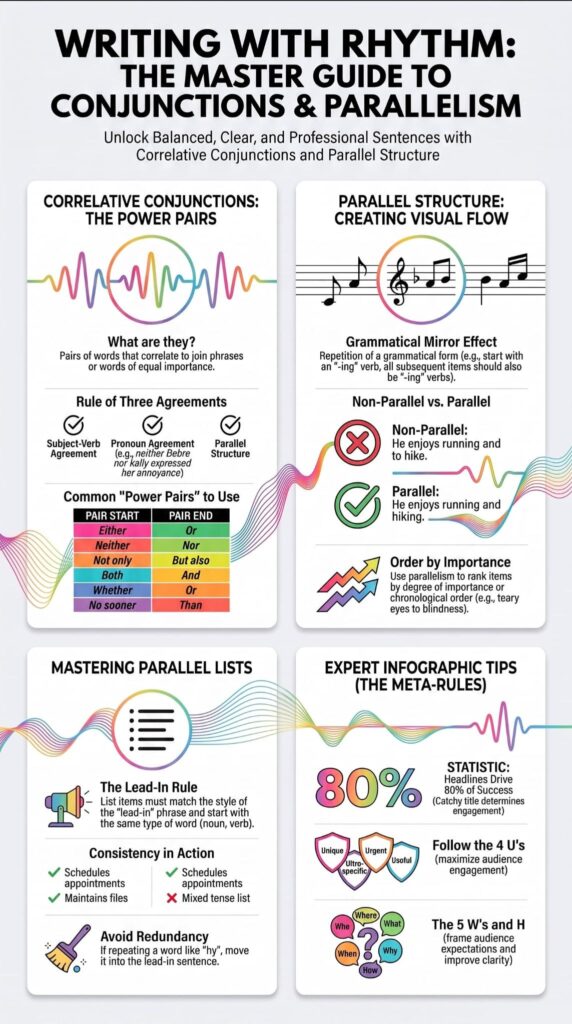
Parallel structure makes sentences easier to read because it presents related ideas in a consistent grammatical pattern. We began paying closer attention to parallelism after editing reports, essays, and business documents where the ideas were strong, but the sentences felt uneven. In many cases, the problem was not vocabulary or grammar accuracy. It was an inconsistent sentence structure that interrupted the natural flow of reading.
Small revisions often made a noticeable difference.
Incorrect:
Our goal is improving communication, to build confidence, and clearer writing.
Correct:
Our goal is improving communication, building confidence, and developing clearer writing.
The revised sentence is easier to follow because each item shares the same grammatical form. This principle is also reflected in the APA Style guidelines, which recommend consistent grammatical patterns to improve readability.
When editing, we use a simple checklist.
- Match nouns with nouns.
- Match verbs with verbs.
- Match infinitives with infinitives.
- Keep both parts of correlative conjunctions balanced.
Over time, checking for parallel structure becomes a natural habit. It helps our writing sound smoother, clearer, and more professional without making sentences longer or more complicated.
How Does Punctuation Change Meaning?
Punctuation shapes meaning as much as grammar.
Many learners think commas exist only for pauses. In reality, commas often determine whether information is essential or additional.
Consider these examples.
| Restrictive Clause | Nonrestrictive Clause |
| The students who passed received certificates. | The students, who passed, received certificates. |
The first sentence refers to only some students.
The second suggests every student passed.
The difference comes entirely from comma placement.
Independent clauses also require proper connections.
The following methods create correct sentence structure.
- Join clauses with coordinating conjunctions.
- Use semicolons before conjunctive adverbs.
- Rewrite one clause as a dependent clause.
- Avoid comma splices.
Strong punctuation improves both clarity and grammatical precision.
FAQs
How can I practice mastering complex English grammar every day?
The best way to improve mastering complex English grammar is to study a small topic every day instead of trying to learn many advanced grammar rules at once. Read authentic English, rewrite short passages, and complete advanced grammar exercises with complex grammar examples. Regular english grammar practice improves grammar accuracy, builds grammar confidence, and helps you apply english grammar nuances naturally in everyday communication.
How can I avoid common advanced grammar mistakes in writing?
Many common advanced grammar mistakes happen because learners memorize rules without understanding grammar in context. Review your writing carefully and check english syntax, advanced english syntax, english word order, and sentence relationships. Regular grammar error correction helps improve grammatical precision, strengthens advanced english writing skills, and supports grammar for clear communication in academic and professional writing.
Can advanced grammar improve both speaking and writing skills?
Yes. Advanced English grammar helps you express ideas more clearly in both speaking and writing. Learning advanced grammar patterns, advanced sentence construction, and complex sentence structures allows you to organize ideas with greater clarity. Consistent grammar for fluent English practice helps you develop english fluency through grammar, making accurate sentence patterns feel natural during real conversations and writing tasks.
Which grammar topics should C1 and C2 learners study first?
Learners studying C1 English grammar or C2 English grammar should first master dependent clauses, independent clauses, relative clauses, conditional sentences, mixed conditionals, advanced verb tenses, and perfect modals. These grammar topics appear frequently in formal communication and advanced writing. Studying them systematically builds english grammar mastery and makes mastering advanced grammar more achievable over time.
How can I use advanced grammar naturally without sounding too formal?
Using sophisticated English grammar effectively means choosing the right structure for the situation instead of selecting the most complex option. Practice professional English grammar and academic English grammar while also paying attention to discourse markers, cohesive devices, transition words, and collocations and grammar. This approach develops natural English grammar, supports precise English communication, and improves overall advanced English proficiency.
Mastering Complex English Grammar Takes Time
When I first began learning English, I thought mastering grammar meant memorizing every rule. Over time, I learned that grammar becomes meaningful when it helps us communicate clearly and confidently in real situations. That lesson has stayed with me throughout my years of learning, teaching, and continuing to improve my own language skills.
At Ivy Languages International, we approach grammar with that same mindset. We know that real progress comes from steady practice, patience, and using the language every day, not from chasing perfection or expecting native-level English proficiency overnight.
We continue learning alongside our students because language is something we keep developing throughout our lives. Wherever you are in your journey, we look forward to helping you build stronger English, one step at a time.
Related articles
- https://ivylanguagesinternational.com/advanced-english-mastery-training/
- https://ivylanguagesinternational.com/advanced-english-vocabulary-for-professionals/
- https://ivylanguagesinternational.com/achieving-native-level-english-proficiency/
References
- https://researchportal.helsinki.fi/sv/publications/the-english-mandative-alternation-a-grammatical-analysis-with-a-m/
- https://repository.londonmet.ac.uk/5721/