Education
Reading advanced English literature online is one of the best ways to build stronger English skills while exploring great books from different time periods. When I first began reading classic novels, I thought finishing the book was enough. I soon learned that real progress came from slowing down, asking questions, and understanding the world behind the story.
That approach changed the way I learned English and the way we teach at Ivy Languages International today. Reading became less about getting through pages and more about growing one step at a time. Keep reading to discover practical ways to read with more confidence and understanding.
Quick Reads: Better Ways to Read
A few simple habits can make advanced literature easier to understand and more useful for long-term English growth.
- Read beyond the words: Use historical context, literary themes, and the original text to understand what the author means.
- Study at a steady pace: Choose books that fit your level, read in shorter sessions, and return to difficult passages when needed.
- Build skills together: Combine reading with note-taking, listening, writing, and speaking to develop a stronger understanding of English.
What Does Reading Advanced English Literature Online Mean?

When I first started reading advanced English literature online, I expected the hardest part to be difficult vocabulary. I wasn’t right. The words mattered, but the bigger challenge was learning how authors shared ideas through history, culture, and writing style. That lesson stayed with me.
Reading advanced literature means working with authentic books instead of simplified readers. It also means using trusted resources that explain the background of a story. Free digital libraries have made this much easier. Today, readers can access thousands of public-domain books online without visiting a university library.
As I spent more time reading, I realized that understanding one chapter often depended on what happened before it and the world the author lived in. Looking at historical events, literary themes, and character choices helped every book make more sense.
Advanced reading also teaches us to notice things we might miss at first. We begin paying attention to symbolism, narrative structure, and how different readers may interpret the same passage. That takes patience. It also becomes easier with every book we finish.
Why is advanced reading different?
Advanced literature asks us to think beyond the plot. We are not only asking what happened. We also ask why the author wrote it that way and what ideas still matter today.
Some common features include:
- Rich vocabulary
- Longer sentences
- Historical context
- Symbolism
- Different interpretations
Every challenging book adds experience that helps with the next one.
Where Can We Read Advanced English Literature Online?
When I first searched for classic novels online, finding the books wasn’t difficult. Understanding them was another story. I quickly learned that reading the original text alongside reliable study material made a big difference.
Many trusted digital collections provide free access to classic literature. Some also include notes, introductions, or historical information that helps explain difficult passages. Reading both the book and the background gives us a fuller picture.
I also found it helpful to use educational resources instead of depending on short summaries. Summaries can explain the plot, but they cannot replace the author’s own words. Reading the original work helps us notice writing style, character growth, and themes that often disappear in condensed versions.
Over time, I spent less time searching online and more time reading because I knew which resources I could trust. That saved time and made studying more enjoyable.
| Resource | How It Helps |
| Public-domain libraries | Read classic books for free |
| University study guides | Explain historical background |
| Annotated editions | Clarify difficult passages |
| Academic articles | Offer deeper interpretation |
These resources support learning without replacing the reading itself.
Why does background matter?
Many authors wrote for readers who already understood the customs and events of their time. Learning that history often makes confusing chapters much easier to understand.
How Do We Choose Books That Match Our English Level?
I made a common mistake when I began reading classics. I picked books that were far beyond my reading level because I thought harder books would help me learn faster. Instead, I spent more time checking the dictionary than reading the story.
Things changed after I chose books that challenged me without stopping my progress. I could follow the main ideas, learn new vocabulary from context, and enjoy reading again.
A helpful guideline is to accept that not every word needs to be familiar. If we understand most of the page, we can often figure out new vocabulary by reading the sentences around it. That keeps the story moving.
I also found that building difficulty step by step gave me more confidence. One finished book prepared me for the next.
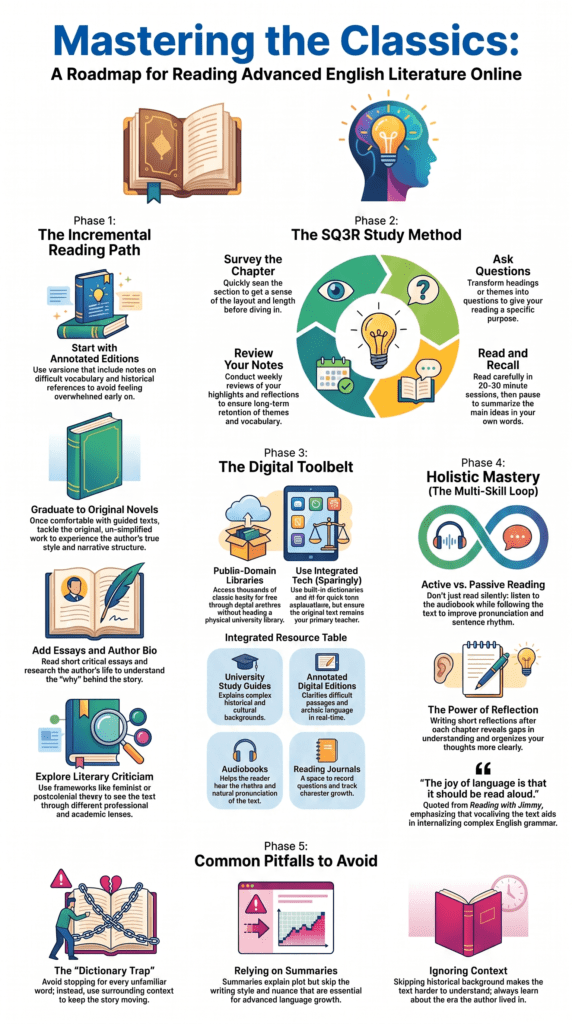
A simple reading path looks like this:
- Begin with annotated editions.
- Read original novels.
- Add short critical essays.
- Learn about the author.
- Explore literary criticism later.
There is no prize for choosing the hardest book first. Slow progress often lasts longer than rushing through difficult material.
Should we start with classics?
Yes, but choose editions with notes and explanations. Good guidance makes classic literature much less overwhelming, especially during the first few books.
Why Do Many Readers Find Classic Literature Difficult?
Credits: Dr Alok Mishra (Literature)
Before I understood classic literature, I thought I needed a larger vocabulary. Later, I realized vocabulary was only one part of the challenge. Older writing styles, historical references, and different ways of telling a story often slowed me down much more.
Some novels begin with long descriptions instead of action. Others expect readers to understand customs that no longer exist. That can make the first chapters feel slow. I remember putting one novel aside more than once before returning with more patience. I’m glad I did.
Many readers experience the same obstacles.
- Older language
- Long introductions
- Historical references
- Symbolism
- Changing viewpoints
Those challenges don’t mean we are poor readers. They are part of learning to read literature written in another time.
I also learned that stopping for every unfamiliar word made reading harder, not easier. Reading a full page first often gave enough clues to understand the meaning naturally. That surprised me.
Why doesn’t a dictionary solve everything?
Many passages use figurative language instead of literal meaning. Reading the surrounding paragraphs often explains more than a dictionary definition ever could.
In the next part, I’ll continue with the remaining sections, including online tools, study methods, combining reading with listening and writing, common mistakes, and a natural founder-style conclusion.
Which Online Tools Help Us Understand Literature Better?
When I first started reading novels online, I depended too much on quick searches whenever I found a difficult paragraph. That habit broke my concentration. I spent more time reading explanations than reading the book itself.
Later, I kept my study tools simple. I used a built-in dictionary for unfamiliar words, highlighted important passages, and wrote short notes in the margins. Those small changes helped me stay focused on the story while still learning something new.
For readers who also need stronger workplace language, studying advanced English vocabulary for professionals can help build a wider working vocabulary without taking attention away from the literary text.
The goal is not to let technology do the reading for us. It should help us think more carefully about what we are already reading.
Some tools I still find useful include:
| Tool | Purpose |
| Built-in dictionary | Check unfamiliar words |
| Audiobooks | Hear natural pronunciation |
| Notes or highlights | Save important ideas |
| Reading journal | Record questions and thoughts |
I also use AI from time to time. It can explain literary terms or compare different interpretations. Still, I always return to the original text before accepting any explanation. The book should remain our main teacher.
How Can We Read More Deeply Without Feeling Overwhelmed?
I used to believe that studying longer meant learning more. It didn’t. After an hour or two, I often forgot what I had read. Shorter sessions helped me remember much more.
Now I try to read for about twenty to thirty minutes at a time. That gives me enough time to stay focused without becoming tired. If I reach a confusing chapter, I finish the section before stopping. Many questions become clearer after reading a little farther.
A steady routine has helped me more than any shortcut. For readers who want a broader structure for improving their English, advanced English mastery training can also support steady practice across different language skills.
- Read every day.
- Finish one chapter.
- Write a few notes.
- Review them each week.
- Return to difficult passages later.
Reading this way feels slower at first, but the understanding lasts much longer. Looking back, I learned more from months of steady reading than from a few long weekends with a stack of books.
Good habits matter. They also become easier with time.
Why do shorter sessions help?
Classic literature asks us to pay attention to details. Reading in smaller blocks keeps our minds fresh and makes it easier to notice themes, character growth, and important ideas.
Which Study Methods Make Literary Analysis Easier?
Early on, I highlighted almost every page because everything seemed important. That didn’t help much. I had plenty of notes but very little understanding.
Things improved after I followed a simple reading process. One method that many teachers recommend is SQ3R. It breaks reading into smaller steps that are easier to manage.
The steps are straightforward.
- Survey the chapter.
- Ask questions.
- Read carefully.
- Recall the main ideas.
- Review your notes.
I also like asking a few simple questions after each chapter. What changed? Why did it matter? What surprised me? Those questions help me think instead of rushing to the next page.
Over time, I noticed patterns that I had missed before. Characters repeated certain behaviors. Symbols appeared again and again. Historical events shaped important decisions. Those details became easier to see because I slowed down instead of trying to find quick answers.
Reading carefully isn’t fast. But it has been worth the effort.
How Can Reading, Listening, Speaking, and Writing Work Together?
For a long time, I only read silently. I thought that was enough. Then I started writing short reflections after finishing each chapter. I quickly realized there were parts of the story I had misunderstood.
Later, I added audiobooks while following the printed text. Hearing the rhythm of the language helped me understand longer sentences and improved my pronunciation at the same time.
I also became more aware of how grammar works inside complex literary sentences. Working on mastering complex English grammar nuances helped me pay closer attention to sentence structure and meaning.
A simple routine has served me well.
- Read the chapter.
- Highlight key ideas.
- Listen to the same section.
- Review your notes.
- Write a short reflection.
Each activity supports the others. Reading builds understanding. Writing helps organize ideas. Speaking about a book with someone else often reveals details I missed the first time.
As highlighted by Reading with Jimmy
“The joy of language is that it should be read aloud.” – Reading with Jimmy
Progress didn’t happen overnight. It came from repeating the same habits over many months. Looking back, consistency taught me far more than trying a different method every week.
How Does Ivy Languages International Support Advanced Readers?
The reason I care about guided learning comes from my own experience. Learning English took patience, steady effort, and many mistakes along the way. Reading alone helped, but discussing books with others helped even more.
That experience continues to shape our work at Ivy Languages International. We want students to build confidence one step at a time instead of feeling pressured to know everything immediately.
Our learning approach includes:
- Guided discussions
- Reading support
- Writing feedback
- Speaking practice
- Personal encouragement
Each part supports the others. Reading improves vocabulary. Discussion builds confidence. Writing helps organize ideas more clearly.
Research from TESOL Journal shows
“In my view, however, integrative extended reading (IER), where reading is presented through at least two language skills, is an appropriate and effective approach because it connects both in-class and outside-class reading with speaking and/or writing assignments in a scaffolded manner.” – TESOL Journal
I have learned that lasting progress rarely comes from rushing. It comes from showing up, reading another chapter, asking another question, and staying curious. Those small steps add up over time.
That is the kind of learning environment we hope every student experiences.
What Mistakes Can Slow Our Progress?
When I first started reading advanced literature, I thought working harder meant looking up every word and finishing each chapter as quickly as possible. I soon learned that these habits often made reading more tiring. I spent too much time with the dictionary, rushed through difficult pages, and sometimes leaned on summaries instead of sitting with the original text.
Now, I try to avoid a few common mistakes:
- Checking every unfamiliar word
- Skipping the historical context
- Ignoring notes and questions
- Reading difficult sections too quickly
- Relying too much on summaries
I still use reference materials when I need them, but I do not stop for every unfamiliar word. I also give myself time to return to passages that felt unclear. After finishing a chapter, I compare other views instead of letting them shape my first reading.
I did not understand every book on the first try. That is normal. With patience and practice, difficult texts become less intimidating. Each book teaches me how to approach the next one with a little more confidence.
FAQ
What is the difference between close reading and textual analysis?
Close reading examines specific details in a passage, including word choice, tone, sentence patterns, and imagery. Textual analysis connects those details to larger ideas in the work.
When reading advanced literature online, both approaches can help you explain how a passage creates meaning. They also encourage you to support your interpretation with details from the original text.
How can literary criticism help me understand difficult books?
Literary criticism gives you different ways to examine a book. One critic may focus on character development, while another may study symbolism or historical context. You do not need to accept every interpretation.
Comparing several critical perspectives can help you notice ideas you missed during your first reading and develop a clearer interpretation based on the text.
What is an annotated text, and why should I use one?
An annotated text contains notes that explain difficult words, historical references, cultural details, or unusual passages. These notes are useful when a book uses older language or assumes knowledge of its time.
They give you helpful context without replacing the original work. Annotated texts can also make difficult books easier to read when you are studying independently.
How does narrative structure affect my understanding of a novel?
Narrative structure controls how a story presents events, information, and different viewpoints. A novel may move between time periods, change narrators, or reveal important facts slowly.
Paying attention to these choices can help you understand character development and dramatic irony. It can also explain why certain parts of a story seem confusing before becoming clearer later.
When should I use literary theory while reading?
Literary theory is most useful after you have formed your own response to a text. Start by reading the work and noting what interests or confuses you. Then use an interpretive framework to explore those questions.
Approaches such as feminist criticism, postcolonial theory, and reader-response theory can provide useful perspectives without replacing your own understanding of the book.
Keep Growing Through Advanced English Literature
Reading advanced English literature takes patience, but we don’t need to understand every word to make progress. Each chapter gives us a chance to build stronger reading skills while becoming more comfortable with complex ideas. The key is to keep reading, even when the process feels slow.
We grow through consistent practice, not pressure. If you’re ready to take the next step, Ivy Languages International can help you build confidence through meaningful English learning. Start reading, keep learning, and grow with us.
References
- https://readingwithjimmy.com/?t=c
- https://eric.ed.gov/?id=EJ1489608
Related Articles
- https://ivylanguagesinternational.com/advanced-english-vocabulary-for-professionals/
- https://ivylanguagesinternational.com/advanced-english-vocabulary-for-professionals/
- https://ivylanguagesinternational.com/mastering-complex-english-grammar-nuances/

Comment(01)