
How to think in English naturally became important to me when I noticed how often I paused to translate simple thoughts before speaking. At first, even ordinary moments, like ordering food or planning my day, took extra effort. I started practicing by naming things around me, describing what I was doing, and using short English phrases throughout the day.
Progress was slow, but repetition gradually made those connections easier. At Ivy Languages International, we recognize that steady practice matters more than rushing through lessons. Thinking directly in English takes time, patience, and regular use. Keep reading to explore practical habits that can make English feel more natural.
Quick Reads: Think in English With Less Translation
Thinking in English gets easier when small, consistent habits replace the need to translate every thought.
- Use simple ideas first: Connect English directly to objects, actions, and situations instead of translating from your first language.
- Practice for 5 to 10 minutes: Short daily sessions can build stronger habits than occasional long study periods.
- Learn useful phrases: Familiar phrases and everyday routines make it easier to respond without building every sentence from scratch.
Why Is It So Hard to Think in English Naturally?

When I first started using English more often, I noticed that every thought paused in my first language before it reached English. It happened without me realizing it. If someone asked me a simple question, I understood the idea, translated it, and only then answered. That extra step made conversations feel slower than they needed to be.
This is a normal part of learning. Our brains rely on what already feels familiar. As we gain more exposure to English, those connections begin to change. Instead of linking an idea to our native language first, we gradually connect the idea directly to English.
Stephen Krashen explains that language grows through understandable input rather than memorizing grammar rules. Over time, repeated exposure helps English become more automatic.
Translation is not a mistake. It is often a bridge that helps us move from what we already know to what we are still learning. With enough practice, that bridge becomes less necessary because English begins to come to mind on its own.
Can You Force Yourself to Think in English?
I used to believe I had to think in English all day to improve. It sounded like good advice, but it quickly became tiring. Every thought felt like another exercise, and I spent more time worrying about mistakes than using the language naturally.
Thinking in English is not something we can force. It develops through regular use over time. Many experienced learners say their first English thoughts appeared during everyday moments, like walking to work, shopping, or making dinner. They did not plan for it to happen. It came after months of listening, reading, speaking, and using simple English every day.
Instead of trying to replace every thought at once, build a few English moments into your routine. Describe what you are doing. Think about your plans for the afternoon. Repeat useful phrases while you are walking.
For learners who want a more structured routine, how to master English fluency online can also provide a useful framework for building regular practice.
Small habits feel easier to keep, and they place far less pressure on you. That steady practice gives your brain repeated chances to build stronger English connections.
How Can You Stop Translating in Your Head?
One change made a real difference for me. Instead of matching English words with words from my first language, I started connecting them with pictures, places, and everyday experiences. It felt slow at first, but after a while I noticed that recalling words became easier.
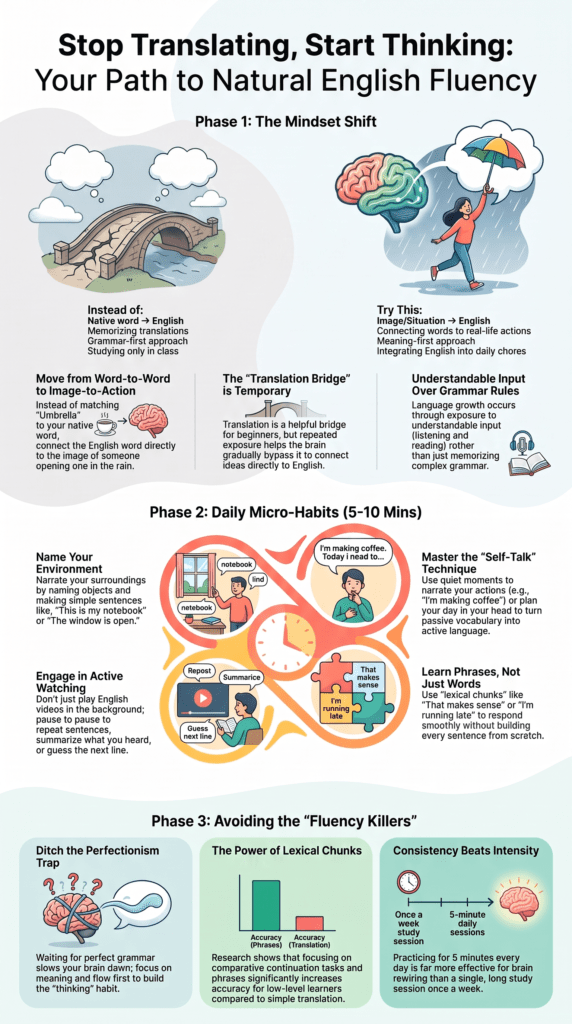
For example, when learning the word umbrella, picture someone opening it in the rain instead of thinking about its translation. The image becomes the meaning. Each time you repeat that connection, your brain strengthens it.
The same idea works with actions. Imagine making coffee while saying the English words in your mind. Picture opening a door, washing dishes, or riding a bus. Those real situations help English feel more natural because the language connects directly with daily life.
| Instead of | Try This |
| Native word → English | Image → English |
| Memorizing translations | Connect words to real situations |
| Grammar first | Focus on meaning first |
This approach takes patience, but many learners find it helps reduce mental translation over time.
Which Daily Habits Help You Think in English?
The habits that helped me most were also the simplest. They did not require long study sessions or complicated exercises. I practiced for a few minutes whenever I had the chance, and that consistency mattered more than the amount of time.
One easy habit is naming objects around you in English. Look at your desk, your kitchen, or your bedroom. Say what you see, then make short sentences. “This is my notebook.” “The window is open.” “My phone is on the table.” These simple descriptions train your brain to connect English with real objects.
Another helpful habit is talking through everyday actions. While making breakfast or cleaning your room, quietly describe what you are doing. You can also plan your day in English before leaving home or review what happened before going to bed.
Try habits like these:
- Name nearby objects.
- Describe simple actions.
- Plan your day in English.
- Review your day before bed.
- Practice for 5 to 10 minutes.
Small routines become easier to repeat, and repeated practice is what helps English feel more natural.
Why Does Self-Talk Make English Feel More Natural?
Credits: Slow English Podcast
One habit I kept coming back to was self-talk. It did not feel impressive, and no one else could hear it. Still, it became one of the most useful parts of my daily practice. I did not need a class or a conversation partner. I only needed a few quiet moments during the day.
Self-talk gives us a safe place to practice. We can test new words, repeat familiar phrases, and speak without worrying about making mistakes. That removes much of the pressure that often comes with real conversations.
Self-talk can also support achieving native level English proficiency because it gives us regular opportunities to turn passive vocabulary into active language.
Keep the language simple. Talk about what you are doing, what you need next, or how your day is going. A short practice might sound like this: “I need to answer this email.” “I’ll cook dinner after work.” “I forgot my water bottle.”
Even 30 seconds is enough. Those short moments add up over time. As the same phrases come back again and again, our brains begin to retrieve them with less effort. That gradual change is often how thinking in English starts to feel more natural.
Why Should You Learn Phrases Instead of Single Words?
For a long time, I focused on learning individual vocabulary words. I could recognize many of them, but speaking still felt slow because I had to build each sentence piece by piece.
People rarely speak one word at a time. They use familiar groups of words that naturally fit together. Learning these chunks helps us respond more smoothly because we are remembering complete ideas instead of creating every sentence from the beginning.
As highlighted by Asian-Pacific Journal of Second and Foreign Language Education
“Compared with English-Chinese translation, cloze tests, and recitation, comparative continuation tasks significantly increased the accuracy rate of lexical chunks. This effectively balanced the asymmetry of ‘high comprehension but low production’ among low-level English learners.” – Asian-Pacific Journal of Second and Foreign Language Education
Start with phrases you can use every day. For example:
- I’m running late.
- That makes sense.
- Let me check.
- I’ll think about it.
- Can you repeat that?
Repeat these phrases while reading, listening, or speaking. Then use them whenever the opportunity comes up. After enough repetition, they begin to feel familiar. Instead of stopping to choose every word, you recognize the whole phrase. That saves mental effort and helps conversations flow more naturally.
Does Watching English Content Really Help?
Watching or listening to English can help, but only if we stay involved with what we hear. I noticed that simply playing videos in the background did very little for my speaking. My understanding improved, but my own English changed much more slowly.
The difference came when I started interacting with the content. I paused to repeat short sentences. I summarized what I had just heard. Sometimes I guessed what the speaker would say next before pressing play again. Those small actions kept my mind active instead of passive.
Choose content that is easy enough to understand. It could be a podcast, a short lesson, an interview, or a news story about a topic you already enjoy. When the material feels interesting and understandable, it becomes easier to keep practicing.
For learners working toward more advanced control of English, advanced English mastery training can fit naturally alongside active listening and speaking practice.
The goal is not to watch for hours. A short session where you actively listen, repeat, and reflect usually teaches far more than spending a long time watching without speaking.
What Mistakes Keep Learners Translating?

One mistake I made was believing I needed perfect English before speaking. That expectation slowed everything down. I spent too much time searching for the “right” sentence instead of using the English I already knew.
Another common mistake is limiting practice to study time. If English only appears during lessons, our brains continue to treat it like a school subject instead of part of everyday life. Small moments outside formal study often matter more than we expect.
Research from Repositorio Institucional BUAP
“The earlier findings manifest that ‘Think in English’ is related to translating and interpreting by interference from mother tongue (L1) to target language(L2). When a Foreign language learner cannot trigger the language outputs spontaneously in speaking performance/situations committing accuracy and fluency errors.” – Repositorio Institucional BUAP
Watch for these habits:
- Waiting for perfect grammar.
- Studying without speaking.
- Giving up too quickly.
- Practicing only once a week.
- Comparing your progress with others.
Thinking in English grows through regular use, not perfect performance. Some days will feel easier than others, and that is normal. The important part is continuing to use English in ordinary situations. Over time, those repeated experiences help reduce translation and make English feel more familiar.
FAQ
How long does it take to develop automatic English responses?
There is no fixed timeline because English fluency depends on your level, exposure, and practice. Regular daily English practice can make your responses faster over time.
At first, you may still rely on mental translation. With steady listening, speaking, and repetition, your brain can begin producing automatic English responses with less effort and fewer pauses during everyday conversations.
Can English self-talk improve fluent English speaking?
Yes. English self-talk gives you private speaking practice without the pressure of a real conversation. You can use it to rehearse answers, describe plans, or practice natural English expressions.
This can build English confidence and make spontaneous speech easier. With regular practice, English self-talk can also strengthen your thought patterns and help you express ideas more naturally.
How can I use an English-only dictionary without translating?
An English-only dictionary can help you connect new words directly with their meanings. Instead of translating each definition, read the explanation and study the example sentences.
Then create your own sentence using the word. This approach supports English vocabulary building and reduces language switching. Over time, it can help you understand unfamiliar words through English context.
What should I do when mental translation interrupts my speech?
Do not stop speaking every time mental translation appears. Use simpler words and continue expressing the main idea. You can also practice English mental rehearsal before common situations, such as ordering food or answering questions.
Repeating these situations helps your brain process English more quickly. Over time, this practice can reduce pauses caused by deliberate translation.
Can journaling help create an internal monologue in English?
Yes. English journaling gives you time to organize your thoughts without the pressure of speaking quickly. Write about ordinary events, decisions, feelings, or plans using familiar language.
As journaling becomes a daily routine, you may begin forming an internal monologue in English more often. It can also strengthen thought fluency and make spontaneous thinking easier.
Make English Your Default Inner Voice
Thinking in English doesn’t happen overnight. We build it through small, repeated habits that gradually make English feel more natural. A few minutes of naming things around us, planning our day, or speaking to ourselves in English can create stronger connections over time. Consistency matters more than perfection.
We don’t need to rush the process. With regular practice, we can build confidence and make English a more natural part of everyday life. Start your next step with Ivy Languages International and keep building your English confidence.
References
- https://link.springer.com/article/10.1186/s40862-025-00384-3
- https://repositorioinstitucional.buap.mx/items/aa325b77-5572-4d83-8bc7-0bc4c862e5d3/full
Related Articles
- https://ivylanguagesinternational.com/how-to-master-english-fluency-online/
- https://ivylanguagesinternational.com/achieving-native-level-english-proficiency/
- https://ivylanguagesinternational.com/advanced-english-mastery-training/


Comment(01)