
Tips
Speaking English with native confidence comes from practice, not perfect grammar or a perfect accent. I learned this when I could understand English well but still hesitated during real conversations. Speaking clearly was harder when I had to answer quickly or explain an idea without planning it first. Progress takes time, but each conversation gives me something to work on.
Over time, I worked on short conversations, pronunciation, useful phrases, and staying calm after mistakes. At Ivy Languages International, we take the same practical approach by connecting English practice with real situations learners may face. Keep reading to build a routine you can actually maintain.
Quick Reads: Confidence Speaking Wins
Speaking with confidence grows through regular use, practical practice, and patience rather than perfect English.
- Speak before you feel ready. Confidence grows when we keep speaking through pauses, mistakes, and unexpected questions instead of waiting for perfect English.
- Practice the language you actually use. Useful phrases, pronunciation practice, listening, and real conversations help us build English that fits everyday situations.
- Use mistakes to guide your practice. Each difficult moment can show us what to work on next, whether it is pronunciation, vocabulary, speaking speed, or responding naturally.
What Does “Native Confidence” Really Mean?

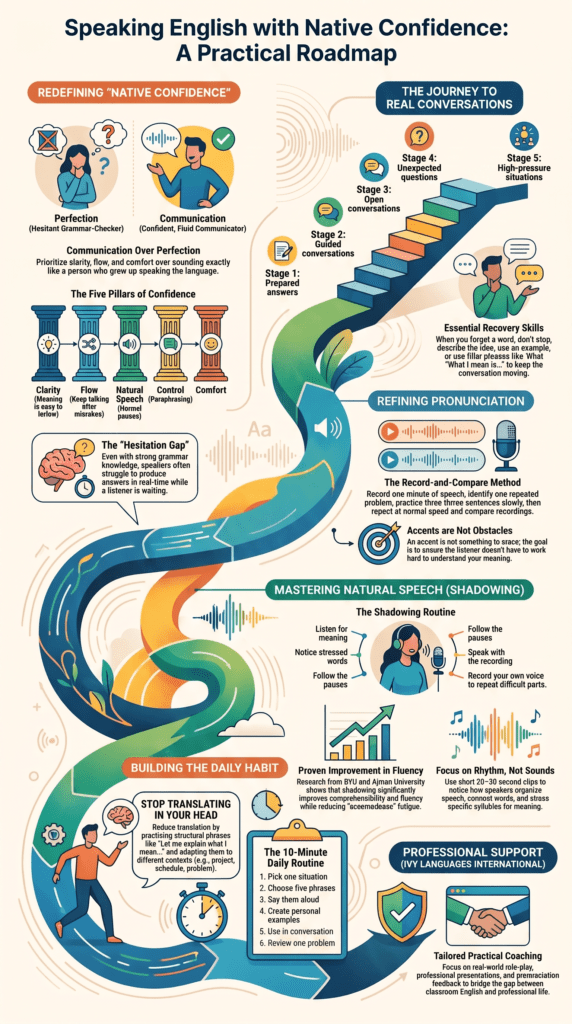
For me, native confidence means being able to speak English without checking every sentence in my head first. I don’t need to sound exactly like someone who grew up speaking English. I need to communicate clearly and stay comfortable when a conversation takes an unexpected turn.
That can be harder than it sounds. I may understand a grammar rule but still hesitate when I need to use it quickly. Those moments are part of speaking.
So I look at confidence through practical signs:
- Clarity: My meaning is easy to follow.
- Flow: I can keep talking after a mistake.
- Natural speech: I use familiar phrases and normal pauses.
- Control: I can explain something another way.
- Comfort: I don’t avoid speaking because I fear mistakes.
English is spoken by people from many language backgrounds. Their accents can sound different, yet communication can still be clear. That matters because the goal isn’t to copy one person’s voice.
For me, achieving native-level English proficiency is more about comfortable communication than copying a particular accent.
Instead, I want English that lets me handle real situations. I want to answer questions, explain ideas, ask for clarification, and take part in conversations without freezing.
Why Does Confidence Matter More Than Perfect Grammar?
I can know a lot of grammar and still struggle to speak. I’ve experienced that gap myself. Understanding English on a page is different from producing an answer while another person is waiting.
When I focus too much on avoiding mistakes, I have to think about grammar, vocabulary, pronunciation, and the other person’s words at the same time. That’s a lot to manage during one short conversation.
So I prefer to measure speaking progress by what I can actually do.
- Speak for longer without stopping
- Answer questions more quickly
- Recall useful phrases
- Recover after mistakes
- Handle more real situations
Mistakes still matter. But they can give us information about what to practice next. If I keep making the same pronunciation mistake, I can work on that sound. If I often pause because I can’t find a phrase, I can practice that phrase until it becomes easier to recall.
I also find it more useful to compare my current speaking with my earlier speaking. Comparing myself with someone who has spoken English every day for years doesn’t tell me much about my own progress.
Confidence grows through use. We speak, notice a problem, practice it, and speak again.
How Can We Stop Translating Before Speaking?
I can reduce translation by practicing English around situations I already understand. Instead of memorizing long word lists, I practice phrases that I expect to use.
I also found that thinking in English naturally can make speaking feel less forced. For example, I might practice:
- “Let me explain what I mean.”
- “The main issue is…”
- “Could you clarify that?”
- “We’re still working on…”
- “I see your point, but…”
Then I create different examples with the same structure.
“Let me explain what I mean about the project.”
“Let me explain what I mean about the schedule.”
“Let me explain what I mean about the problem.”
The words change, but the structure stays familiar. That makes it easier to speak without building every sentence from zero.
A short daily practice can help.
- Pick one familiar situation.
- Choose five useful phrases.
- Say each phrase aloud.
- Create three personal examples.
- Use them in conversation.
- Review one problem afterward.
Ten focused minutes can give us useful speaking practice. I also try to practice language that belongs to my real life. If I need English for meetings, I practice meeting phrases. If I need English for travel, I practice questions and responses I may actually use.
Does Shadowing Help Us Sound More Natural?
Credits: Speak English With Class
Shadowing can help us notice pronunciation, rhythm, pauses, and connected speech. I find it most useful when I keep the recording short.
A long speech can become tiring. So I prefer a clip of about 20 to 30 seconds. I listen several times and focus on one feature instead of trying to copy everything.
First, I listen for the meaning. Then I listen for stress and pauses. After that, I speak along with the recording.
The basic routine is:
- Listen for meaning
- Notice stressed words
- Follow the pauses
- Speak with the recording
- Record my own voice
- Repeat difficult parts
Research from Brigham Young University shows
“The data showed that all participants improved significantly from the pre-test to post-test in fluency and comprehensibility, while reducing their accentedness.” – Mishelle Kehoe, Brigham Young University
I don’t need to copy the speaker’s accent. I want to notice how the speaker organizes speech.
For example, some words receive more stress because they carry the main meaning. Words can also connect when people speak at a normal speed.
I recommend using the same short recording several times before changing it. Repetition gives me a chance to notice things I missed during the first listen.
But I also avoid turning shadowing into a test. If I can’t match every sound, that’s fine. The point is to make spoken English easier to produce and easier for other people to follow.
How Can Ivy Languages International Support Speaking Goals?
I’ve learned that speaking practice works better when it has a clear reason behind it. If I know why I need English, it becomes easier to choose what to practice.
At Ivy Languages International, we can connect speaking lessons to situations that learners may face in daily life or at work. The first step is identifying the situation that causes the most difficulty.
Maybe I can write professional emails but freeze during a phone call. So we can build lessons around the language that fits the situation.
- Live speaking practice
- Professional conversation
- Presentation practice
- Customized learning goals
- Pronunciation feedback
- Real-world role-play
We also offer different learning formats, including private one-on-one coaching. This can give learners room to work on specific problems without trying to fix everything at once.
For learners who want a more structured path, advanced English mastery training can support continued work on higher-level speaking and communication skills.
But lessons are only one part of the process. I need to use the phrases, speak through mistakes, and notice where I struggle.
The point isn’t to promise a quick change. It is to build a clear routine and keep working on it.
When practice has a purpose, progress becomes easier to see. We know what we are working toward, and we can adjust when our needs change.
How Can We Make Pronunciation Practice Easier to Keep Doing?
Pronunciation practice can become tiring when we try to change too much at once. I’ve found that shorter sessions are easier to repeat.
A short recording can give us enough material. We might choose two or three sentences and work with them for several days.
On the first day, we can listen for word stress. On another day, we can focus on pauses. Later, we can listen for how words connect during normal speech.
We can also record ourselves before and after practice. Even a one-minute recording can show things that are difficult to notice while we are speaking.
A basic routine could look like this:
- Record one minute
- Find one repeated problem
- Choose three practice sentences
- Speak slowly
- Repeat at normal speed
- Record again
- Compare both recordings
As noted by research from Ajman University
“Based on the study’s results, there was a significant improvement in three speaking measures, namely, the ability of learners to imitate a speech model, comprehensibility, and fluency. Results indicated that the participants improved significantly on all speaking measures apart from accentedness.” – Zakarneh et al., World Journal of English Language
If my final sounds are unclear, I practice word endings. If I put stress on the wrong syllable, I practice that pattern. If my speech sounds too slow and separated, I work on connected speech.
I also remind myself that an accent isn’t something I need to erase. People speak English with many different accents. If someone can understand what I mean without having to work hard.
What Role Does Listening Play in Speaking With Confidence?
When I started working on my spoken English, I noticed that knowing the words was not always enough. I could understand a sentence, but I still struggled to respond naturally. Listening helped me see what was missing.
I began paying attention to how people actually speak. I listened for useful phrases, pauses, stress, and the way speakers respond.
For example, I often heard phrases like:
- “Well, I think…”
- “Let me explain.”
- “The way I see it…”
- “What I mean is…”
- “That makes sense, but…”
I started using these phrases in my own conversations. I also noticed that fluent speakers connect sounds and change their rhythm. At first, familiar words sounded strange.
Instead of trying to catch every word, I listened to short sections several times. First, I focused on the meaning. Then I listened for phrases and repeated them aloud.
If I found a useful phrase, I used it in a sentence about my own life. This made listening feel less passive.
Over time, those patterns became more familiar. Speaking started to feel less forced, and I became more comfortable joining conversations.
How Can Real Conversations Build Confidence?

When I first started speaking English with other people, I noticed something practice exercises could not prepare me for. I never knew exactly what the other person would say next. That uncertainty made me nervous.
Someone might change the topic, ask a follow-up question, or use a phrase I had never heard before. I had to learn how to keep going, even when my answer was not perfect.
I found it easier to build up slowly:
- Stage 1: Prepared answers
- Stage 2: Guided conversations
- Stage 3: Open conversations
- Stage 4: Unexpected questions
- Stage 5: Higher-pressure situations
I might start by introducing myself. Then I practice answering simple follow-up questions. Later, I explain an opinion without planning every sentence.
Feedback also became more useful when I asked specific questions. Instead of asking if my English was good, I asked whether my answer was clear or if I spoke too quickly.
I focused on one correction at a time. Then I practiced it again.
Over time, real conversations gave me proof that I was improving. I made mistakes, learned from them, and kept going. That experience helped my confidence feel more real.
FAQ
How long does it take to build confidence in spoken English?
There is no fixed timeline because speaking confidence depends on your current level, practice habits, and how often you use English. Someone who speaks every day may improve faster than someone who studies once a week.
Regular practice matters most. Track small changes in fluency, response time, pronunciation, and comfort instead of expecting sudden progress.
What should I practice if I understand English but struggle to respond?
Start with situations where you often get stuck. Practice short answers, follow-up questions, explanations, and common responses from those situations. Record yourself and notice where you hesitate.
Then build a small set of useful phrases around those moments. This approach connects speaking practice with your actual needs instead of relying on random vocabulary lists.
Can I improve my speaking confidence without practicing with native speakers?
Yes. You can build strong speaking habits with classmates, tutors, language partners, or other English learners. What matters is having regular chances to respond, explain ideas, and handle unexpected questions.
Different speakers can also expose you to different accents and communication styles. This wider experience can make real conversations easier to manage when situations change.
How can I sound more natural without changing my accent?
Focus on features that make your speech easier to follow rather than trying to remove your accent. Work on word stress, sentence rhythm, clear word endings, pauses, and connected speech.
Listen to short examples and compare them with your recordings. Natural speech is not about copying one person’s voice. It is about making your meaning clear and easy to understand.
What should I do when I forget an English word?
Do not stop the conversation just because you forget one word. Describe the idea in another way, give an example, or use a simpler word. Phrases such as “What I mean is…” can help you continue while you think. These recovery skills are important because real conversations rarely go exactly as planned, and confident speakers know how to keep communicating.
Build Confidence Through Consistent Speaking Practice
Speaking English with more confidence doesn’t require perfection. We build it by speaking regularly, practicing useful phrases, and learning from mistakes as they happen. Each conversation gives us another chance to become more comfortable expressing ourselves.
The goal is simple, communicate clearly and keep improving. When you’re ready to take the next step, Ivy Languages International can support your progress with practical English learning. Speak more. Practice consistently. Grow with us.
References
- https://scholarsarchive.byu.edu/etd/10069/
- https://research.ajman.ac.ae/en/publications/mobile-assisted-shadowing-transforming-pronunciation-for-arab-eng/
Related Articles
- https://ivylanguagesinternational.com/achieving-native-level-english-proficiency/
- https://ivylanguagesinternational.com/how-to-think-in-english-naturally/
- https://ivylanguagesinternational.com/advanced-english-mastery-training/