
Tips
English for beginners (starter strategies) starts with something simple: small steps done daily. I learned this the hard way. When I first began learning English, I tried to force progress by memorizing long word lists without a plan. It felt heavy and slow.
In many cases, steady progress comes from structured support, which is why some learners eventually explore English tutoring online as part of their journey. Confidence grows quietly, not all at once. This guide comes from that lived path, shaped by time and patience. If you’re starting now, keep reading and let’s take these steps together.
English for Beginners Starter Strategies at a Glance
If you remember nothing else, these simple points reflect the core ideas behind starting English with clarity and confidence.
- Consistent daily habits matter more than long study sessions once a week.
- Confidence grows when we practice speaking out loud every day.
- Clear grammar and essential vocabulary form the base for long term success.
How To Start Learning English Online
When I help someone start learning English online, I usually begin with what has worked over time, the kind of rhythm you see in people who truly understand how to start learning English online. The first step is much simpler. You pick one structured beginner lesson and show up for it at the same time each day. Twenty or thirty minutes is enough.
I’ve seen students here try to study for hours on a Saturday, then forget everything by Monday. Their progress stalled. The ones who succeeded treated their online study like a morning coffee or an evening walk, a non-negotiable part of their day.
I recommend starting with the absolute basics: greetings, numbers, and verbs like ‘to be,’ ‘to have,’ and ‘to go.’ These words are your tools. Don’t worry about advanced grammar yet. Just focus on building a habit. Before you choose any material, ask yourself: can I commit to this time every day? If the answer is yes, you’re already halfway there.
Here’s a short checklist that has worked for my students:
- Choose one structured beginner course
- Study at the same time each day
- Practice speaking from lesson one
- Review vocabulary every week
Best Tips For English Beginners
Credits: English with Emma · engVid
My best tips for beginners is to stop trying to learn everything at once. Focus on the words you will actually use. In my first year teaching, I saw a student struggle. He knew complex terms but couldn’t order a coffee.
We shifted his focus to the top 100 most common words, words like time, day, go, make, and know. His confidence changed in weeks. These words appear constantly, and mastering them gives you a foundation for everything else.
Another tip is to speak from day one, even if it’s just to yourself. I remember practicing by describing what I was doing: “I am making tea. I am opening the door.” It felt silly, but it built a natural rhythm.
Repetition is key. Saying a word ten times helps you remember it better than reading it a hundred times. Don’t be afraid of mistakes. They’re not failures; they’re just feedback.
To stay on track, try this simple approach:
- Use flashcards for five minutes daily
- Read short sentences out loud
- Practice a simple dialogue each week
- Look at your mistakes every weekend to learn from them
Overcoming Fear Of Speaking English

The fear of speaking is real, and much of the progress I’ve seen comes from small repeated steps that slowly build comfort. Especially when learners focus on getting past the fear of speaking.
My voice would get quiet, and my hands would feel shaky. The research shows most people feel this anxiety. The way past it isn’t a magical trick; it’s steady, low-pressure practice. We start by having students narrate their own actions in English alone at home. “I am reading a book. The book is blue.” There’s no one to judge you.
This repeated exposure, psychologists say, slowly teaches your brain that there’s no real danger. The fear decreases. We then move to recording a short voice memo once a week.
Hearing your own voice is powerful, you can hear your progress. Finally, joining a small, supportive practice group makes a huge difference. Everyone is learning, so the pressure is off.
Here are the exercises that help build speaking courage:
- Practice speaking to a mirror for two minutes daily
- Record and listen to one short sentence each week
- Use a technique called shadowing, repeat after a slow audio clip
- Find a small, friendly conversation group for practice
Establishing A Daily English Study Routine
Building a daily study routine is about creating a habit, not about willpower. Years ago, I decided to study every evening at 8 PM at my kitchen table. The place and time became a signal to my brain. Research from Duke University says nearly half of what we do daily is habit. You can make English one of those habits.
A good 30-minute routine has three parts. Spend ten minutes on vocabulary, ten on a single grammar point, and ten on speaking. This balance keeps it from getting boring and builds all your skills. Don’t study for two hours one day and then skip the next three.
Table Simple 30-Minute Daily Routine
| Time Block | Focus Area | What To Do |
| 10 minutes | Vocabulary | Review 10 essential words and say them out loud |
| 10 minutes | Grammar | Practice one basic rule like subject-verb agreement |
| 10 minutes | Speaking | Read a paragraph aloud or repeat a short dialogue |
Consistency is what creates progress. Harvard Health notes that regular mental exercise, like language practice, strengthens the pathways in your brain for long-term memory.
Essential Vocabulary For English Beginners
Forget long, random word lists and focus instead on the kind of high-frequency language that builds essential vocabulary for English beginners.Start with the words you see and use every day.
When I first arrived, I learned by putting sticky notes on objects in my house: window, door, table, chair. Seeing the word while touching the object made it stick. This is called visual repetition, and it works.
Focus on practical groups. Learn words for food, family members, colors, and the days of the week. The Oxford English Corpus research shows that a core list of about 100 high-frequency words forms the backbone of everyday talk.
Words like water, food, mother, father, red, blue, Monday, and Tuesday will serve you constantly. The British Council has found that knowing these core words well is a strong predictor of early speaking confidence.
Organize your learning into these useful categories:
- Food and drink (apple, water, milk, bread)
- Family and people (mother, friend, teacher, child)
- Home objects (bed, lamp, phone, book)
- Basic travel phrases (hello, thank you, where is…?)
Mastering Basic English Grammar Rules
Basic grammar rules can be intimidating, but they’re just the structure that holds your words together. Start with the most common building block: subject-verb agreement. This simply means if your subject is singular, your verb often needs an ‘s’. “He walks.” “She works.”
It’s a simple rule, but it’s one of the most common mistakes beginners make, as noted by resources like the Purdue OWL.
Next, learn the verb “to be” (I am, you are, he is) and how to make simple sentences negative (I am not) or ask questions (Are you…?). Don’t try to learn all the tenses at once. Master the present simple tense first. Use it to talk about your daily habits: “I work,” “I eat,” “I study.”
Break your grammar study into small, clear steps each week:
- Week 1: The verb ‘to be’ (am, is, are)
- Week 2: Subject-verb agreement basics (He walks, They walk)
- Week 3: How to use articles (a, an, the)
- Week 4: Forming simple questions and negatives
How To Practice English Pronunciation Alone
You can improve your pronunciation significantly on your own. Especially when you build small daily habits around practicing your pronunciation solo. I did it by reading children’s books out loud every night. The sentences were simple, and it helped me hear the rhythm of English.
Start by recording your voice reading a single sentence. Then, listen to a native speaker say the same sentence and compare. You’ll hear the differences in your vowel sounds and word stress.
Pay special attention to the melody of questions, your voice usually goes up at the end. Also, practice tricky consonant pairs, like the difference between “v” and “w” or “th” sounds. Linguists point out that intonation, the rise and fall of your voice, can change the meaning of what you’re saying.
Here is a simple solo practice routine:
- Read one paragraph aloud daily, focusing on clear speech
- Practice 5 minimal pairs (ship/sheep, bat/bet) to train your ear
- Try a beginner tongue twister slowly, like “She sells seashells”
- Use shadowing: play a short audio clip and repeat immediately after, trying to match the speed and tone
Finding Beginner-Friendly English Tutors
A good tutor for a beginner isn’t necessarily the one with the most advanced degree. It’s the one with patience. When I look for tutors for our students here, I listen for how they correct mistakes. The best ones offer calm, clear corrections that feel like help, not criticism. They understand that mistakes are a necessary part of the process.
Experience with true beginners is key. A tutor who usually teaches advanced students might move too fast. Look for someone who has a clear lesson structure for A1 learners and focuses on building confidence. At our school, we prioritize creating a supportive environment where students aren’t afraid to try.
Use these points to evaluate a potential tutor:
- Do they have specific experience with absolute beginners?
- Is their lesson plan for you clear and structured?
- What is their method for correcting errors? Is it encouraging?
- Is their schedule and pricing consistent and manageable for you?
Common Mistakes English Beginners Make
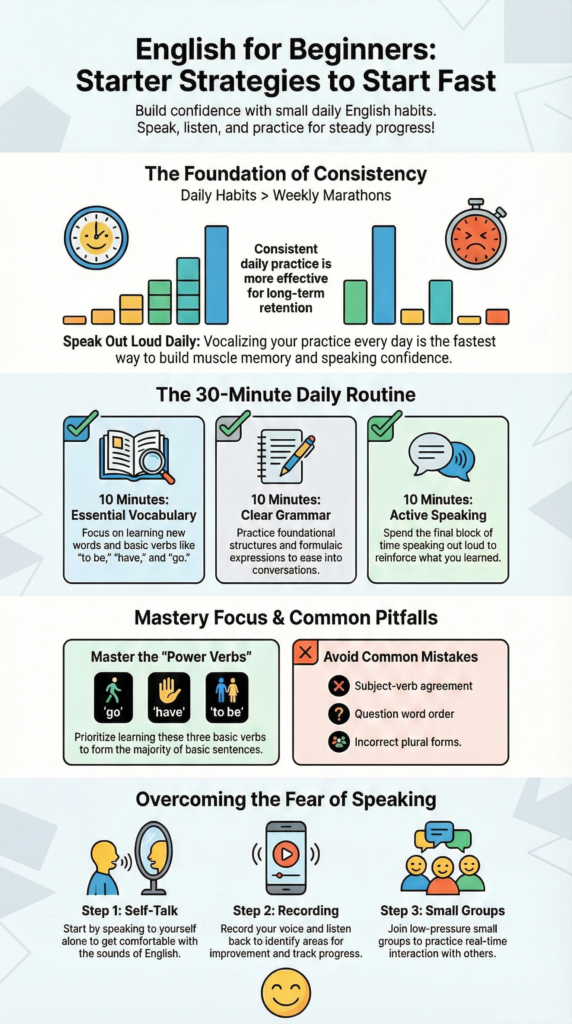
Everyone makes mistakes early on, and many patterns repeat in ways that feel familiar once you’ve seen the same early learning missteps again and again. I used to say “He go to school” instead of “He goes to school.” Forgetting that ‘s’ on the verb is extremely common. These aren’t signs of failure; they’re signs you’re learning.
When beginners start forming questions, word order often becomes confusing. According to Accademic Blog,
“After the question word, use an auxiliary verb such as do, does, did, is, are, was, etc. The subject of the sentence (he, she, it, they, etc.) should follow the auxiliary verb.” – Bay Atlantic University
This small structure helps avoid one of the most common beginner errors and makes sentences sound immediately clearer.
Other typical mistakes include forming plurals incorrectly (adding ‘s’ to words like ‘child’ to make ‘childs’ instead of ‘children’) or translating phrases directly from your native language, which often doesn’t work. The British Council’s research shows that consistent, gentle correction is the best way to learn from these errors.
Let’s look at a few common ones to watch for:
- Tense errors: Using present for past (“I eat dinner yesterday”).
- Subject-verb mismatch: “The people is happy” (should be are).
- Literal translation: This creates unnatural phrases.
- Overusing “the”: “I love the music” vs. “I love music.”
Simple English Conversation Topics
The goal of learning English is to communicate comfortably, often starting with familiar and practical simple English conversation topics. In our English groups, we always begin with introductions: your name, where you’re from, and your job. It’s simple, predictable, and builds immediate confidence.
One helpful technique is learning short, reusable phrases instead of building every sentence from scratch. Research from WestEd highlights the value of formulaic expressions,
“In addition to using sentence frames, we suggest teachers use formulaic expressions, which are phrases that help start or link ideas and can be used in many situations. Initially, students learn them as unanalyzed chunks, almost as if they were one word.” – Aída Walqui
These ready-made phrases make early conversations smoother and less intimidating.
Communication experts find that practicing these structured dialogues regularly increases fluency faster than almost anything else. Role-playing simple situations, like ordering food or asking for directions, is incredibly powerful practice.
Here are some reliable topics to rotate through each week:
- Introductions and greetings
- Your daily schedule
- The weather and seasons
- Your likes and dislikes (food, movies, music)
- Asking for and giving simple directions
FAQ
How do I start if I want English for beginners starter strategies that actually work?
Start with simple steps you can repeat every day. Focus on short English starter lessons and follow a clear daily English routine plan. Learn greetings, numbers, and the top 100 English words beginners use most often. Practice speaking out loud, even alone. Small, repeatable habits build stronger progress than long study sessions that feel overwhelming.
Can I learn English online free without feeling lost or overwhelmed?
Yes, you can learn English online free if you keep your approach simple and structured. Choose one learning path and avoid switching between too many online English courses beginners often try.
Use beginner English tips like short listening sessions and easy English dialogues practice. A steady 30 minute English routine keeps learning manageable and helps you stay focused.
What are simple ways to overcome speaking fear English beginners often feel?
Start with low-pressure speaking practice that feels safe and repeatable. Try mirror practice and record your voice to track improvement. Many learners use the shadow speaking technique to copy natural rhythm and tone.
Self talk English practice during daily activities also helps. These fear of speaking English solutions build confidence slowly and reduce anxiety over time.
Which habits help build English faster than memorizing random words?
Strong habits make a bigger difference than memorizing long word lists. Use flashcards for vocabulary building and label objects around your home. This creates natural English immersion at home.
Add short pronunciation practice and focus on present simple tense mastery. A steady daily English routine plan builds real retention and helps you use words more naturally.
What common beginner mistakes English learners should avoid early on?
Many beginners struggle with the same patterns. Common beginner mistakes English learners make include tense mistakes, weak subject verb agreement basics, and confusion with articles like a, an, and the.
Literal translation and incorrect English word order also cause problems. Paying attention to these early helps you avoid English grammar errors and build clearer communication.
English for Beginners Starter Strategies That Build Real Confidence
Confidence in English is not a certificate on a wall, it is the quiet moment you understand a question and answer without fear. It grows when you choose to speak, even if your voice shakes. Will you wait for perfect grammar, or will you trust that practice makes progress? If you continue, fluency becomes possible.
At Ivy Languages International, you are not judged, you are guided. We help you practice daily, overcome hesitation, and see real growth. Do not let fear decide your future. Choose steady effort, choose support, choose your voice.
References
- https://bau.edu/blog/common-esl-mistakes/
- https://www.wested.org/blog/supporting-english-learners-oral-language-development/
Related Articles
- https://ivylanguagesinternational.com/how-to-start-learning-english-online/
- https://ivylanguagesinternational.com/best-tips-for-english-beginners/
- https://ivylanguagesinternational.com/overcoming-fear-of-speaking-english/
- https://ivylanguagesinternational.com/establishing-a-daily-english-study-routine/
- https://ivylanguagesinternational.com/essential-vocabulary-for-english-beginners/
- https://ivylanguagesinternational.com/mastering-basic-english-grammar-rules/
- https://ivylanguagesinternational.com/how-to-practice-english-pronunciation-alone/
- https://ivylanguagesinternational.com/finding-beginner-friendly-english-tutors/
- https://ivylanguagesinternational.com/common-mistakes-english-beginners-make/
- https://ivylanguagesinternational.com/simple-english-conversation-topics/